Cheiro
http://en.wikipedia.org/wiki/Cheiro
Cheiro: Palmistry for All at Project Gutenberg
http://www.gutenberg.org/files/20480/20480-h/20480-h.htm
INSERT: Picture of my hand I accidentally poked at work with a pencil on the Life Line, a day after being poked several times in the same hand by thorns while above the Head Line itself in Herman Park. I noted the connection between the multiple pokings at the time, but didn’t realize until just now, in looking down at my hand, that the last poke occurred precisely on the Life Line. The other pokes from the day before came on the thumb of the other hand (right).
I’m wondering if this poked point on the Life Line represents The Present, or a specific point in Herman Park, perhaps the position of Shark Rock or what I now may call *Poke Rock*, which has an actual hole going all the way through it.
Also confusing to me now is that, traditionally, palmistry’s *Head Line* lies below the Heart Line apparently, contrary to what some Internet sites say. So, top to bottom: Heart Line, Head Line, and then Life Line as the 3 major lines of the hand.
I also wanted to re-examine the Hand map of Baxter County Arkansas talked about before in relation to Sharieland (May post).
Here’s the original source:
http://ozarkshistory.blogspot.com/2010_12_01_archive.html

Eye in Hand.
—–
Hucka D.:
Closest to Herman[‘s Mansion]. Dewey defeats Truman. Dewey is Herman. Head Line includes. Um. 2 Hermans on either end. Trumann near Herman Arkansas.
—–
Interesting: “H E A D” and “lines” (grid overlay).
http://www.datasync.com/~rsf1/sfran.htm
Position of Trumann, Arkansas related to this grid. It lies basically in the exact center on the western edge.

Translation: these grid lines are all *head lines*, like the famous Chicago Tribune’s “Dewey Wins”. This is also the location of the St. Francis *Sunk Lands*.

In the known history of the world, no other earthquakes have lasted so long or produced so much evidence of damage as the New Madrid earthquakes. Three of the earthquakes are on the list of America’s top earthquakes: the first one on December 16, 1811, a magnitude of 8.1 on the Richter scale; the second on January 23, 1812, at 7.8; and the third on February 7, 1812, at as much as 8.8 magnitude.

Detail from above map, zooming in. Notice that two names within the St. Francis Sunk Lands involve the two objects that poked my hand several days ago: Thorn [School] and Lead [Fork], situated within 1 mile of each other. These resonate with the thorny bushes that stung my thumb twice, and the lead in the pencil that poked my palm. Notice also there are *2 separate* Lead Forks on this map, not far apart, as if to reinforce this resonance. Am I stretching it? I don’t think so — just being a completist.
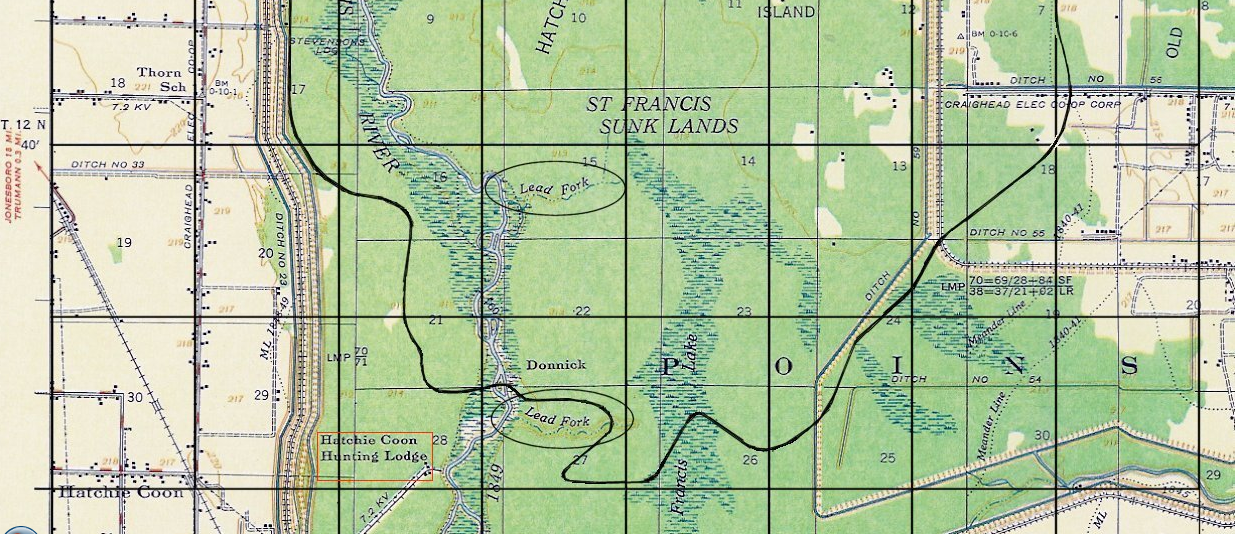
Robert Fritzius, the author of the attached article, noticed the repeated Lead Forks as well, along with some other name oddities within his pinpointing grid. I’ll quote them here, which includes queer info on Panther Island:
The clear cut area near the north end of Hatchie Coon Island was apparently a Homestead Settlement back in 1908. It is accessible from the east via Craighead County Road 82, which is also known as Hatchie Coon Road. [Added 06 Jan 2006.]
About a mile east of the homestead settlement just mentioned, is an area known as Panther Island. This area is enclosed inside an oval on the topo map. Shawnee Chief Tecumseh is credited with prophesying that a continent shaking catastrophe would occur on December 16th 1811. The name Tecumseh means Panther in the sky. Anybody having knowledge of how Panther Island came to have that name please contact the author. (Does Indian history in any way connect Chief Tecumseh with Lake St. Francis?) [Added 28 Feb 2006.]
He continues…
At the bottom of the section of the USGS topo map, shown just above, there is a ditch located along the inside edge of the eastern levee which borders the St. Francis sunk lands. The ditch is labled “Iron Mines Creek.” (This name is enclosed in a elongated vertical ellipse.) Anybody having knowledge as to whether there ever were iron mines in the St. Francis Lake area, and if so, where they were, please contact the page author. Also, on the St. Francis river, itself, near the former southern boundary of St. Francis Lake, are two annotations, “Lead Fork.” (These are enclosed in the shorter horizonatal ellipses.) If anybody knows what the meaning of these notations are, especially if the words “Lead” pertain to the metallic element bearing the same name, please contact page author. [See correspondent’s comments below.]
[Added 26 Feb 2006.]According to Scott May, a member of the Hatchie Coon Hunting and Fishing Club, Inc., the 1849 meander line (shown on the 1956 topo map above) is a misnomer, because when the surveyors came in the winter of 1849, the water was too deep in the area near Hatchie Coon. This fact is reflected on the surveyor’s notes available in the State Land Office in Little Rock, AR. [Added 08 Aug 2006.]
According to May, the southern “lead fork” is locally known as “Stud Horse Run,” and the fact that the same name appears in two different locations may be a mapping error. He says (with respect to the word lead, as in lead forks) “It is definitely lead as in the metal. I have never heard it pronounced as in to “lead” the horse to water.” [Added 08 Aug 2006.]
The hunting and fishing club, mentioned above, is located on the west side of the St. Francis river, southwest of the lower “lead fork.” On the 1956 topo map, it is located inside the red rectangle. [Added 09 Aug 2006.]
If there were any lead or iron mines, however temporary, in the Hatchie Coon/Saint Francis Lake area, then there may be old photographs, news clippings, or other narrative materials relating to them. These could be tucked away in albums or stored in other keepsake stashes. Any readers who can find any materials of this nature, which provide dates, names, locations, etc., of the mines, is heartily encouraged to contact the author. They can be incorporated on this webpage. [Added 08 Aug 2006.]
More info about an attached theory concerning a comet that passed by Earth at the same time the New Madrid earthquakes occurred by Fritzius:
http://www.datasync.com/~rsf1/1811.htm
He and others speculate the two events could be connected, and that the St. Francis Sunk Lands is the result of a meteor impact that caused the earthquakes (!). And of course, coming from my direction again, there’s the whole tie-in with Second Life’s Sunklands, but that’s too much info to cram into this post.
 Sunklands