was also a lot of talk about a SID’s 1st Oz interview, Hucka D. You and I.
Hucka D.:
Damn I can’t get any sleep[ because of you]!
bb:
I’m trying to press forward with the momentum.
Hucka D. (rubbing big bee peepers):
It’s morning. The sun’s up. And I’m up. This is wrong.
bb:
It’ll be okay. I’ve been looking up the keyword “interview” in the Baker Blinker Blog. I was planning the Sylver Forest related interviews, then the Mike Casey interview came along, which was the only *real* interview completed. Then we were going to do the SID’s 1st Oz interview. We talked a number of times about it when I first came to Rubi in 2008. We kind of started it, in fact. We talked of “Dark Globe” representing a kink in the A-Z progression of tiles in SID.
Hucka D.:
I’m not quite ready to talk about that again.
bb:
That’s fine. Hold on…
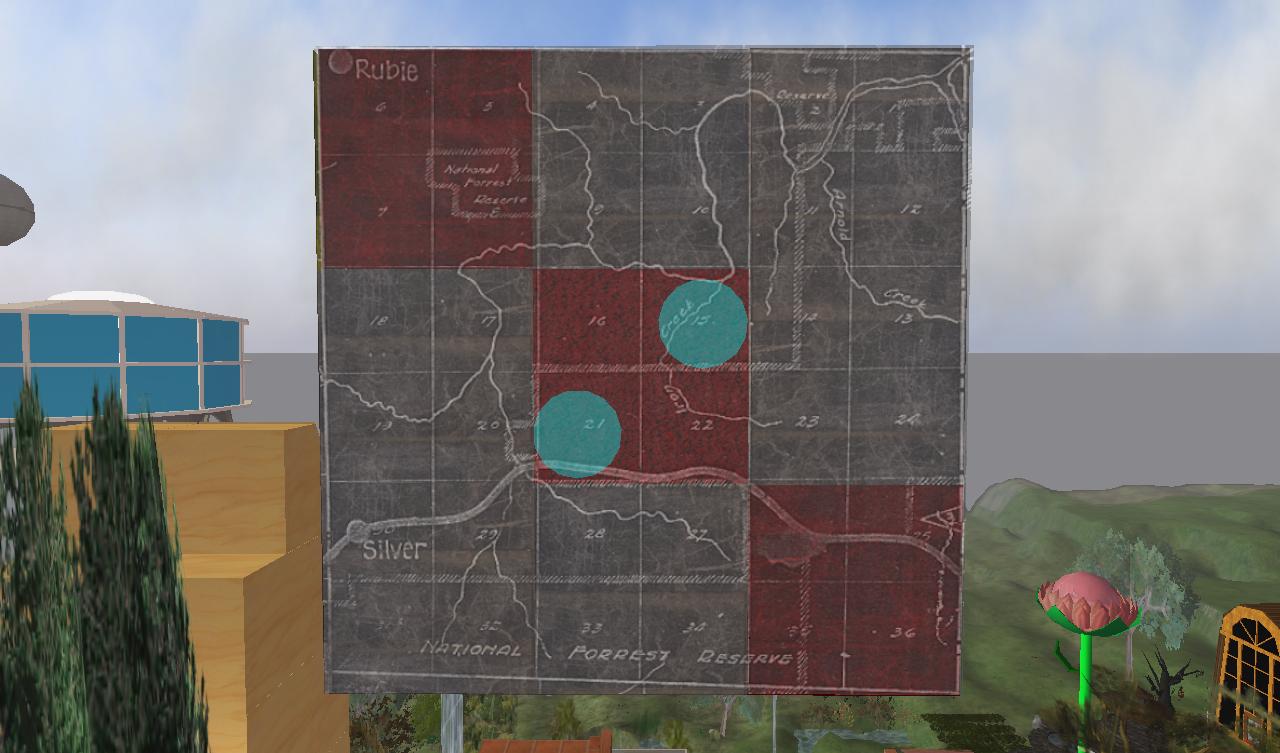
There’s the old front of the Temple of TILE in Rubi. This would be centered about where the Coolie Building stands now. It is a very telling front. In fact, this front is *still* in VWX Town — it’s inside the Tyle Cube revolving in front of the vacant Home Orange, Hucka D. Remember how Baker Blinker found it in ZicZac inside this cube and “unfolded” it? To me, in looking at it again, the red squares all stand for the Rubi sim that VWX Town takes up over a fourth of now. (no answer) That the 3 red squares lie on a diagonal, and resemble a game of tic tac toe, stands for *The* Diagonal that use to exclusively belong to Rubi until recently, when it was found to extend across the *whole* Heterocera continent. Exciting new Second Life development for this year fer sure. Hucka? Anyway, the fact that the rest of the squares on the map are Silver, and that Silver is the only other population place marked on this particular map…
Hucka D.:
There’s a plane! Over there.
bb:
In Nowheresville?
Hucka D.:
No. We’re suddenly somewhere. Like Ringo and The Boob. We’re not going around in circles no longer. The record has ended and the needle lifted. Back to reality.
bb:
A plane, eh?
Hucka D.:
Yes!
bb:
Where?
—–
bb:
If you turned the ballerina on a diagonal, her eyes would match the 2 blue circles on that map, Hucka. Given that the urn held above her head, at that angle, would match the Red Rubi sim…
Hucka D. (still pointing out *The* Window):
Aww. It’s gone. You missed it.
bb:
You listening, Hucka? The Ballerina is The Diagonal.
Hucka D.:
She is VWX Town which *contains* part of The Diagonal. She has a container. VWX Town contains. Boy you should have seen that plane. Beautiful!
bb:
Here’s a theory. Lucky’s Magic Village use to be called Camp Rubi, and was a place for wee people to vacation or go to camp. It’s near the confluence of 1st and 2nd Streams. Should we name the streams?
Hucka D.:
All the colours of the rainbow. Wow!
bb:
Are we still talking about the plane? Or the camp?
Hucka D. (still pointing outside and looking at me, bb, now):
Rainbow.
—–
Related links:
http://www.tshaonline.org/handbook/online/articles/hrc12
Ideas: Camp Ruby was a logging camp, and the locus of logging activity around Rubi in Ancient times (pre-Linden). They logged the lower 3/8ths of Rubi and perhaps more. They logged the Sylver Forest in other words. Key quote:
The site was renamed Camp Ruby when the W. T. Carter and Brother Lumber Company established a logging camp there in 1926. According to local lore, A. B. Clayton was sent to select a good site; having chosen the heavily wooded area of Old Hope, Clayton renamed it after an acquaintance named Ruby Moore.

http://www.texasobserver.org/2806-out-in-east-texas-in-search-of-edward-swift/
Born in 1943, Swift spent his earliest childhood in the Big Thicket idyll of Camp Ruby, a small, faltering logging community tucked into the Great Piney Woods-from which his family would be flung by the Texas Forest Service into the mortal coil of nearby Woodville when Swift was 8 years old. Having visited the town, I find it difficult to believe anyone has ever grown up happily there, but Swift-an early balletomane twirling through town in a green wool skirt-certainly did not.
Like its courthouse, Woodville would remain, throughout Swift’s writings, a maddening model of backbiting, small-town repression, while Camp Ruby would be mythologized (in A Place with Promise and My Grandfather’s Finger) as an East Texas Eden-a green and easy home of hot melons and tall tales from which Swift would inherit his dissent and his story-telling craft. He offers this history of the Big Thicket:
Tyler County Court House
“The early settlers called it No Man’s Land, a hiding place for ne’er-do-wells of all descriptions. During the Civil War, the Thicket was a well-known refuge for pacifists and Jayhawkers, those who refused to fight for the South. It was also a haven for renegades, recluses, and religious fanatics … the wildest of dreamers, and the maddest of madmen. And although they were rabid individualists, they were similarly marked with loose tongues and poetic speech … They knew instinctively how to tell as well as how to enlarge upon a story while keeping it rooted in truth … that a story is a living thing and should grow with each telling.”
http://edwardswiftartist.com/#/the-artist/4527907027

—–
Camp Rubi is now called Lucky’s Magic Village.

 Sunklands