Category Archives: Herman Park

Lion’s Roar 01

Another great hiking and art making day in and around Byng. Actually went over into the next valley *north* of Byng for the first time this hiking season, or into the drainage area of the fabled Lost Valley. If I keep my focus on Byng, I believe this valley will become quite important.

But the bigger story today, probably, was the further evolution and refinement of Lion’s Roar itself, the heart of the Byng mythology. In several shifts this crisp, blue autumn day — 3 to be exact — I seemingly perfected Lion’s Roar’s railroad (note to self: maybe better to shorten the name to Lion Roar), while simultaneous setting up the “town” itself around its lower end. 37 pieces of track total were used.

I’m simply going to move into the pictures themselves for further explanations. Below we have a picture of the “town” near the beginning of the day, with the bottles still on the ground and the track still getting into shape. However, I notice here that the old timey coffee pot (left) is already being used to prop up a curvy part of the track, which means that I’d already done some work before taking this midday picture, actually. Original tests for this part of the track, taking place the day before this one, had it set up slightly higher on part of the rock juts themselves, which turned out to be impractical in my estimation. The new track was instead set up on pots such as the 2 shown in the picture, with a lower, rounder example propping up the track to the extreme right in the below photo.

Subtracting the railroad track itself (pieces numbering 37, as mentioned before), Lion’s Roar is now composed of 45 more or less permanent objects, including 30 bottles and 15 other objects, mostly pots, hauled in from neighboring Yards Mtn. (see this older post, for example). Below is the largest object currently residing in the town, a dome effect that puts in mind the head part of Robbie the Robot for some reason. Interesting, because I’ll compare another object of Lion’s Roar with another famous robot in just a moment. As for what this particular object’s real life purpose was, I don’t have a clue right now. Its large presence and unusual shape also reminds me of the similar qualities of Billfork’s B-Hivia, made from an old stove belly in that case. More on the comparisons of Billfork and Lion’s Roar in a moment as well.

Oh, and here we are already at a picture of the other object in Lion’s Roar reminding me of a robot head. Can you guess? Fans of Dr. Who probably picked up on it right away: yes, it looks kind of like a Dalek head, hehe. I’ll have to get proper names for both of these “robot head” objects asap.

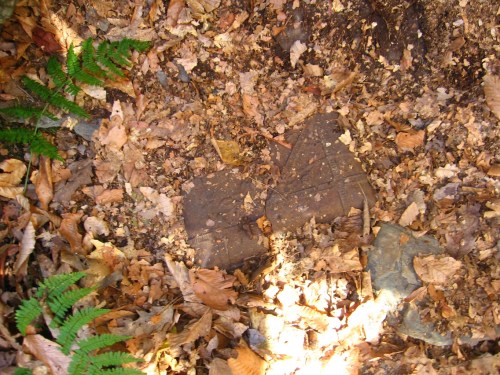
Another interesting object used as a kind of doormat into Lion’s Roar. I believe it may be an old stove door. Unfortunately, I jumped on it from a rock above at one point and broke it in two today.
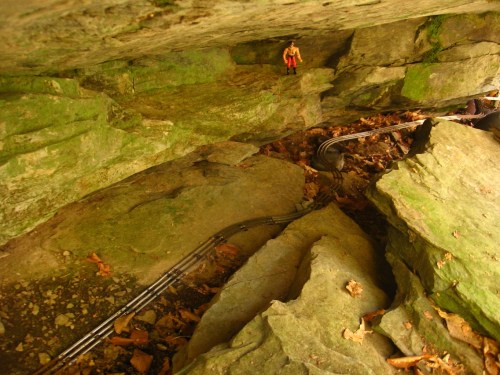
Angle into the heart of Lion’s Roar. Sue is still standing on the rock ledge near this center (small red object).

Another, smaller coffee pot also used to prop up part of the railroad.

Yet another. This happens to lie under the piece representing the exact center of the railroad, or the 19th counting from either end. Seems significant. More on that soon also.

Sue directing the construction of the railroad. I can still hear the echoes of his thunderous roars even now hours and hours later. Is he the *true* Lion of Lion’s Roar, then? Perhaps *he* thinks so. And just where *are* his traveling and exploring companions Stu, Spit and Sid? I can’t find them anywhere. But he seemed pretty happy today doing all the shouting and ordering himself. He’s OK alone right now, seemingly, or as OK as he gets.

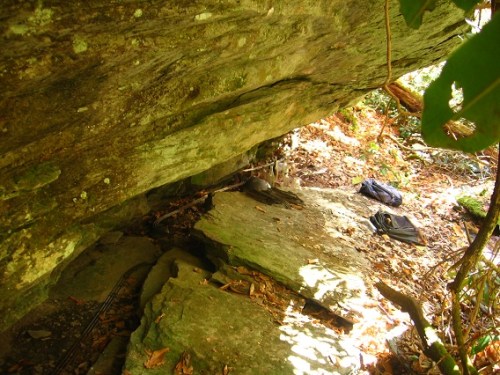
Upper end of the railroad track. I logically call the two ends of the rail Upper End and Lower End. Maybe shorten those to Up End/Low End. To remind, Lion’s Roar proper exists at the lower end of the rr.

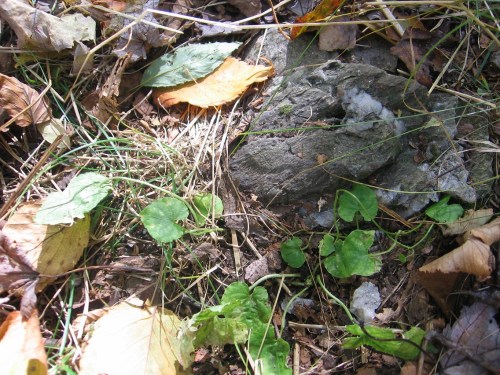
Btw, I call that large, pale stone in the below photo Overturned Rock, because that’s exactly what I did with it when first discovering some kind of animal poo on its surface. Problem solved.
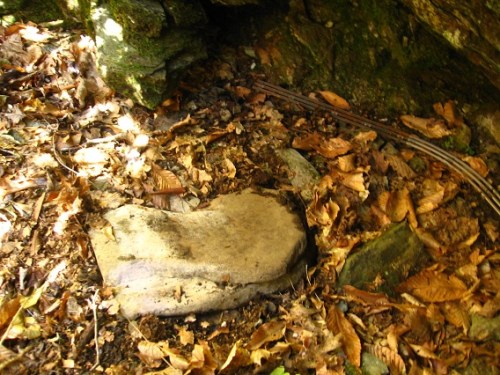
More near the center of the rail, with Sue unseen in the photo just above. Very interesting ledge effect here, and I’m sure a name will be attached to it. Seems almost like a meeting place (?)

There’s Sue again. He’s almost standing above Center Pot, as I’ll perhaps start calling it, or the pot that holds up the very middle track of the system — 19th again. So there’s 18 track pieces uphill from this and also 18 track pieces downhill. This is the most interior part of Lion’s Roar.
Leave a comment

Filed under Byng, Herman Park, Toy Avatars, Wealthy Mountain

Byng Again

Another hike into Byng yesterday. Not a lot new discovered, but did revisit and reexamine both Kansas and Kentucky. Set up some train track in Lion’s Roar, but nothing finalized. Great fun… evening sun shining on me as I worked. The train track will be set up all along the interior wall of the Lion’s Roar rock, a natural setting. Thought of even leaving it up in the winter, but I suppose it would rust anyway; better just to finalize it (today?) and then take pictures to remember and re-create the layout later, just like I did in Billfork. This would be the 3rd marble track set up in the woods, after Hermania and Billfork. This could be the most natural of the 3 locations to set it up. Marbles from Kansas originally? Or at least they settled there in some number. Perhaps a track ran all up and down Kansas at some time in the past, terminating in Lion’s Roar. Instead of a single foot path winding through Kansas, you’d have that single track. Highly industrialized, like a coal country valley with a rr running through it. I’ll always remember Kansas as the place I resolved the Tin S. Man – Wallace3 friction of nearby Green Oz Valley, and add in Kentucky of course, since the Bee Line seems to, among other things, represent long, straight synchs like DSotR2.
How to further develop Kentucky today or tomorrow or Monday? Need to identify the skull there. Need to probably mark out the line better — I think I have the correct alignment, and, indeed, it appears to be about 65 yards long, or 2/3rds the length of a football field. My theory now is that it begins in a clump of grass between Lovely Dovey Trees (which have lost about all their leaves since I took snapshots of them last weekend), and ends at Tie Rock.

Buy compass to get the angle of Bee Line. I’m not finished with it yet.

Most important new find might be the discovery of the sanctioned center of Bee Line, or what I’m presently calling Center Rock.

There’s even a tiny central hole in this rock to emphasize the name. It lies between Central Tree and Tiny Tree, and, of course, right on the Bee Line. As I’m estimating, it’s about 13-14 yards to the lower end of Bee Line from this rock, and then about 50 yards to the upper end. It’s not in the phyiscal, linear center, then, just a central theoretical measuring point, like the Greenwich meridian. I think I’ll call the rock Tiny Central, then, since it lies between two trees of those names.

Will train track be set up in Kentucky? It seems to be more of a lab in this way. Did marbles come here, if they lived in Kansas below it? Perhaps. Maybe they created the Bee Line. So many mysteries remain.

Leave a comment

Filed under Byng, Herman Park, Wealthy Mountain

Kansas & Kentucky & More 02

continuing with descriptions of 1st map of the general Byng area, featuring both Kansas and Kentucky (flat platform area on ridge above Byng)…

we move to Kentucky on the ridge above Bing. Kentucky is then separate (to the immediate south) from the 4 Byng areas identified in the Kansas and Kentucky and More 01 post just below, or Upper Byng, Impasse, Kansas, and Lower Byng.

Locations in Kentucky:

Bee Line — the central ley line (literally perhaps) of Kentucky, cutting across the entire ridge diagonally and staying on a constant slope and angle throughout its 60-70 yard length. Seems very unique.

Tie Rocks — at upper extremity of the Bee Line, perhaps, representing 3 small stone juts from the ground that I used to tie the string subsequently extended across the whole of Bee Line. An alternate name is End Rocks, since they lie at the end of this line.

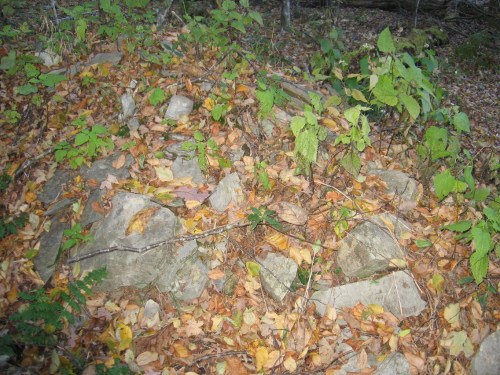
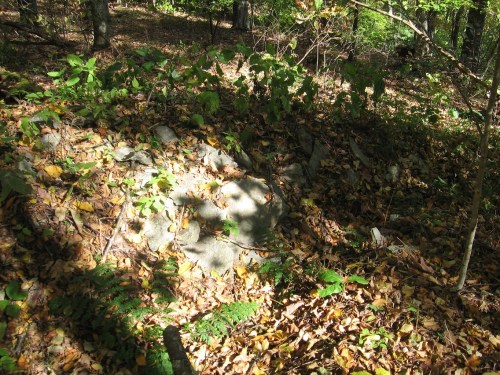
Rocky Mound — mysterious perhaps even ultra-mysterious mound just in front of Tie Rocks, and which Bee Line runs around just at its upper or higher end. Is approx. 15 feet in length. More investigation needed, perhaps even a dig? Possible that Rocky Mound could also be used as a sighting station toward neighboring Yards Mtn. (again, Kentucky is on the slopes of Wealthy Mtn. to the west of Yards Mtn.) per the Devil Seat of Poe’s “Gold Bug” short story (see below); totally unverified as of yet.

3 Trees — 3 trees just across Bee Line from Rocky Mound.

Split Log — long fallen tree mysteriously (once again) split in two almost right on the Bee Line. Represents perhaps 1st clear indication of this line with its stark division.

Rot Cathedral — large rotting tree trunk of reddish color, several yards to south of Bee Line.

Tiny Tree — central tree, perhaps, of Kentucky, and bark mysteriously (once again!) worn out near its base. Represents a polar opposite of huge tulip tree in Poe’s “Gold Bug”. Sits in middle of grass clumps.

Central Tree — the other candidate for central tree of Kentucky, and smart enough to snag the literal title before Tiny Tree or any other tree could step in. Tiny Tree and Central Tree then lie equidistance and on opposite sides of the Bee Line.

Bottle Clearing/”GOLD BUG” — if Tiny Tree or Central Tree is the central tree of Kentucky, then surely the cleared out space between them, which I have called both Bottle Clearing and GOLD BUG, represents the overall central area of Kentucky. Is about 3-4 yards in diameter, or about the same size as the space cleared out by Legrand for the dropping gold bug (from the skull in the huge tulip tree) of Poe’s story. In our case, a gold bug was found *after* the area was mostly cleared — inversion again. This gold bug was then removed and taken home by me for the wife to see and admire, and also our cat got a hold of it afterwards so we had to then put it in a small bottle to preserve.

Lovey Dovey Trees (not named on map) — two beech trees at the end of the Bee Line (Bee Line immediately between them) that are very similar in size and intertwine with each other in their leafy parts, becoming as one.

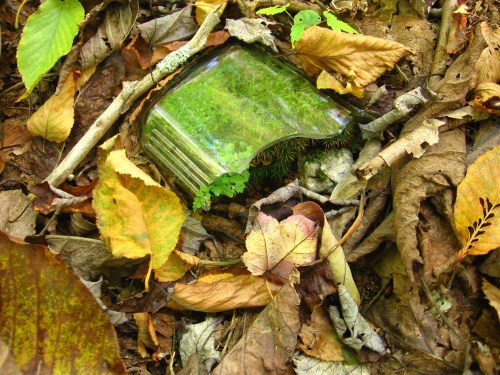
Terrarium — bottom of apparently same bottle shattered between Tiny Tree and Central Tree, and containing growing moss and at least one other small plant, hence the name. Very green! Just downhill from Lovey Dovey Trees and below the start of Bee Line.

Twomore Trees — two more (conjuncted) tree, as stated, in lower Kentucky and perhaps important in future events of the area. Do not intertwine, however, like L.D. Trees.

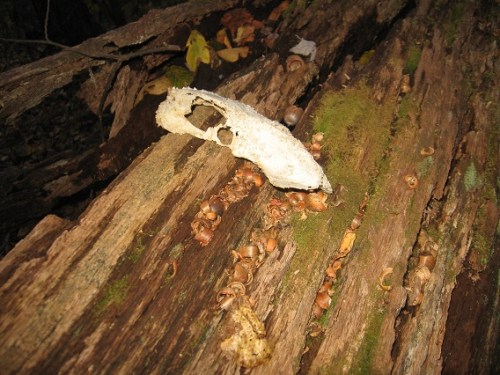
One Eye Skull — unk. animal skull with only one eye socket remaining. Probably a direct resonance with Poe’s skull in “Gold Bug” going on here, since the skull’s eyes are featured in that story. Found in extreme southeast Kentucky and then positioned on top of nearby log for better photos.

2 Comments

Filed under Byng, Herman Park, Wealthy Mountain

Kansas & Kentucky & More 01

1st map of the general Byng area, featuring both Kansas and Kentucky (flat platform area on ridge above Byng).

Byng Stream — starts high up on Wealthy Mtn. as a multitude of various forks which combine just before The Impasse (see below). Byng Stream basically runs through these areas:

– Upper Byng (forks just mentioned, in open, walkable woods);
– Impasse or The Impasse (rhododendron clogged region where forks unite as one stream — Byng — which then flows more rapidly as it forms several, long cascades;
– Kansas (general area between lower extent of Impasse and Lion’s Roar that has a navigable path running through it [in contrast to Impasse], forming more of a gorge-like region with steep sides);
– Lower Byng (from Lion’s Roar to mouth of creek at Flanigan’s Fork next to the nearest road — runs through a more open area here with, as in Upper Byng, many options for traversing)

Individual sites on Byng Stream:

Lion’s Roar — near lower end of Kansas that Byng flows all the way through; is a large, overhanging rock, the largest in the mapped area, it seems, and perhaps by a considerable margin. The overhang is extended enough so that I could stay here in the rain and be comfortable without getting wet, a notable plus in future considerations about developing this area. Lion’s Roar already shelters 50 objects (jars, pots, etc.) coming from the side of neighboring Yards Mtn., pieces of a future art happening in this area, no doubt.

Kansas Path — traceable path running all the way through the Kansas region of Byng, starting at the upper reach of Lower Byng and ending at the start of Impasse.

Periwinkle Falls — small cascades just upstream from Lion’s Roar. Split in paths just before, with left hand path (Kansas Path still) taking you upstream and right hand path forming basic beginning of Mystery Path connecting Kansas and Upper Byng in passing around the eastern side of Impasse.

Four Minutes — area recently cleared of dead rhododendron just above Periwinkle Falls. Represents possible future site of Temple of TIDE and more. Mystery Path runs through here; Kansas Path on other side of Byng from here. Named for a Roger Waters song.

Rock Island — small isle of rocks upstream from Four Minutes, near the center of Kansas. Debate in past whether this is part of Kansas or older defined yet vague regions of both Illinois and Iowa, perhaps stemming from the existence of a city called Rock Island (named for an island located between these 2 states) in the “real world”.

http://en.wikipedia.org/wiki/Rock_Island,_Illinois

This also seems to imply an assoc. between Byng Creek and the Mighty Mississippi River. Iowa and Illinois, seen as one, are also 2 states bridging Kansas to the west (bordering Iowa) with Kentucky to the east (bordering Illinois). Some say our Rock Island floated downstream from somewhere within The Impasse, losing its Illinois/Iowa ties in the process (deeply debatable).

6 Mile Hill — as yet undeveloped region surrounding a large, dead tree (Rot Tree) in upper Kansas. Could be a center of that already mentioned future art happening. Perhaps. The name 6 Mile Hill relates to 4 Minutes also found in Kansas, and also a 6 Minute Hill on the Jeogeot continent of Second Life located in a sim of the same name. Shrine of Second Life here, then? (Jeogeot?)

Impasse Trees/”SF”/Mine — composing a single area in extreme upper Kansas, on the edge of Impasse and where you can’t keep making your way upstream on Byng directly because of clogging rhododendron, falling trees, briars, and more. The Mine in question is rumoured to be owned by Lisa the Vegetarian, and thus is perhaps an old quartz mine. “SF” just below it (“Suspiciously Flat”) may also be a hopeful reference to gold town San Francisco. Kansas Path end can connect to Mystery Path here, but the way up the embankment is quite steep, with falls and possible loss of limbs forewarned.

Kansas & Kentucky & More 02

3 Comments

Filed under Byng, Herman Park, Wealthy Mountain

Kentucky

Revisited Kentucky yesterday and produced the following pictures. First up is of a string I set up running all along the Bee Line of Kentucky, which I was surprised to find out runs about 60-70 yards across the ridge. Amazingly long, straight line, then, and I’m starting to strongly suspect a direct affinity with DSotR2, another amazing alignment of considerable length. If these two line-ups are essentially one underneath it all, or directly related to each other, then this casts the Tin S. Man/Wallace3 relationship in nearby Green Oz Valley in a new light, perhaps one of renewed cooperation.

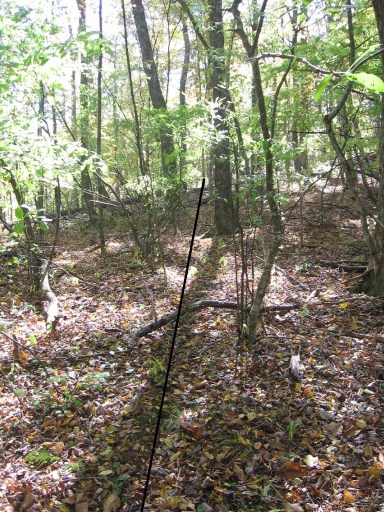
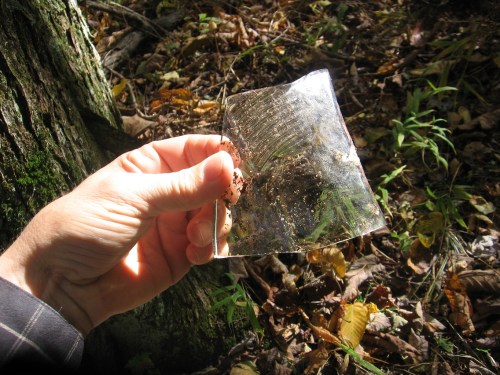
First up in our stringed line pictures comes the glass shard left in the ground just up from what I consider now the two central maple trees of our Kentucky story — more on those trees just below. As you can see, the string representing the Bee Line almost directly crosses over this buried segment of glass.

Bee Line running past the tree with the hole at the bottom pictured in this earlier post, and also Split Log just behind it, mentioned in the same post.

I’m calling these 3 rocks projecting from the leaf covered ground here Tie Rocks, not because they wear ties, har, but because these are what I tied the upper end of my string to, and so also marking this as the probable, upper reach of Bee Line itself. Might also be called “End Rocks”, then.

Another picture of that mysterious, rock covered mound just on the opposite side of Bee Line from these rocks.

So back to the 2 maple trees where the glass shards came from, here we have pictured the considerably smaller of the two, called Tiny Tree for now. Contrast this to the description of Poe’s skull bedecked, very tall tulip tree in “The Gold Bug”, already discussed in this earlier post. Since writing that text, I’ve also noticed that the Bee Line runs right through the two maple trees in question, basically bisecting an imaginary line running between them. I believe Tiny Tree relates directly to Poe’s aforementioned, huge tulip tree, then (inversion or reversal), and is doubled by the larger maple right on the opposite side of Bee Line.

Another very interesting thing to mention is that Tiny Tree’s bark has been worn off toward its base, as seen below. Have deer been rubbing against it? Or is this possibly additional handiwork by humans from previous times? It seems like more the actions of a knife did this. Could be wrong, but that makes for a lot of rubbing if not.

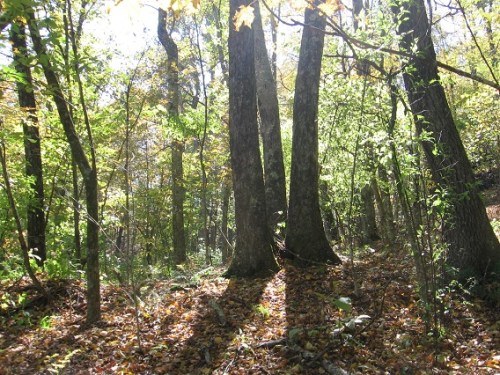
2 tall beech trees, which bend toward each other at their tops to intertwine in the leafy parts, seem to dramatically mark the lower end of Bee Line, which might start in the gap between them or in the immediate vicinity. The higher merger of the trees way up in the air here seems to mirror the unifying energy of the Bee Line between them on the ground. Yes, seems significant.

Lastly and probably not leastly we have the presence of an actual skull in Kentucky, of unknown animal origin. This comes from the southeast corner of the platform region. Is it a fox, perhaps? Doesn’t look like a calf’s but could be wrong, once more. Also significant is that only one of the two eyes sockets remain on the skull (the right one), and Poe’s “Gold Bug” story prominently features eyes of a skull. Specifically, Legrand’s servant Jupiter had to drop the gold bug and attached line through the *left* eye of the skull, and not the right eye. Only the left eye drop of the bug determines the correct position of the treasure subsequently uncovered, although the right eye was mistakenly tried first because of Jupiter’s inability to tell his left from his right.

Maybe the skull is that of a domestic dog instead?? (at least it’s not human!)


fox skull

1 Comment

Filed under Byng, Herman Park, Wealthy Mountain

Gold Bug

Comparisons between the discovery of the Bee’s Line of the Kentucky Flat (another type of “natural platform”, as mentioned in Poe’s excerpt here) with primary events in Poe’s “Gold Bug” short story.

The natural platform to which we had clambered was thickly overgrown with brambles, through which we soon discovered that it would have been impossible to force our way but for the scythe; and Jupiter, by direction of his master, proceeded to clear for us a path to the foot of an enormously tall tulip-tree, which stood, with some eight or ten oaks, upon the level, and far surpassed them all, and all other trees which I had then ever seen, in the beauty of its foliage and form, in the wide spread of its branches, and in the general majesty of its appearance. When we reached this tree, Legrand turned to Jupiter, and asked him if he thought he could climb it.

There are no tulip trees in my Kentucky, but instead beech and maple trees, it appears. There is a central tree of maple variety, however, probably as tall as any on this flat or platform, and it is in front this tree I found my own version of a gold bug, about 2 feet from the circumference of the trunk.

During this colloquy no portion of Jupiter’s person could be seen; but the beetle, which he had suffered to descend, was now visible at the end of the string, and glistened, like a globe of burnished gold, in the last rays of the setting sun, some of which still faintly illumined the eminence upon which we stood. The scarabaeus hung quite clear of any branches, and, if allowed to fall, would have fallen at our feet. Legrand immediately took the scythe, and cleared with it a circular space, three or four yards in diameter, just beneath the insect, and, having accomplished this, ordered Jupiter to let go the string and come down from the tree.

I cleared a space of about 3 or 4 yards in front of aforementioned maple tree, to find the bits and pieces of an old, shattered bottle. In the clearing process I stumbled upon the gold bug. Legrand in Poe’s story clears the ground *for* the dropping gold bug, which landed in its approx. center.

Driving a peg, with great nicety, into the ground, at the precise spot where the beetle fell, my friend now produced from his pocket a tape-measure. Fastening one end of this at that point of the trunk of the tree which was nearest the peg, he unrolled it till it reached the peg, and thence farther unrolled it, in the direction already established by the two points of the tree and the peg, for the distance of fifty feet –Jupiter clearing away the brambles with the scythe. At the spot thus attained a second peg was driven, and about this, as a centre, a rude circle, about four feet in diameter, described. Taking now a spade himself, and giving one to Jupiter and one to me, Legrand begged us to set about one to digging as quickly as possible.

For me, the Bee’s Line, straight as if laid out with a tape measure, extended from the center of this cleared space about 30 yards up to the crest of the hill separating Kentucky from the rest of Herman Park. The line in my case was found first, then the space cleared when I followed the line to the maple tree to reveal the broken pieces of the bottle, then the gold bug uncovered. It was basically backwards from Legrand’s process…

We now worked in earnest, and never did I pass ten minutes of more intense excitement. During this interval we had fairly unearthed an oblong chest of wood, which, from its perfect preservation, and wonderful hardness, had plainly been subjected to some mineralizing process –perhaps that of the Bi-chloride of Mercury. This box was three feet and a half long, three feet broad, and two and a half feet deep. It was firmly secured by bands of wrought iron, riveted, and forming a kind of trellis-work over the whole. On each side of the chest, near the top, were three rings of iron –six in all –by means of which a firm hold could be obtained by six persons. Our utmost united endeavors served only to disturb the coffer very slightly in its bed. We at once saw the impossibility of removing so great a weight. Luckily, the sole fastenings of the lid consisted of two sliding bolts. These we drew back –trembling and panting with anxiety. In an instant, a treasure of incalculable value lay gleaming before us. As the rays of the lanterns fell within the pit, there flashed upwards, from a confused heap of gold and of jewels, a glow and a glare that absolutely dazzled our eyes.

… except I didn’t discover any skeletons or treasure at the crest of the hill to start the whole thing. There *was* a rock pile that seemed artifical. Should I dig there? (probably not).

There appears to be no parallel to Legrand’s cryptic parchment either, created by Cpt. Kidd. NOTE: Perhaps the *bottle* itself is the parchement in this case, and not the treasure itself? Pieced back together, does it create some type of similar message? What of the bottom piece of the bottle, found away from the rest and acting like a miniature terranium now? NOTE: Connected to the expression “message in a bottle”, like in The Police song of the same title? One might also have to break such a bottle to retrieve the message. So the message could be the equivalent to Poe’s cryptic parchment here, except there’s no parchment of course. Is there?

NOTE: I skipped the part in Poe’s story about missing the treasure on an original dig by Legrand and co. because the golden bug was dropped from the wrong eye by the dyslexic Jupiter.

NOTE: There is a slight possibility that the crest of the hill with the rock piling can act as a sighting spot, much in the manner of the Devil’s Seat in Poe’s story.

1 Comment

Filed under Byng, Herman Park, Wealthy Mountain

Hiking Day 4 Pics 03

Close up of the split log discussed in the last blog entry, with Kentucky’s Bee Line passing almost directly through this separation.

3 grouped trees (species?) near the uphill end of the Bee Line. The mysterious rock piling is to their left, just on the other side of the line running next to them.

The rock piling itself. Difficult to take a great picture of, but I’ll try again soon. It looks like it could be the dirt covered roots of an overturned tree, but although there’s an old tree trunk nearby and pointed in the right direction, there’s still a separation between it and this mound. Plus we have all those rocks on top of the dirt mound, if that’s what it is. Could it be rock all the way through instead? It still could be that a dig is in order here. Am I scared? Certainly!

What appears to be the base to the bottle that was shattered at an unknown date in Kentucky. It has turned into quite the miniature terrarium in the meantime, and I hated to move it because of this and disturb the still quite green and alive moss and plants growing within. Its position is a couple of yards off and perhaps also below the Bee Line a bit, behind the gap between two trees that may mark its true beginning.

Moving away from Kentucky, then, I continued to hike clockwise around the west side of Wealthy Mtn., soon coming across this rock outcropping with its own small cave or enclosure…

… but *nothing* like what was only about 20 to 30 yards beyond this: one of the very few, legitimate caves I’ve found in the Blue Mountain area on my many, many hikes. The sucker is about 20 feet deep, and prism shaped — that is, its front entrance and back wall both make pretty even and symmetrical triangles, with straight side walls and a level floor connecting them. The cave is also fairly wet inside, and I didn’t feel comfortable entering even on a bright, sunny day like this. Perhaps it was the foreboding poison ivy growing all around the top and sides of the enclosing rocks that put me off, when no other examples of that species were found anywhere in the immediate area that I saw. Upon returning home, I was also *quite shocked* to also find an “orb” in one of my two pictures of the cave itself, and shaped, for all the world, like a *coin*, similar in dimensions to a Roosevelt dime but whose “face” appears more like Eisenhower on his commemorate 70s dollar piece. Hucka D. and I talk about these and other possible significances of the “Prism Cave” or “Coin Cave” in a post just below.

A picture of the blowing poison ivy adorning the top of the cave. Quite dense and a seeming warning of danger.

Keeping on in a clockwise direction around Wealthy Mtn., a distance of several football fields brings us to another ridge of rocks, which appears to be just above the upper end of Green Oz Creek and on the edge of a long and basically impenetrable rhododendron bramble separating me from it.

Sadly having exhausted my days off this particular week, I left Sue in charge of all the loot at Lion’s Roar, and promised to return and reunite him with exploring companions Stan, Spit, and Sid. I dare not back out on this vow for fear of consequences.

Leave a comment

Filed under Byng, Herman Park, Toy Avatars, Wealthy Mountain

Hiking Day 4 Pics 02

More Kentucky pics, and now we are at the heart of the matter: the finding of a *”bee line”* running all the way across this ridge totaling a distance of about 35 yards or so. Below is a log split almost on this bee line, which gave me one of the first, large clues that the obviously mystical and occult line was present in the first place.

This photo represents a basically failed attempt to show this Bee Line running through the woods up to the ridge marking a western limit of Kentucky. So in a doctored up version beside it I highlight where the line is.

Just after discovering the line, I started to find bits and pieces of a broken bottle right in the path of it, and beside a prominent maple tree of the ridge. I cleared out an area of several yards around in the process…

… finding, for example, a small glass bit underneath a rock…

… and then this *gold bug* clinging to the side of another rock in sweeping away more leaves, which I instantly knew to be important. I think I had already made the link with Edgar Allen Poe’s famous detective short story “The Gold Bug” when taking this picture, since I vaguely remembered some kind of “bee’s line ” or plumb line also being mentioned in that tale.

The gold bug turned over to show off more of its defining color.

The bits of found glass shards kept piling up at the base of the maple tree as I continued to uncover them in the immediate area.

Another shot of the smaller tree in the middle of the grass clumps, the same as pictured at the beginning of this particular blog post. The shards were mainly found between it and the maple tree, which would be behind me-the-shooter here.

Yet another piece of glass uncovered, right on the Bee Line. I decided not to remove this particular shard. Despite the volume of glass found, I still think it all came from a single shattered bottle.

Another section of the Bee Line. Does that tree to the left form some kind of avatar home, complete with a front door? The thought had to cross my mind. Similar “doors in trees” exist in the immediate area as well, and perhaps one or two more quite close to the Bee Line, even. Hafta check that upon a return here.

2 Comments

Filed under Byng, Herman Park, Wealthy Mountain

Hiking Day 4 Pics 01

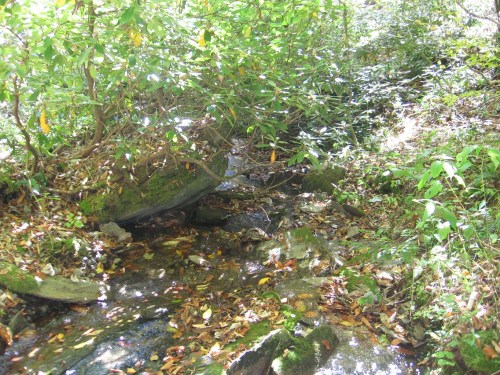
Photo of Byng (Creek) as it passes the flat, cleared area now known as Four Minutes (just left, offshot). The large rock in the center of the photo, as yet unnamed, lies between the creek and this flat spot. Four Minutes is now also the place where, technically, the Mystery Path connecting Kansas/lower Byng and upper Byng starts. More elements of fate, then, that the space was cleared by me of dead rhododendron plants several days ago, as it allows one to move freely up the embankment now where this path then leads.

Further upstream, we have an interesting isle of rocks, also unnamed. Is this another site for a potential temple of some kind, perhaps of a rock variety itself?

Upper extreme of Kansas, where it almost looks like someone has dug into a bank behind an uprooted tree. At least Sue thinks so; more on Sue soon.

A section of the Mystery Path, depicting one of many small white rocks seeming to mark the trail along the way. I cannot doubt that these are signature stones of Lisa the Vegetarian, who appears to now communicate to me (and potentially others) through *quartz*.

We then move to Kentucky, a larger flat spot on the ridge just west of Byng. Below is pictured a small yet central tree found in the middle of an area with several patches of grass. Kentucky has become very important to a correct, synchronistic interpretation of Byng and also Wealthy Mtn. as a whole, it seems. Obviously we have more workings of Lisa V. to take into account here.

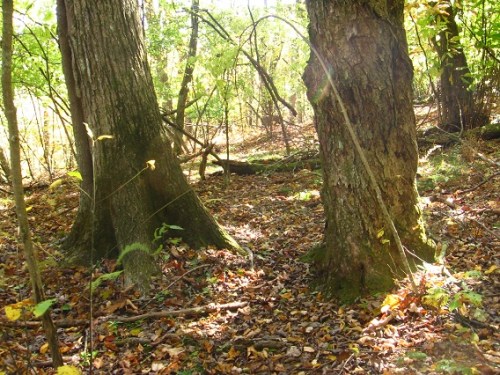
Two Kentucky trees that seem to have a path running between them.

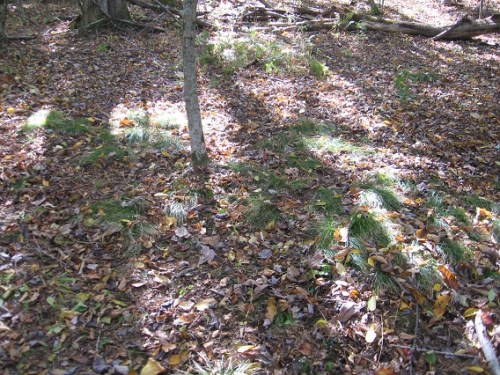
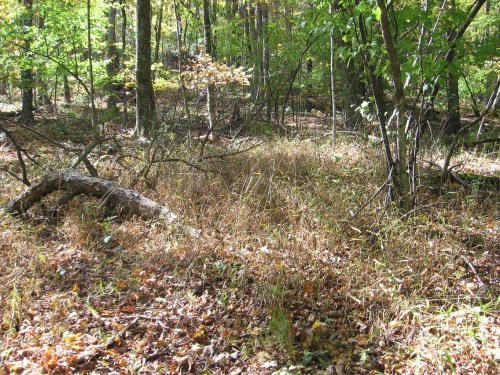
More isolated clump of grass on this ridge quite near the above trees.

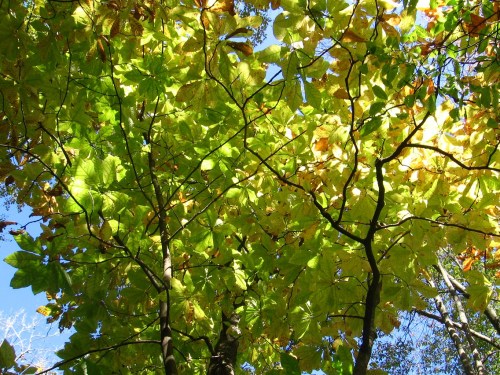
Looking up into a buckeye tree, I believe. The leaves are peaking now around this elevation.

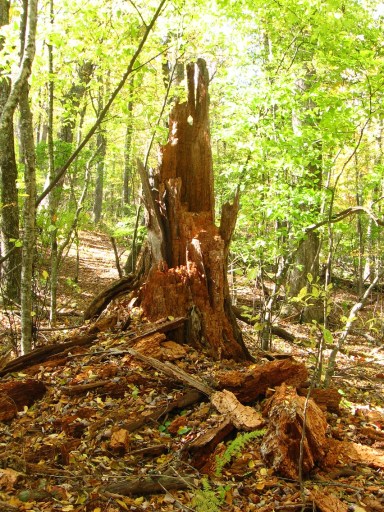
Rotting log creating a colorful Kentucky landmark via its intense redness.

More grass, but of a different, taller species that the types pictured above.

Leave a comment

Filed under Byng, Herman Park, Wealthy Mountain

Hiking Day 3

Another remarkable day of hiking in Herman Park. Visited Herman’s Grave again on Yards Mtn. and got some really good pics of the epitaph plaque on the back of it finally. Can do some analysis. Also I’m thinking that Herman’s Rock with its lighting bolt quartz vein is intimately and directly tied into this gravestone, and that the two are somehow one. Strange thought I know. I didn’t realize until yesterday that you can see the grave clearly from the top of this rock. Got more objects into Lion’s Roar on Byng Creek — about 50 objects total are there now, or probably about the same as at Billfork. I’m now calling Lion’s Roar the big, overhanging rock on the creek itself — this is where the truly magical stretch of the creek begins, running up at least to the impasse where you must go up the bank to the Mystery Path to proceed further. Four Minutes is now the cleared out section about 20 yards upstream from the Lion’s Roar rock, where a TILE Temple might be built in the future. Further up, closer to Impasse, we have Six Minute Hill. I might clear some of that area out tomorrow, in fact. Why not. All 50 objects come from the top of the Yards Mtn. ridge, the stuff I was originally going to set up in Wedge but decided to move to Lion’s Roar several days ago. Wedge is on Yards Mtn., while Lion’s Roar and Byng (Creek) are on the side of neighboring Wealthy Mtn. The focus really remains on Wealthy Mtn. still, then, continuing the Tinsity-Wallace story from earlier this month and also last month.

Another area I’ve been exploring is the 4 Valley region between Green Oz Creek and Byng Creek. But none of the 4 streams of these valleys approaches Green Oz and Byng in size. There’s also Bass Ackwards Lake (B.A. Lake) to deal with ,which Green Oz Creek empties into and B.A. Creek comes out of. Or perhaps that’s Ackwards Creek?

Oh wait. Bass Ackwards Lake would be another lake in Herman Park instead. The one I’m talking about would be called — well, let’s just call it Green Oz Lake for now.

Another major stream pouring off the north side of Yards Mtn. was also explored yesterday, as yet unnamed as well. Its size compares to Byng.

Frank and Herman Parks just by themselves are going to keep me busy exploring and mapping and populating with art for the rest of my life easily. Today is the first day….

Leave a comment

Filed under Byng, Herman Park, Yards Creek