Category Archives: Haze County

Whitehead Crossing, 12/31/15 01

The first shot comes not from Whitehead Crossing but Ashville, where I hiked around about 2 weeks ago. I won’t say exactly where — oh yes, I do have a fake name for the hill I trekked up and down. It’s called Hemp Hill, a potential center for an Ashville mythology. I’ll have more on this knob soon enough; just didn’t want to lose track of the particular photo of it below in the meantime. More on Ashville in this blog here. And I haven’t written about it in so long I forgot *its* true fake name, which is Middletown. Maybe a talk with Carrcassonnee about Middletown is in order. I seemed to have summarized my interactions with it through the Embarras collage series of Jan/Feb *last* year (can’t believe it’s 2016 already!), which contains many images from that city.
IMG_1152smaller

Back to Whitehead Crossing, which I visited both Thursday (12/31) and Friday (1/1) for several hours apiece. And I might even return today and Sun. Of course, this particular area is heavily documented in both the present blog and the old Baker Blinker Blog, starting back in 2010 when I first explored it in general. There is little in the present pictures that hasn’t been documented before in terms of just photographing objects. But it seems when I go back I see things from a different angle, or, better, things *change*, almost of their own volition.

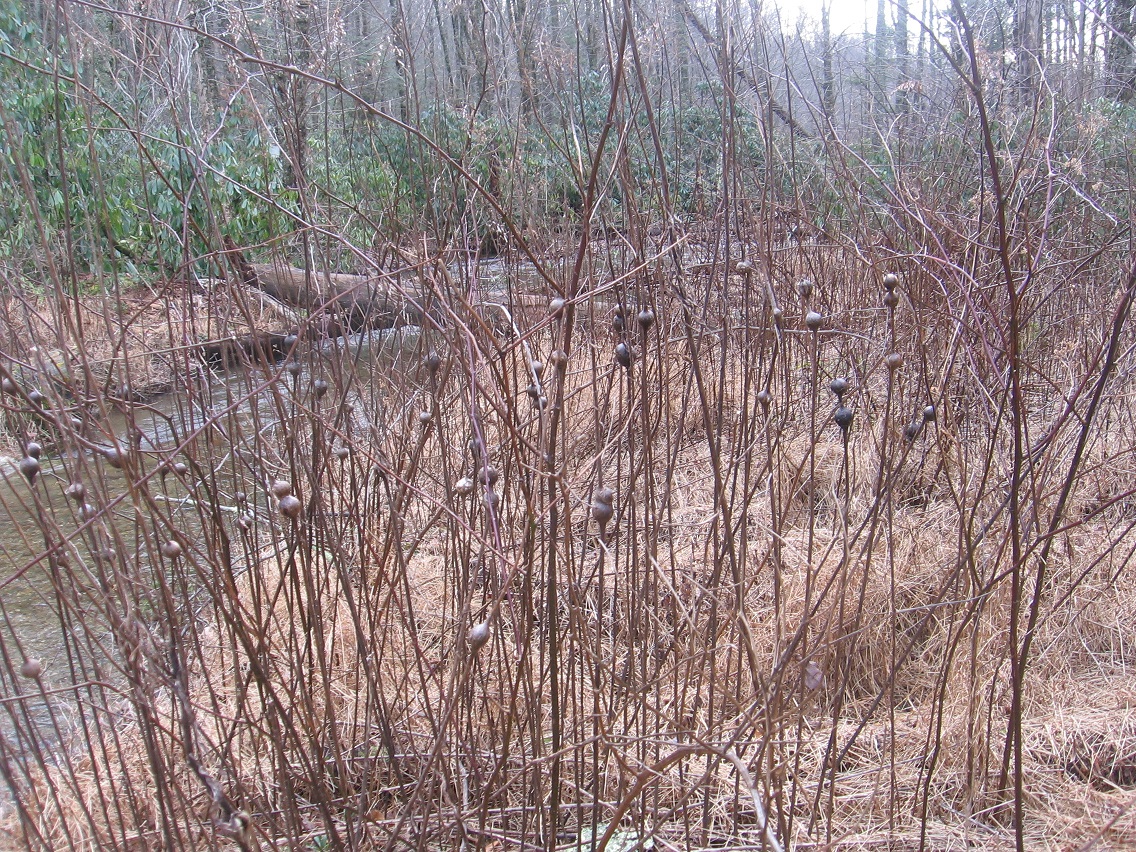
The first photo comes from the Korean Channel just south of Whitehead Crossing proper, depicting some bulbous weeds I thought interesting.
IMG_1162smaller

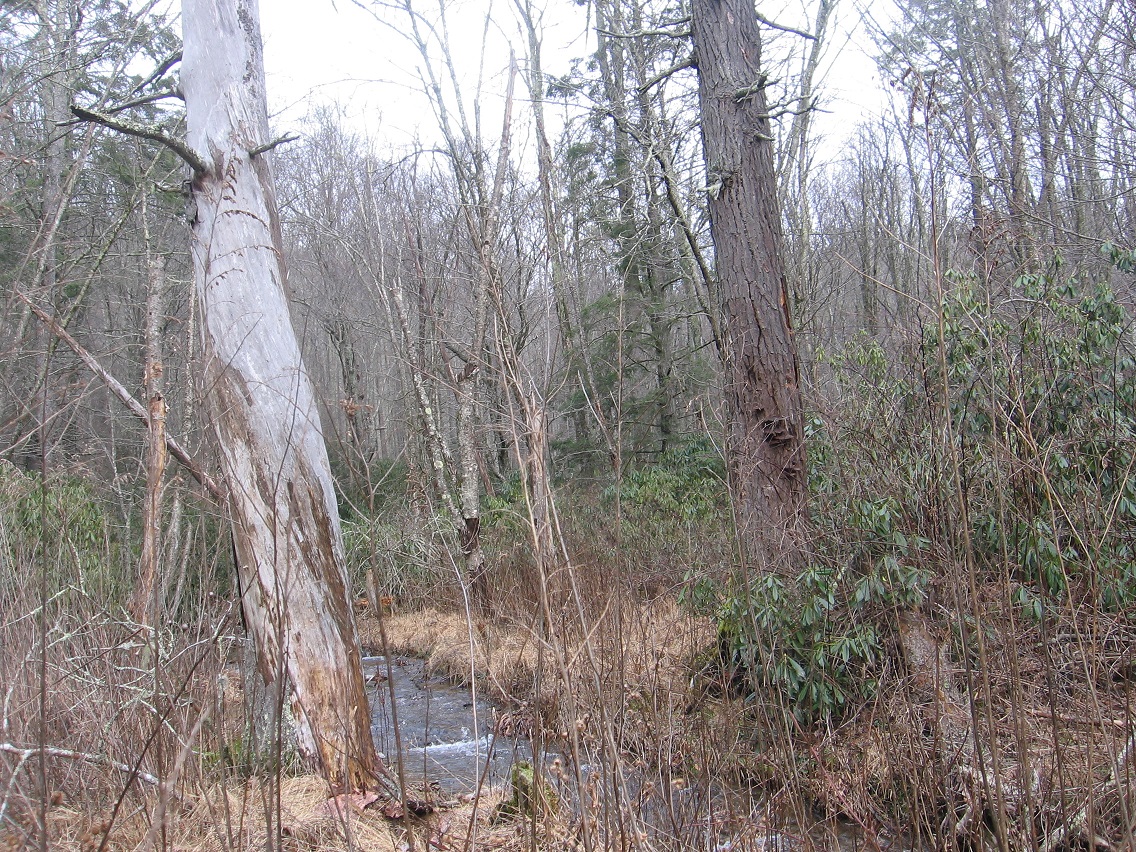
Then we move to the two giant, dead hemlock trees that mark a sort of gateway into the area, acting like Boaz and Jachin pillars in their dark and light coloring respectively, and positioned on opposite sides of The Crossing’s central Green Stream. This would be in the middle of about a 100 foot straight run of the stream I call, simply enough, The Straightway, which traditionally begins and ends with two islands (Rocky I. and Cresent I.). I say “traditionally” here because the composition, shape, and even locations of the islands can change over time.
IMG_1168smaller

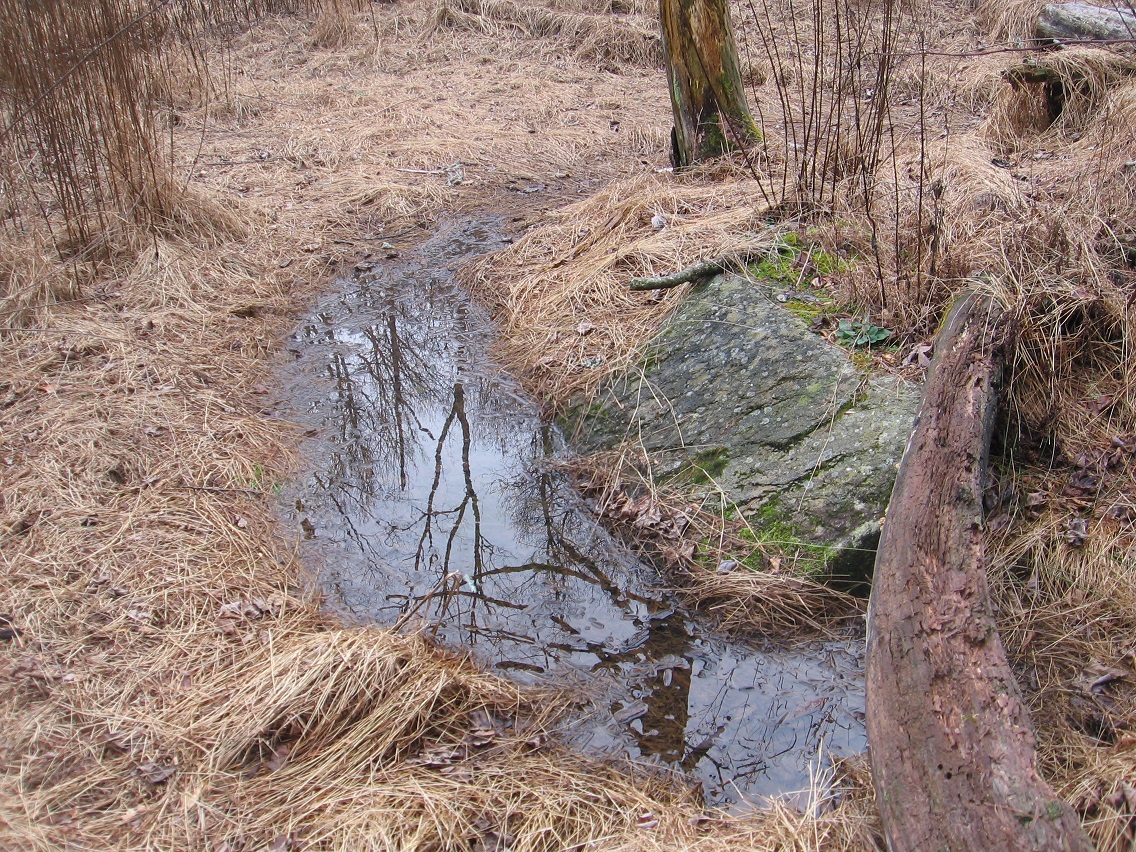
The depression below Crocodile Rock is filled with water. It’s rained quite heavily in Blue Mountain at times during the past week. But often when I visit Whitehead Crossing, it’s dry around this rock.

IMG_1169smaller

IMG_1170smaller

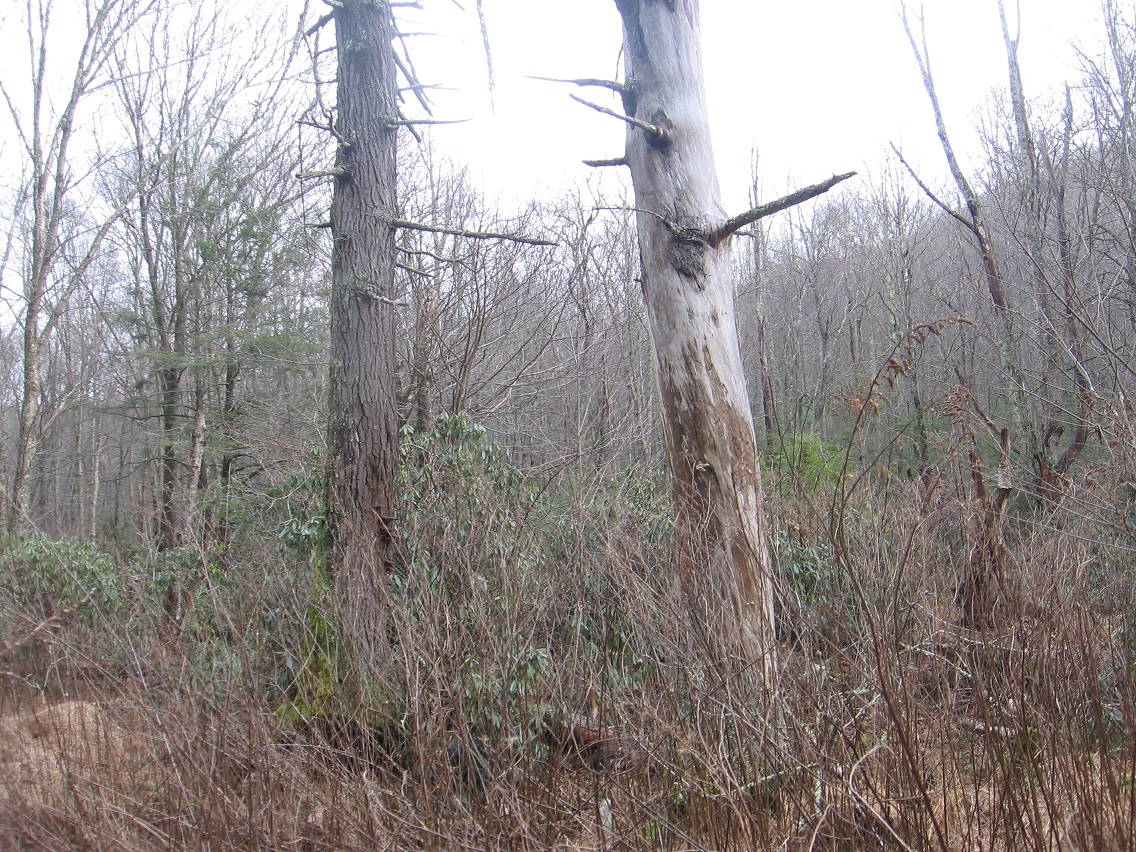
Another shot of the dark and light hemlock trees surrounding Green Stream.
IMG_1171smaller

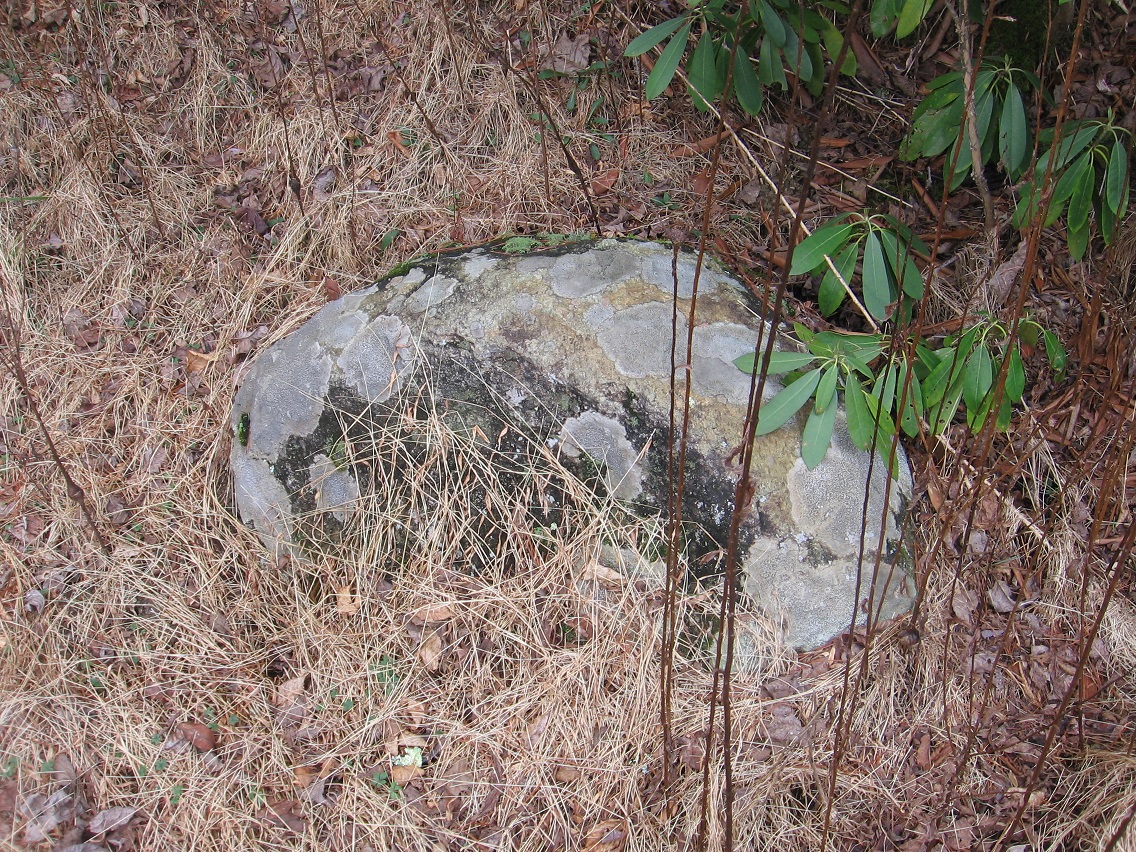
The Welcome Matt stone, which acts as a set with Crocodile Rock, along with another stone bordering Green Stream called Eagle Rock (I think). All 3 are about equal in terms of surface size, and also lie on the same general line approximately equidistant from each other. I’ll have to remember to take a measuring tape out there sometime to find exact distances.
IMG_1176smaller

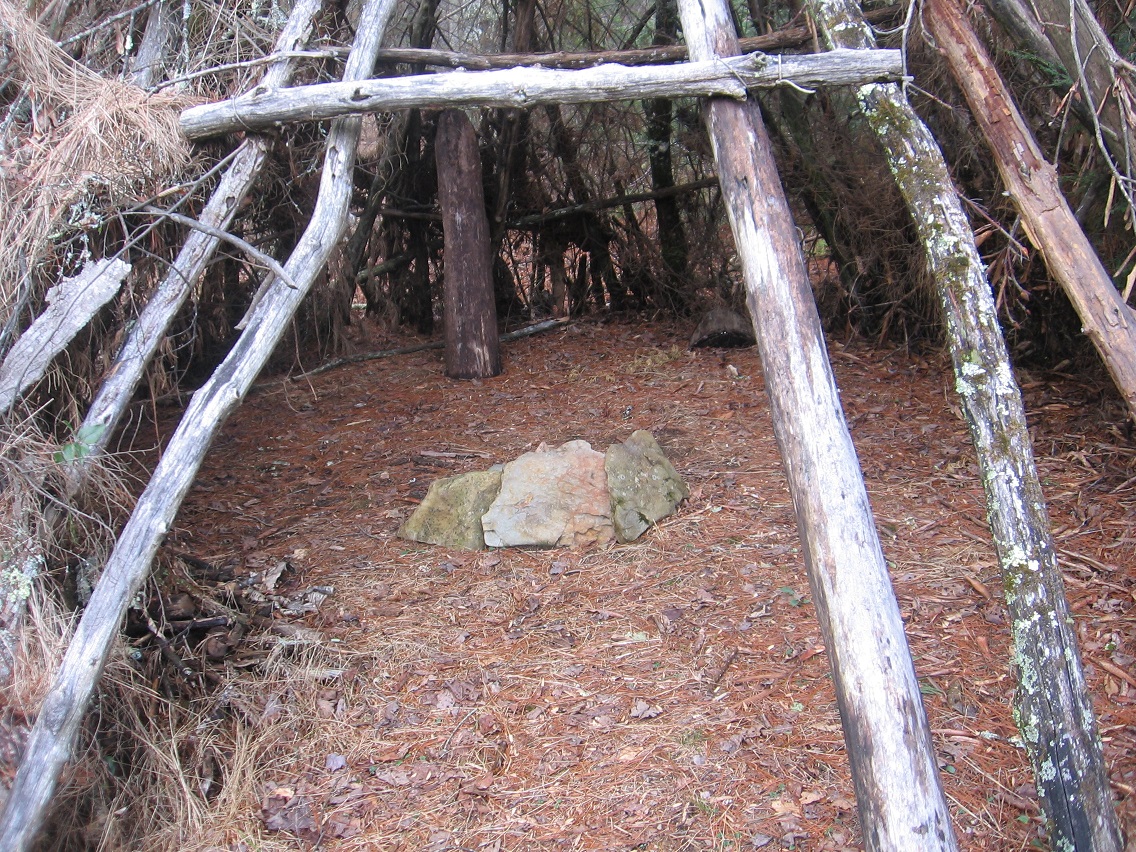
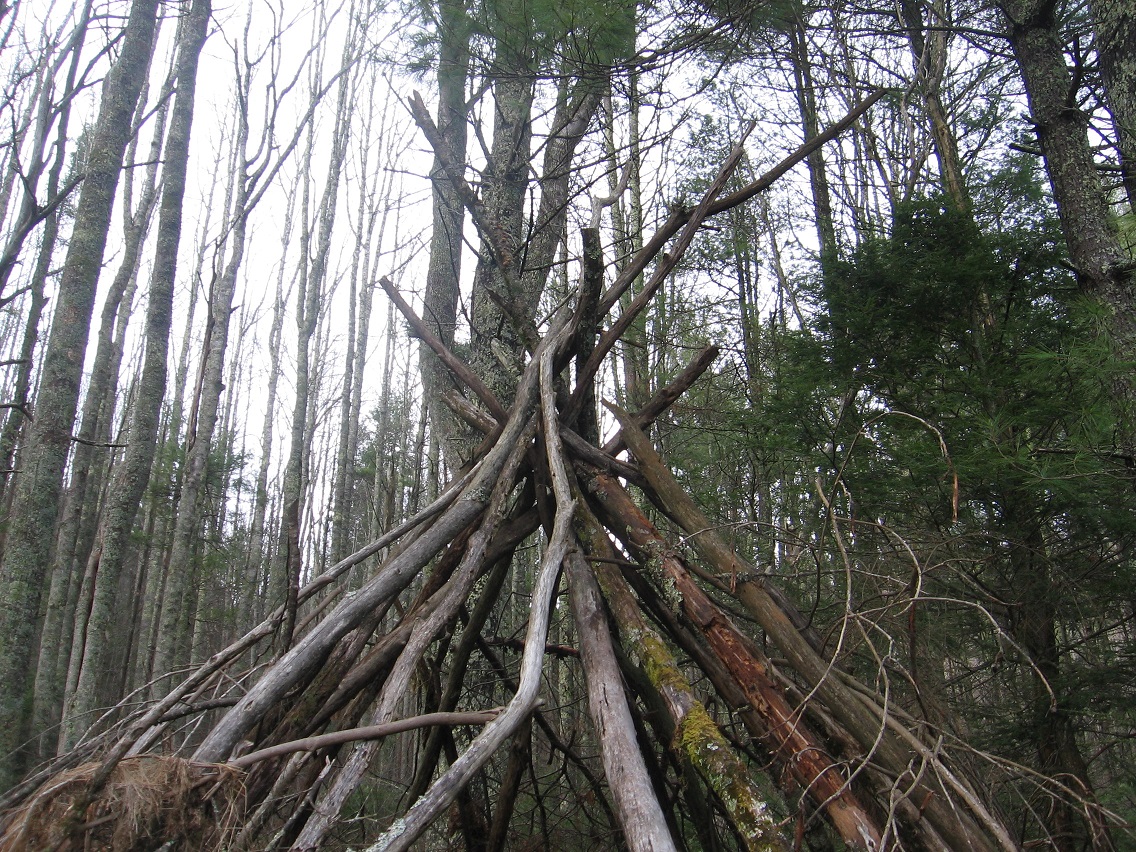
We step up from Welcome Matt, and what’s called Matland in general at the top of the Korean Channel, to revisit Whitehead Crossing’s stick teepee next, something built by the hands of unknown others just this past June. I don’t think the structure been used for much of anything since it was constructed, and certainly it was never weatherproofed. I initially feared that someone, perhaps a student at the local collage, would simply move in the teepee for the summer and perhaps longer. But it never happened, and now we just have a useless shell of a thing. I’ve even contemplated knocking the teepee down, but that might bring some kind of bad karma. You have to be careful about altering the nature of the area. The *builders* of the teepee might have “sinned”, but I didn’t want to compound their errors by making judgements of my own.
IMG_1178smaller

Second Life’s Spongeberg Resident, crazily enough, claims to have lived in this teepee for a period of time as well. In fact, I think he might still believe he stays there. Is it true? Again I’ll have to ask Carrcassonnee the next time we speak, perhaps later on tonight. She’s back from her trip to Nautilus City, as I understand.
IMG_1179smaller

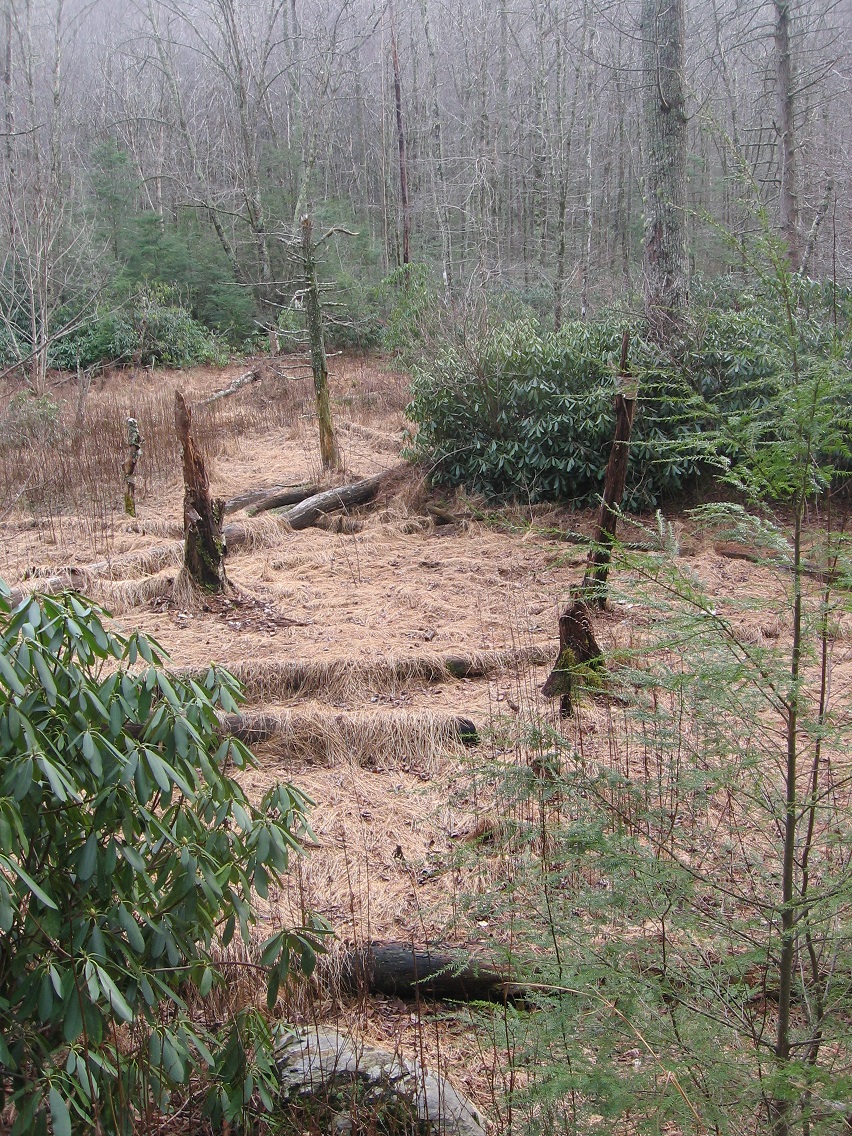
If Spongeberg in fact lives there, this would be his view across Matland from just outside the teepee. The 3 rocks mentioned before are basically in line with each other in this view, with Welcome Matt at the bottom of the photo, Crocodile Rock beneath the small, dead hemlock near the picture’s center, and Eagle Rock unseen beneath a stream bank in the background. I suppose this could be called Three Rock Line or The Line of Three Rocks, then.
IMG_1180smaller

Stepping up from Matland and Welcome Matt into the teepee and Whitehead Crossing proper would symbolically be very similar to Elton John stepping up into the yellow brick road on the cover of his Goodbye Yellow Brick Road album.

Elton_John_-_Goodbye_Yellow_Brick_Road

Leave a comment

Filed under 0001, Frank Park, Middletown^, Whitehead Crossing

Mossman Bigfoot

http://he-man.wikia.com/wiki/MossMan

The cartoon series depicts him as one of the most powerful beings on Eternia, possibly even more powerful than He-Man himself. He is introduced in the episode “Orko’s Garden”, in which he is an urban legend; an Eternian equivalent of the Bigfoot.

Leave a comment

Filed under Mossmen, Toy Avatars

Boos Interpretation 19

(continued from)

We come to “Comparative Heights” now, number 24 in the Boos series. Just in terms of pure aesthetics, I believe this is one of the more successful Boos works, although I don’t think it’s quite as deep as the previous, “uglier” collage (“Goodwater Goodland 03”). Let’s dive into an interpretation and we’ll see.

collage24test04g

At the center of the work is Waving Truman again, having appeared in a Boos miniature already. Here he stands at the end of a row of historic Tungaske baseball players, 12 in number and lined up in terms of relative heights. Truman is at the high end, and the only one that can be said to actually stand the road itself (Tungaske’s Q Street) and not in the grass off the road. He is the 13th, relating him to the Christ figure. On the opposite end from him appears the smallest and darkest of the figures, perhaps in shadow. He could be Judas Iscariot, betrayer of Jesus, in this scenario. In reality, he was probably the baseball team’s manager or coach. Waving Truman is also set apart from the others because he appears in his true colors, the rest being sepia toned. In the road to his right is a miniature version of the likewise sepia colored Fal Mouth Moon Gallery, not in correct proportion at all relative to him, in seeming opposition to the collage’s title. Above him is another sepia character, and also one we’ve seen before in a Boos miniature: “Falling Dorothy” from an early Kansas scene in “The Wizard of Oz”. Here she points to mysterious smoke or cloud writing in the sky that appears to spell out the word “fag” in capital letters, at least according to blog spirit Hucka D.

And speaking of Hucka, we also find him in the present collage beside Truman in his true Second Life form (“Hucka Doobie”), and not as a doll as we’ve seen before in Boos collages 11 and 19. We are moving into something truer — Truman. And in the background, standing in the grounds of the old Tungaske church and school we’ll see more of in coming collages, are two giant green, alien type figures both removing their heads. Hucka Doobie appears to be staring toward them. We know from the Falmouth series that these are 2 “Beemen” who show up in a Whitehead related collage here:

collage87test09

More bee imagery, then. The mirroring “fat” and “thin” figures also hark back to the 2 Roger Pine Ridges of Sam Parr 03 that also reappear in the final Falmouth work. LINK

So to an interpretation: The setting is Tungaske’s Q Street, right beyond where it meets the top end of Atlantic Avenue coming from the south. Maybe the north-south line of baseballs players relates to this avenue, then, and by association Pacific Avenue running parallel to it. I’m remembering that Waving Truman appears in a miniature featuring a Pacific Avenue location. And Hucka Doobie below him is a miniature himself in comparison to other imagery in “Comparative Heights”.

Check this out:

COMPARATIVE HEIGHTS
COLLAGESITY HEIGHTS

“Comparative” contains the same number of letters as “Collagesity”, or 11. 18 total, then, for both “Comparative Heights” and “Collagesity Heights”. We may return to that.

(to bee continued?)

Leave a comment

Filed under Canada/Tungaska, collages 2d, Frank Park, Whitehead Crossing

Boos Interpretation 10

(continued from)

“Boos Attach”, the 14th collage of the Boos series, sort of summarizes some trends we’ve seen building up. We are now in the heart of little Tungaske village, with creatures called boos in both positive and negative aspect swarming on the western horizon. Buildings have been numbered, perhaps for conquest purposes. Is an attack really eminent per the collage’s title?

collage14base02i

The yin-yang ball from collage 12 is being rolled into the center of town. Near it is giant sized Fitz from “12 Oz Mouse” with a meteor for a head. We’ve discussed the Tungaska slant for the collage series in Boos Overview 03 a bit. The meteor has landed. Between the similarly sized meteor and ball (are they suppose to represent the same thing?) is the head of yet another golf iron — we have 2 in the present collage, this one on the right side and then another to the left. Each is apparently wielded by a boos creature seen in the foreground, one negative/black and one positive/white. But the white one’s head is covered up by a spool table, another frequently repeating object in the series. This is obvious reference to Bigfoot again and its spool table, which has been called Brain Head, a yang element. The head of a golf iron does not touch the side of the spool table here, as it does in collage 08 and 11, but since the white boo holds the iron and his head has become the spool table, there’s still a direct relationship inferred, perhaps a more pictorially advanced one.

The black boo holds the golf iron whose head lies between the yin-yang sphere and Fitz-with-meteor-head. I think we have to associate those two spheres with each other. And then there are 2 more boos-as-spheres on the spool table, menacingly surrounding a Mario Brothers character with the table’s central hole showing between his legs. A “3” appears above his head. The grey boo on his left appears to be attacking him, while the one to the right merely closes his or her eyes, unable to watch. These might be the same as the “boos brothers” from the previous collage (“The Boos Brothers”), but, if so, their color is somewhat different, and they’ve sprouted wings in the meantime.

Let’s return to the matching spheres on the right. Are the Tungaske artists rolling the yin-yang ball — still with “Trapped Wheeler” inside — toward Fitz to replace the meteor on his head? Does Fitz need a new head since his old one has been pulverized? The head of the iron between the two begs us to think about this. This is about Bigfoot. This is about Tungaske. But chaos rules all around, and nothing really makes much sense, despite some obvious associations and links that can be made. Let us leave it for now as a depiction of an attack, with some form of damage control in effect.

The next collage, “The Unloading of Bigfoot”, may give us some additional clues about what is going on.

tugaske94g

We are now on the other side of town from the downtown region depicted in “Boos Attach”. A giant shoe has touched down in a vacant meadow. It seems to be unloading red houses — some appear on the ground before it and some are still on the grassy landscape of the shoe. A giant mossman may be in charge of the unloading, aided by a blue octopus who resides in a pool inside the shoe. Another mossman stands on the road looking at the first one. And then the bird sculpture from collage 03 reappears here in the foreground, which I’ve already associated with the circular Bigfoot marble track. A dislodged poster advertising a Tungaske studio tour has fallen on the ground between it and the backwards turning mossman.

Bigfoot and these entities and objects seems to be coming to the rescue for Tungaske. While negative forces attack from the west, a balancing benevolent force appears in the east. Tungaske is most likely saved. We should probably assume that Bigfoot’s spool table is unloaded as the spool table on the property seen in collage 11, which is also on the eastern side of town and only one block down from the setting of collage 15 here. Their shared avenue is named Sask, short for Saskatchewan. Coming up we will visit locations on parallel Tungaske streets called Atlantic and Pacific.

(to be continued)

Leave a comment

Filed under BIGFOOT, Blue Mountain, Canada/Tungaska, collages 2d

Boos Interpretation 08

(continued from)

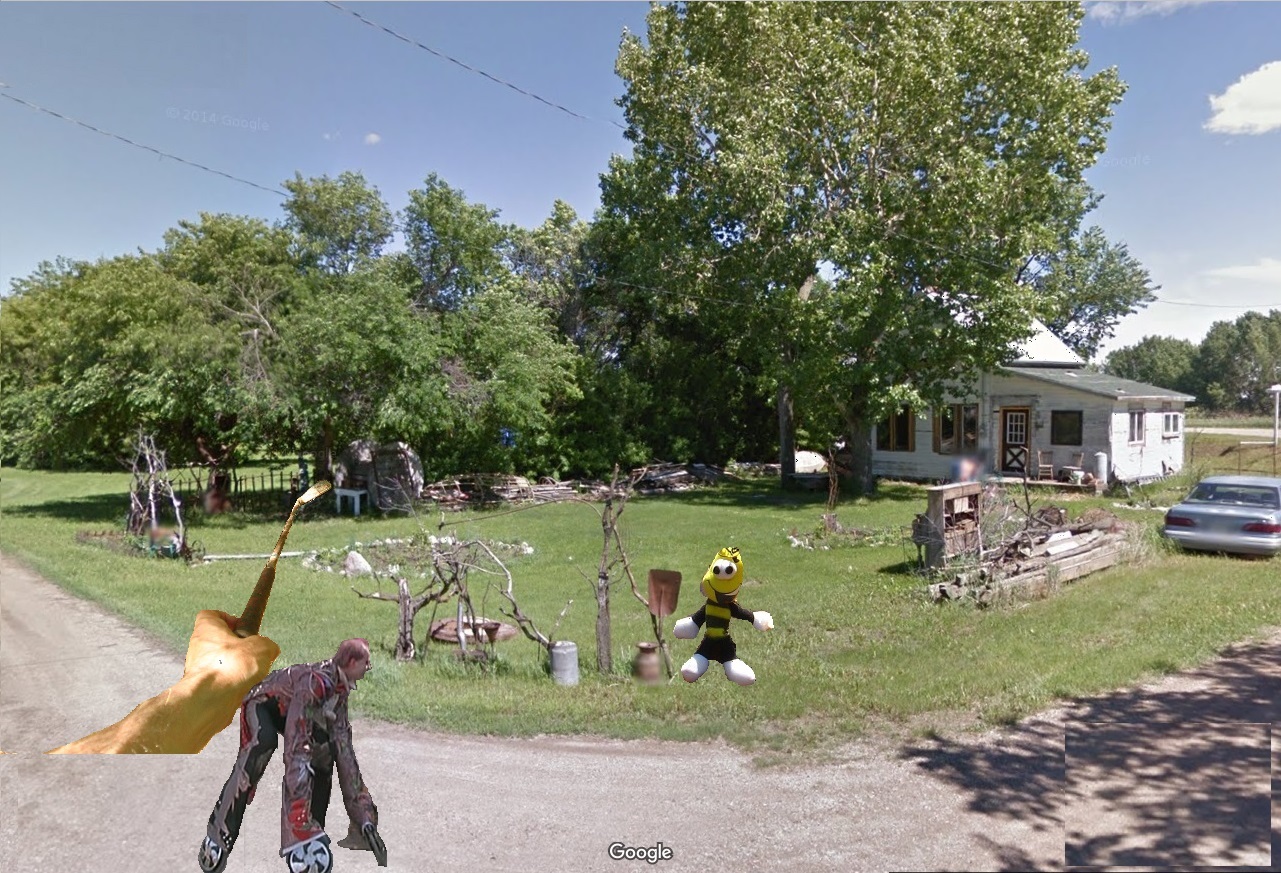
If collage 10 brings us fully into a Tungaske collage environment and establishes an aesthetic foundation for all to come, then collage 11 provides us roots. We are at a particular house that I will not identify except to say that it is the home of a prominent town artist who I seem to be able to identify with more than any of the others. That’s because we’re both artists of *junk*. A key link is the presence of a large spool table on the property, much like I built my Bigfoot junk/toy environment around a (smaller) spool table in part. You can clearly see the Canadian artist’s table in Google Maps Streetview, and also, surprising me, on a short, very choppy video someone made while driving through the town in 2011.

Collage 11, entitled “Hucka Homebee”, is an animation, like collages 02, 03, and 08 before it. Here’s part 1:

Boos11a Huck Homebee

We have the return of several items seen in former collages. Two reappear from collage 5 (“Simpsons Road Bloch”), or the Oz Wheeler and the triangular formation of Simpsons toys. The Wheeler again stands in the middle of a road and at the bottom of the picture. The Simpsons figurines again stand to its right, but in a yard now and not a road. The golf iron from collage 07 (“When Wheels Went Round”) is seen to the Wheeler’s left. Like with that collage, the head of the iron touches a *spool table*. The same Wheeler is found in collage 07, but on top of such a table and not in front of it.

In part 2 of the animation, the Simpsons figurines are replaced by a doll version of resident blog spirit Hucka D., referred to in the title of the piece. Specifically, the doll is superimposed directly atop Homer Simpson in the animation. This symbolizes the home aspect and the rooting act. *I* come to roost in Tungaske, borrowing a resonant artist’s humble dwelling spot. Hucka D. shows the way, becoming “Hucka Homebee” in the process. It’s possible an unconscious nod to a baseball home base occurs here with the positioning of Homer in the corner of the yard. Notice also the parked car to the right, which may resonate with the Boss, MO parked/junked car of collage 01 and 02.

collage11base03

And, yes, I’m aware that Hucka D. has not made himself known in my new round of collage interpretations. I gave him an opening earlier to interpret this particular collage of the series, along with others, but he left it alone. My instinct is to keep moving forward without him for now, until I get myself in a pickle.

collage12test10

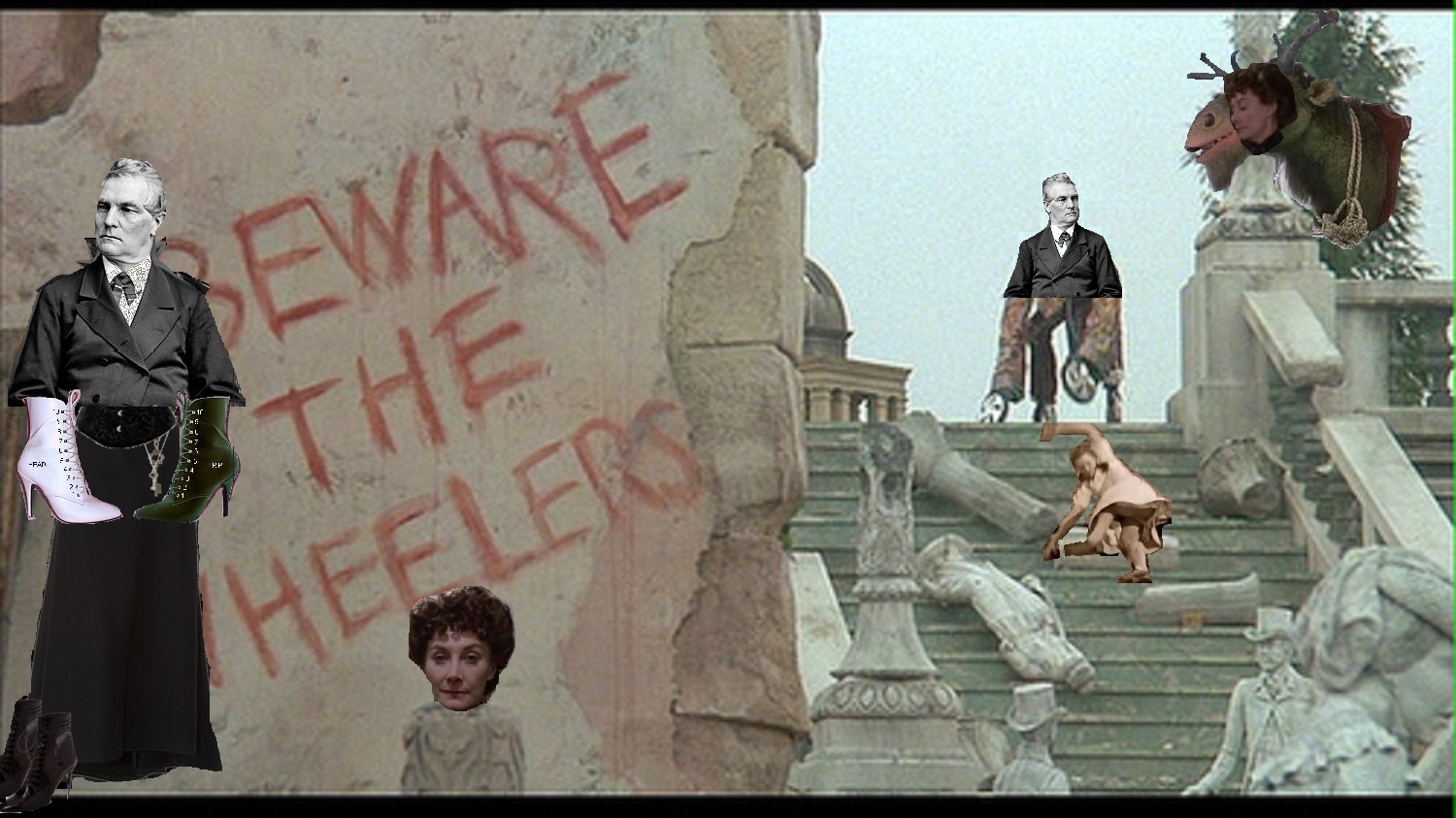
We see the return of the yin/yang or tajitu sphere in collage 12. The artist whose house is featured in the previous collage is one of those pushing or holding up the ball. This is *her* creation, at least in part. Per the title (“Trapped Wheeler”), a Wheeler is encased within the black half of the sphere, but the image is now that of William A. Wheeler, vice president to Rutherford B. Hayes from 1877-1881. However, we’ve also seen this particular Wheeler in the first half of a May 2015 Stonethrow animation I called “Beware The Heelers”. There the association with an Oz Wheeler is first made: the lower half of the stairs version of the vice president is replaced by the wheeled lower part of the Oz creature. Then in the right side version, a different slant on this amalgamation takes place as his hands are instead replaced by shoes.

wheelers16
“Beware (The) Heelers 01”

These same shoes also reappear in the present collage, seen attached to the people on its left hand side. This again stands for the audiovisual synchronicity “Head Trip” we’ve mentioned before in connection with collage 07, “Head Brains”.

Boos Interpretation 05

A spool table appears in that earlier work as well. Perhaps a cursory description of the synchronicity from my August interview by Karl Tune is in order here.

I thought “Head Trip” to be an important work moving forward and I sent out some tapes to people. We were still on the edge of VHS tape days. I was very pleased that about all of them “got it”. At its base, “Head Trip” is a continuous toggling back and forth between 2 movies which are dubbed by 3 audio sources. It involves 47 tiles if you include plain dialog segments, compared to 32 for “Billfork” and 26 for “SID’s 1st Oz”. I mention these numbers for another particular reason.

You have to keep in mind “ST/TD” was a very small forum. Others began mentioning “Head Trip” and I chipped in with my own theories about it. Some tension manifested from the theories. Whytless Physh left the scene, saying he had accomplished all he wanted to do here with “Jesus Who?” Last I heard, I believe he spoke about refocusing his energies on becoming a lawyer. Dave had wrapped up his run of Rush centered synchs. Stegokitty had moved on to different interests. Virotti became frustrated that we were talking about other things besides file sharing. The wheels were falling off, like I said. And not just for this forum, but for the progressing forward of audiovisual synching in a group fashion.

What I’m going to take away from this is the link of the phrase “wheels falling off” here with the “trapped wheeler” aspect. In terms of group energy, “Head Trip” was a dead end. The Wheeler inside the ball is *me*, unable to go further in a particular direction. In another way, it is the interviewer Karl and the limitations of what we spoke about. I purposely concocted our interviews so that they would be of about equal length — another tajitu situation. And each interview itself is divided into 2 equal parts. The gap Karl had in his experiences with audiovisual synching groups acts as the seed for my own interview. And visa versa — I didn’t know a lot of the story behind Shared Fantasia II, for example. Wikipedia defines the yin-yang symbol as, “a circle divided by an S-shaped line into a dark and a light segment, representing respectively yin and yang, each containing a ‘seed’ of the other.”

The Tungaske woman artist whose house we see in collage 11 is the one who most holds the Wheeler figure here “in place,” her arms pushing against his shoulder. The metal sphere the yin-yang ball replaces in the collage might itself be a kind of failure or dead end as a sculpture. Unlike other pieces in the same location (seen in other photos from the particular art event), we do not see it subsequently exhibited in a Tungaske location. Sometimes spheres are difficult to hold together in the long run. You need some help, perhaps divine provenance.

(to be continued)

4 Comments

Filed under BIGFOOT, Blue Mountain, Canada/Tungaska, collages 2d

Boos Interpretation 06

(continued from)

goodlandgoodwater09l

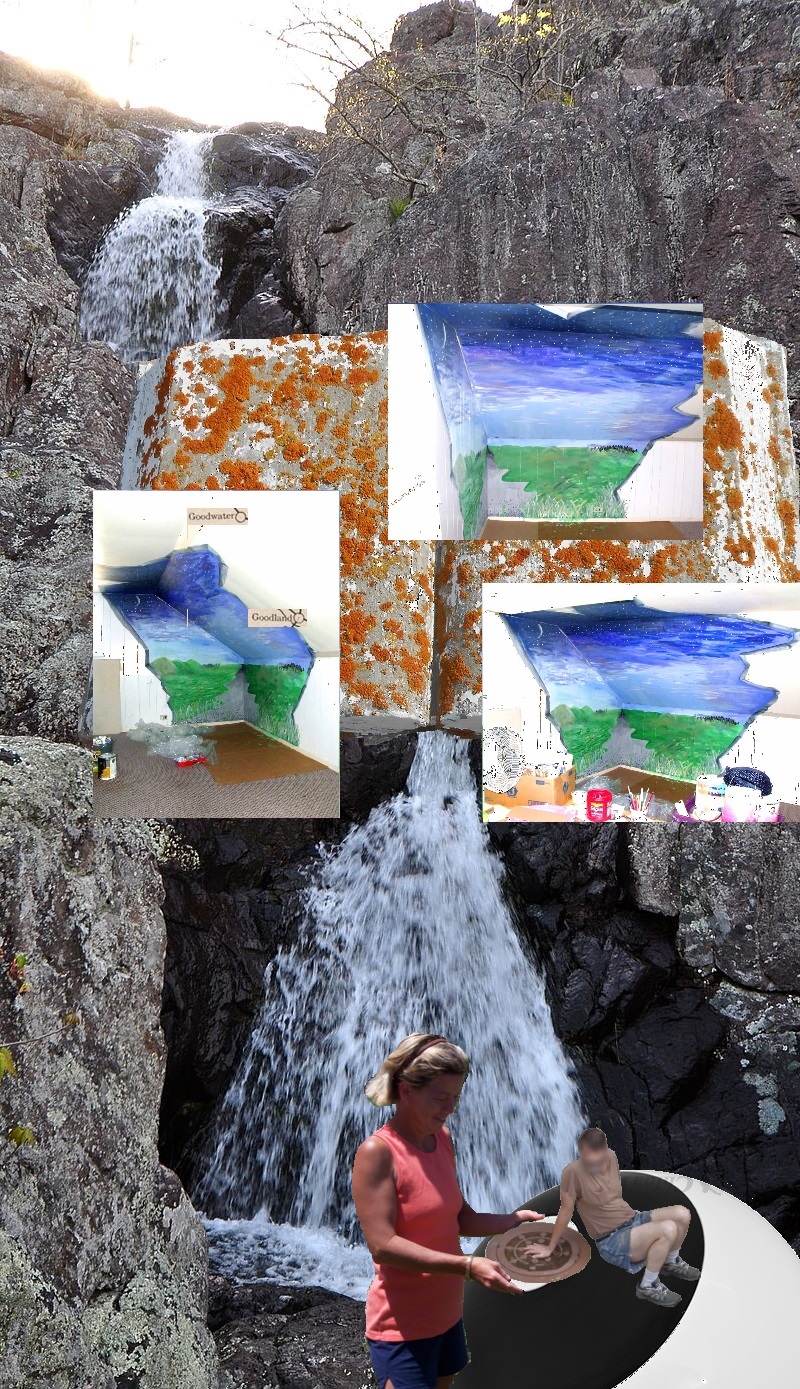
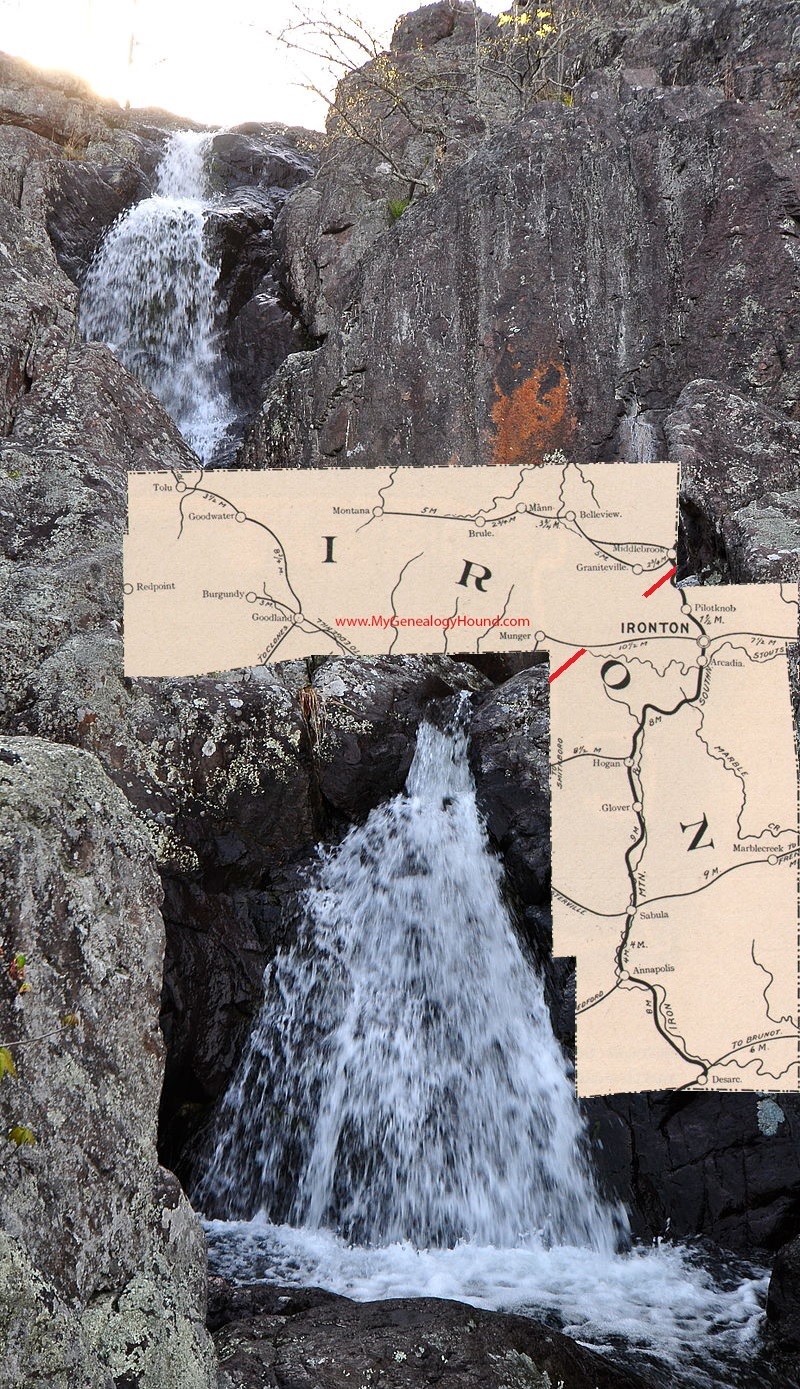
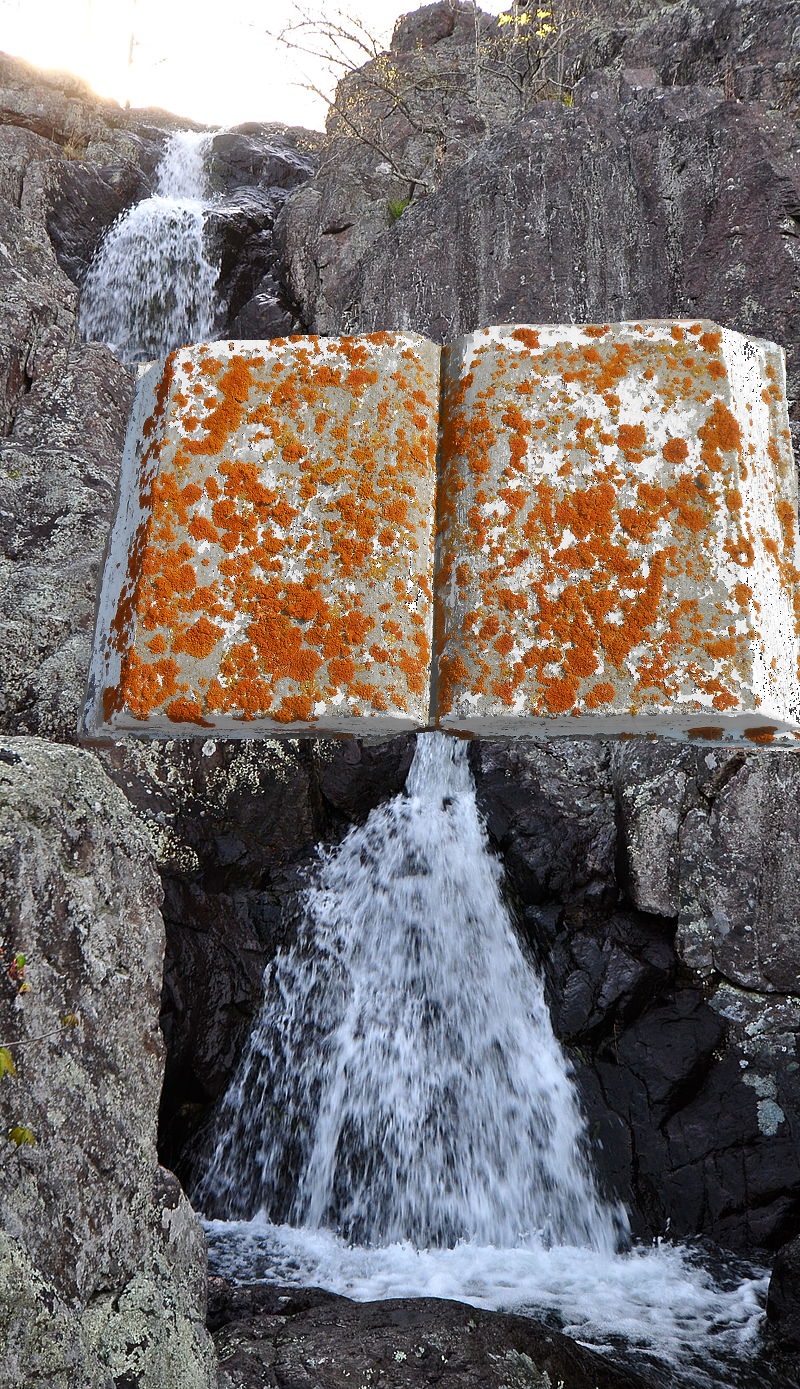
In the 9th collage of the Boos series, entitled “Goodwater Goodland 01”, we return to a Missouri setting, with the base photo being of Mina Sauk, highest waterfall in the state and located in Iron County. In an early draft for this collage, I simply superimposed a map of this county onto the 2 tiered falls, with the idea that both appear in two basic parts as you can see here…

goodlandgoodwater04

The rusty colored patch on the rocks of the falls just above the map acted as another tip to unite the two elements. Then in subsequent drafts the Iron County map was replaced by a “rusty” book I found in cemetery photos of Tungaske, Sask.: the two halves of the county become the two parts of the open book, which the falls pour into (edge) and then pour out of (spine).

goodlandgoodwater09

The book is also notable as being the first image from Tungaske that I use in the Boos collage series, following by many more. The link which led me to this tiny, remote Canadian village? It’s the presence of population places named Goodwater and Goodland in the western part of Iron County, and in the same township (Dent) as the aforementioned Buick and Bixby communities there. Googling images through the conjoined “goodland goodwater” names quickly brought me to this Tungaske cemetery. Among the many pictures online the rust colored funerary book jumped out at me.

In the images I also found this one…

goodlandgoodwater06

… and later learned that the name Tungaske itself means Goodwater according to some sources, thus its presence in the title of what is apparently the definitive history book for the community. But there’s more to the story than this. Check it out here.

The history book and the funerary book are now joined as one. I call the fictional synergy “The Big Book of Rust”. We may even quote passages from it later on.

Now to the elements added just a bit beyond this in the lower part of “Goodwater Goodland 01”. We have the return of a woman artist from the 2nd collage of the Stonethrow series, the one coming before Boos.

collage02test02ah

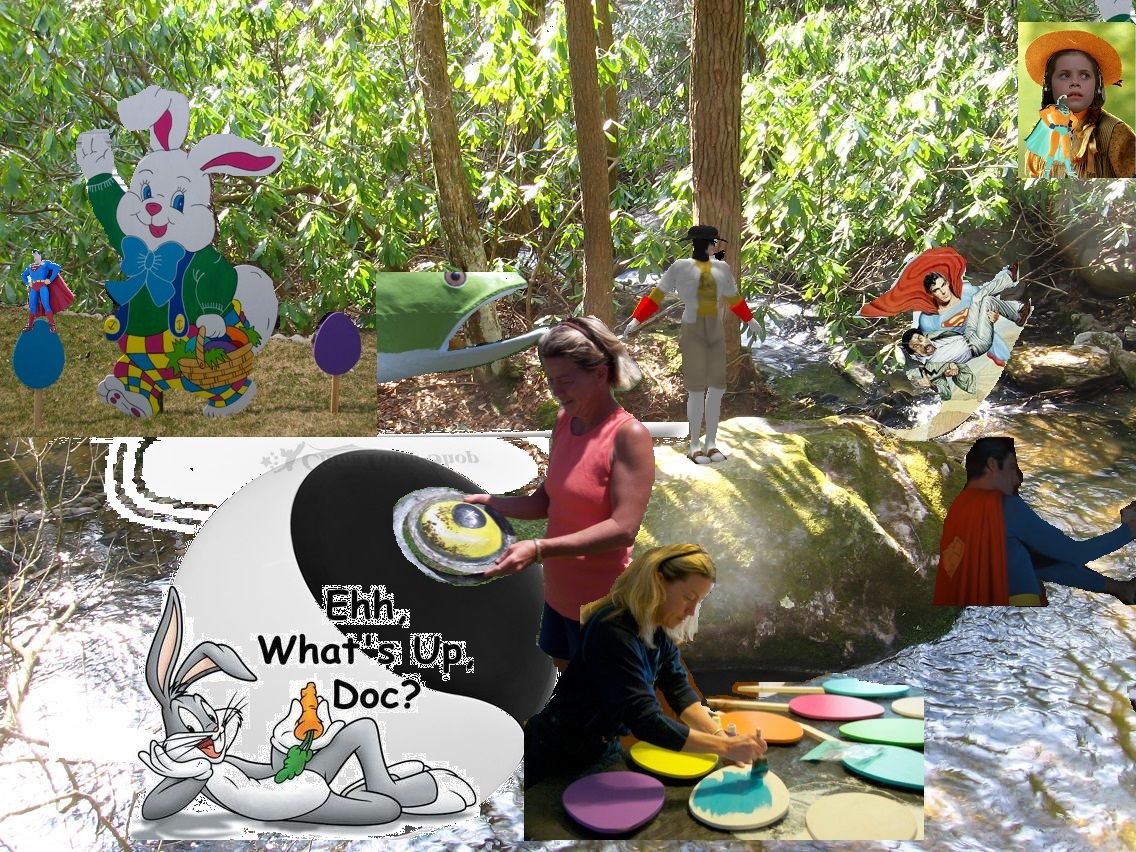
In the present collage, she is again placing a round object into the white “eye” of a tajitu or yin-yang ball. I newly associated this with the Bigfoot art event, which took place in meantime. Namely it is the placement of the “iron smelting plant” to mark the center of the *yin* aspect of the marble race track, where it circles back around to head toward the spool table and complete its circuit. In the new collage, the sculpted eye she holds in the Stonethrow work is replaced by a similarly round sewer cover held down by a hand of Homeless Man (who himself appears in a subsequent Stonethrow collage).

goodlandgoodwater09l

If we look closely, we see the sewer cover, although the same “size” as the pictured white eye of the symbol, is turned in a way that will not fit this eye. The artist even seems to hold the eye more than the sewer cover. This could refer back to the “seed” of earlier collages, which appears in 2 forms perpendicular to each other (car and car’s license plate). There’s also a good chance that the woman artist of “Goodwater Goodland 01” stands in for another female artist from Tungaske, associated with the same tajitu sphere in a collage we’ll be examining soon. But for now, something doesn’t seem to quite fit yet.

And then the final elements of the “Goodwater Goodland 01” — 3 images of the same wall mural — also comes from Tungaske, being placed over on the other image (funerary memorial book) from the same town and partially obscuring it. This could represent differently angled illuminations from “The Big Book of Rust” itself.

(to be continued)

Leave a comment

Filed under BIGFOOT, Blue Mountain, Canada/Tungaska, MAPS, Missouri

Boos Interpretation 05

(continued from)

testcc02e

To continue with the “Head Brains” analysis… instead of resting his hand on the back of the brown cow, Davy Jones clutches the edges of a superimposed spool table. Zappa perches at the top, a dark twelve o’clock figure. A large finger emerges from its center pointing directly to Frank, which I happen to know is a middle finger. The figurative bird that Zappa may be giving Davy at this point in the movie (“…your song’s pretty white,” etc.) seems to manifest for real in the collage. But, if so, the finger is actually pointing at us, the viewers. Hmmm. Jones stares right at it, perhaps aware of the context.
310595_10150399782979534_158084819533_9980024_1504241495_n

However, in looking at it closer, the finger is not pointing directly to 12 if the round spool table translates into a clock (and the finger the hour hand of a clock). The pointing is slightly askew to the right. I think this might represent the clock time 12:01, which can be rewritten as 11 hours and 61 seconds, or 11:66. Let’s keep that in mind to see if more evidence appears later on in the collage series.

Finally we have the transparent giant head of Subgenius prophet Bob Dobbs in the background, his visible eye perhaps fixated on the finger. Zappa was known to be something of an admirer of the Subgenius religion. And that’s another reference to “Head”.

In “Head Brains” we have another clear reference to the Bigfoot art event. One of the fixtures of that event, just recently completed of course, is a spool table, found at the Plateau of Raw Art and then rolled down the hill through the 4 roads territory to be placed beside Bigfeet Swamp and act as a centerpiece. I’ve already speculated an association with the name Brian Head, perhaps itself derived from “Brain Head” and thus directly related to the title of the present collage. I was aware in making this association that the “Head” of “Head Trip” is symbolically white or yang, which makes the complementary, circular iron smelting plant beside it in the Bigfoot event black or yin in energy, linking to the “Trip” part of the audiovisual synchronicity’s name. Let’s leave it at that for now.

collage10test10b

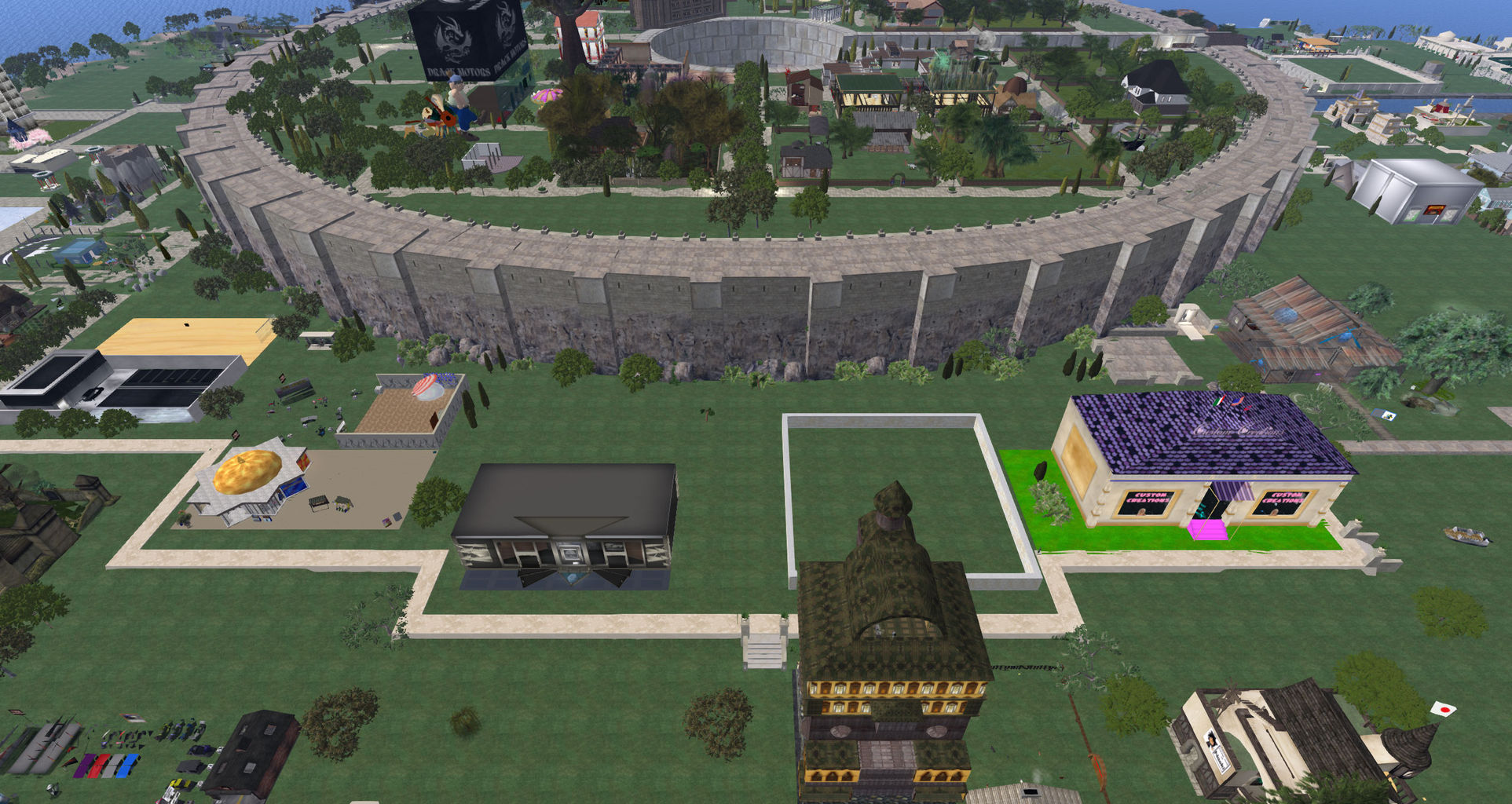
In collage 08, called “When Wheels Went Round”, the spool table returns as a dominating image, or at least the top of one. Now it becomes directly linked to the central Nautilus City location called The Citadel, created on a circular plateau raised about 40 meters above the rest of the otherwise quite flat island-city (save one higher hill to the west). The wall encircling the plateau remains in the collage. However, the top portion with the roads and such has been removed, replaced by the top of a spool table image I found online. The golf iron extending toward this modified Citadel from the foreground is culled from a Bigfoot photo — it’s the original “iron” of the city, found by me prior to the event. That’s my hand holding it, then. In “When Wheels Went Round”, the *head* of the golf iron rests against the bottom of The Citadel wall.

The collage is actually a 2 part animation, where the whole Citadel appears to rotate round and round, or at least that’s the effect I was going for. This reinforces the association with a clock, once more. The Oz wheeler first seen in “Simpsons Road Bloch” a couple of collages back reappears on the edge of the spool table, remaining steady as the table revolves below him — a fixed point. He seems to stare into the central hole of the table, which duplicates an actual hole in the middle of The Citadel. I suppose showing the base snapshot I used for the collage is appropriate here to understand this…

743fcbb3

That’s my Fal Mouth Moon gallery at the bottom of the photo, which remains in the collage. The iron and my hand holding it have the same kind of sepia tint to them as the gallery, a color scheme that will resurface later in “Comparative Heights” (collage 24 of the series). Like everything else in the collage *save* the spool table and accompaning wall, the iron remains the same in both parts of the animation. Only the transformed Citadel changes, with its perpetual whirling.

So what is the meaning of all this? The Wheeler is obviously associable with a wheel, per the collage’s title. Wheels go ’round and ’round. I return to the idea of a clock, with the iron perhaps acting as another type of clock hand, or an indicator of a specific time. Will the giant finger reappear from the central hole when the clock strikes twelve (whatever that means)? The ribbed wall brings to mind clock gears.

Let’s push on…

1 Comment

Filed under **VIRTUAL SL, BIGFOOT, Blue Mountain, collages 2d, Nautilus, Nautilus City^

Centerplace

Snapshot1090_001

bb:

Carrcassonnee, I don’t seem to be able to give up the idea of a virtual Collagesity, despite the Sunklands site being fulfilled to this point, despite the money involved.

Carr.:

Not that much. Keep Collagesity. Another story to come. Build up.

bb:

Bigfoot is pretty much closed up for the winter.

Carr.:

Not so much. Weather will depend. And now you have, let’s say, Ridge Edge. Redge.

bb:

Redge: good. What’s the story on that? Can you tell me?

Carr.:

Redge separates, let’s look, Rediscovery and Bigfoot, but closer to, let’s see, latter. Ladder.

bb:

It’s about halfway in-between the two, yes.

Carr.:

And then you have, let’s listen, Afterfoote?

bb:

Yeah. The secret centerplace of Bigfoot, as I’m seeing it.

Carr.:

That’s where you should build Collagesity. You have all winter.

Snapshot1090_002

Leave a comment

Filed under **VIRTUAL SL, BIGFOOT, Blue Mountain, Heterocera, Rubi^

11/1-2/15 Photos 04

TEXT SOON.
IMG_0740smaller

IMG_0743smaller

IMG_0746smaller

IMG_0749smaller

IMG_0753smaller

IMG_0756smaller

IMG_0763smaller

IMG_0765smaller

IMG_0772smaller

IMG_0785smaller

IMG_0794smaller

IMG_0799smaller

Leave a comment

Filed under BIGFOOT, Blue Mountain

11/1-2/15 Photos 03

TEXT SOON.
IMG_0726smaller

IMG_0728smaller

IMG_0729smaller

IMG_0730smaller

IMG_0731smaller

IMG_0732smaller

IMG_0734smaller

IMG_0735smaller

IMG_0736smaller

IMG_0738smaller

Leave a comment

Filed under BIGFOOT, Blue Mountain