Category Archives: Mississippi

Miss Tippy 02

http://en.wikipedia.org/wiki/As_I_Lay_Dying_%28novel%29

“I gave him this novel.”

“Addie next to Good Grief. Sinclair nearby,” he said, pointing.

“Eastport,” I added, pointing as well. “Boundary.”

(flips pages)

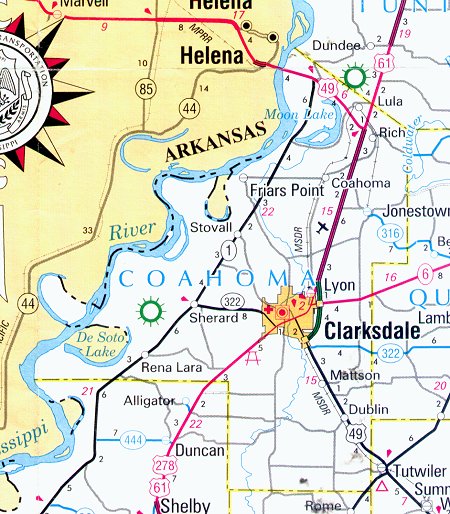
“But of course this is the one I’m most interesting in,” I said. I pointed again. “Foote”, I said, drawing the magnification out. “Grace, Glen Allan, Panther Burn.” “Foote,” I reinforced, “Then Heads on the other side.”

He looked with me. I also thought of the lyrics, “from my head down to my toes,” as 2 of the 4 Beatles — John and Paul perhaps meaningfully — fall flat, head and feet on same level, as in a corpse.

“Helm may also refer to the helm of a ship,” I said, still looking at the northern part of the same county. “This is the body of Addie.”

“Or someone at the helm,” Hucka Doobie chipped in. “A boss, a captain.”

“Helm could also refer to helmet.”

“Or helmets. Helmets cover heads, like in a fireman’s helmet. Like in a football helmet.”

“Here?” he asked. It was a sly observation by him concerning me.

collage61part02c

“What do you think?” I replied.

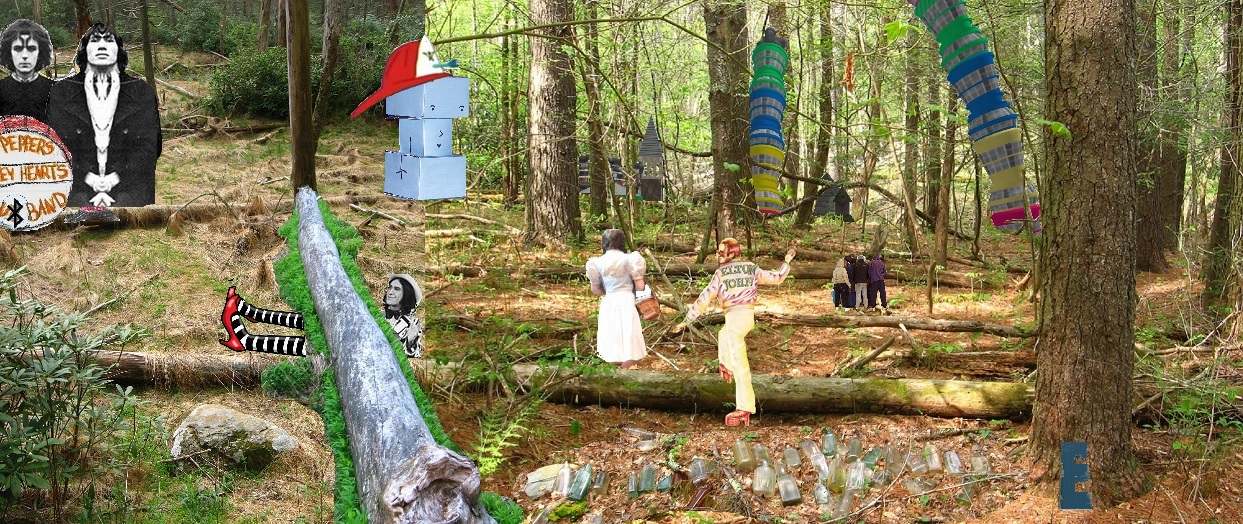
“Feet (pointing)… death… red ruby slippers. red fireman’s helmet. Fits (!)”

How observant, I thought. Like talking to myself. I smiled.

“Well, maybe the big green lined log of the picture is the Mississippi River itself… herself. Miss Tippy.

He kept looking at the picture, and then started pointing once more. “Dorothy has no bottom of her legs, donated to Day Ravies.”

“He might still show up,” I added hopefully but doubtfully at the same time.

“Elton also has ruby slippers or ruby sparkly shoes,” Hucka Doobie observed.

“They cross a perpendicular log to the green lined log,” Roger tacked on. “Maybe a tributary of the Mighty Mississippi?”

“Maybe all three logs — main logs of the picture — are representations of the Mississippi. Fireman Peanut balances on the one further back. Ruby slippered Day Ravies is crushed by the one perpendicular to the other two, and the Elton John cross, again in ruby slippers the 3rd more in the foreground. The same one that cuts off or obscures Dorothy’s own slippered feet.”

“Elton is certainly in better shape than Day Ravies here. He is able to cross atop the log. It acts as no real obstacle in his journey. Peanut also seems content, perched upon a parallel log in the background. His head is covered with a red helmet, but he has no feet. Elton and Dorothy provide his feet.”

“It’s Peanut’s Big Adventure after all,” Hucka Doobie chimed in. “Part Deu.”

“Two.” Roger shrugged at me.

—–

“Everyone has only one head but also almost everyone has 2 feet and not just a foot. Foote.”

(to be continued?)

1 Comment

Filed under MAPS, Mississippi

Miss Tippy 01

http://en.wikipedia.org/wiki/Coahoma_County,_Mississippi

Clarksdale is now the largest and most important city in the county, and was named for John Clark, a brother-in-law of Governor James L. Alcorn, whose home, Eagle’s Nest, was in this county.

http://en.wikipedia.org/wiki/James_L._Alcorn

James Alcorn was elected by the Republicans as governor in 1869, serving, as Governor of Mississippi from 1870 to 1871. As a modernizer, he appointed many like-minded former Whigs, even if they were now Democrats. He strongly supported education, including public schools for blacks only, and a new college for them, now known as Alcorn State University.

Although a former slaveholder, he characterized slavery as “a cancer upon the body of the Nation” and expressed the gratification which he and many other Southerners felt over its destruction.[5]

http://en.wikipedia.org/wiki/Friars_Point,_Mississippi

Friars Point is one of two hypothesized locations where Spanish explorer Hernando de Soto may have crossed the Mississippi River (the other is Commerce, Mississippi).[1]

The town was founded in 1836 and originally called “Farrar’s Point”. When the town incorporated in 1852, its name was changed to “Friar’s Point” to honor Robert Friar, an early settler, legislator, and businessman who sold fuel to passing steamboats. In 1850, the county seat was moved from the nearby town of Delta to Friars Point.[2][3]

Strategically situated at a bend in the Mississippi River, Friars Point flourished before the Civil War as the largest shipping center for cotton south of Memphis.[4]

Friars Point was also home to Confederate Brigadier General James L. Alcorn, whose grave and former plantation, Eagles Nest, are located a short distance east of the town.[7] Alcorn turned from Whig to Republican after the war, and went on to become Governor with the support of the large number of carpetbaggers who had settled in Friars Point.[4]

Charles Lindbergh ran out of gas while flying his plane over Friars Point in 1924, and landed at a place he later called “The Haunted House”.[5][6]

As nearby Clarksdale grew in population and influence, it challenged Friars Point’s hold on the county government. In 1892, Coahoma County was divided into two jurisdictions, one going to Friars Point and the other to Clarksdale. In 1930, the county seat was given exclusively to Clarksdale. Historian Lawrence J. Nelson wrote that by that point, “Friars Point had receded into a sleepy river community.”[4]

Time Magazine wrote in 2013:

Once a thriving port town and the county seat, economic decline has left Friars Point with a lone elementary school, a few churches, a city hall, a post office, a small general store, a museum that opens only sporadically, a nightclub called Show T Boat where a man was shot to death in 2011, and a bank. The town no longer has a doctor or health clinic, a drug store, a sit-down restaurant, a recreational center, a library, or any businesses to speak of. Kids travel 15 miles to Clarksdale for junior and senior high school.[9]

Muddy Waters said the only time he saw Robert Johnson play was on the front porch of Hirsberg’s Drugstore in Friars Point. A crowd had gathered around Johnson, who was playing ferociously. “I stopped and peeked over,” said Waters, “and then I left because he was a dangerous man.”[10][11] In a 1937 recording, Johnson sang, “Just come on back to Friars Point, mama, and barrelhouse all night long.”[12] In Johnson’s Traveling Riverside Blues he sang, “I got womens in Vicksburg, clean on into Tennessee, but my Friar’s Point rider, now, hops all over me.”[13]

Friars Point has been written about by both William Faulkner and Tennessee Williams. At various times, both writers had vacationed at Uncle Henry’s Inn on nearby Moon Lake.

Notable people:

Conway Twitty – country music singer who once held the record for having the most number-one-hit singles.[7]

Deupree’s Historic Homes: Eagle’s Nest

Eagle’s Nest

The home of James L. Alcorn, in Coahoma county, received its name in a most natural way; an eagle had built her nest for many years in a large cottonwood tree in a field adjoining the park which surrounds the residence. In alloting work to the plantation laborers the supervisor spoke of it as the Eagle-nest field, thus the plantation and the home became known as “Eagle’s Nest.” There are several nests of these birds in the cypress brakes just back of the buildings.

The home is a large modern frame structure. The lumber was cut from the forests on the plantation, and dressed by hand under the supervision of Gen. Alcorn. The house has five wide halls, twenty-two large, high ceiled rooms, made home-like and cheerful by ingle-nooks, cozy corners and numerous broad windows. Three bay windows open on the blue waters of the lake on which the home fronts. Broad verandas extend around three sides of the house; the whole surmounted by an observatory commanding a view of beautiful Swan lake, the park, and the broad fields of corn and cotton, the whole making a pictures never surpassed in natural beauty. Mrs. Alcorn tells the following interesting story as to the way the lake received its name:

“In the early days it was a feeding ground for numbers of wild swans. A huntsman on one occasion shot, and broke the wing of one of these graceful birds. It could never again leave the lake; year after year it welcomed the coming of its fellows with glad cries, and pined in sorrow when they plumed their broad wings and took flight for new feeding grounds; it was pitiable to see its efforts to follow. Since then the pretty sheet of water has been called Swan’s Lake. Upon the shore of this lake stands the tree in which the great eagle mentioned above built her nest. She showed both judgment and taste in the selection of a home; for the waters of the lake furnished an abundance of food for her young, and the view is one of unsurpassed beauty.”

The axmen were directed to leave that tree untouched when the field was enlarged by clearing the southern part of the park; but the careless, thoughtless, destroyer of the forest, regardless of orders belted this monarch of ages. The grounds immediately about the house are shaded by large oak, magnolia, holly, and varnish trees. The gardens are gorgeous with bloom from the coming of the dainty snowdrop and purple violet of spring to the asters of the late autumn. In the park, near the southern limit, is a large Indian mound, and on this mound sleeps James L. Alcorn, his grave marked by a marble statue of himself. Near by rest the remains of four sons. Two died in defense of their home and country. Major Alcorn, the eldest, was as brave and true a soldier as ever went to the front of battle. Henry, the second son, then a lad of seventeen years, captured and taken to Camp Chase, contracted typhoid fever and died on the way home an exchanged prisoner, and now sleeps beside his father on the old Indian mound. The wide halls and lofty rooms of this stately home that once echoed to the tread of busy feet, are now silent, and deserted by all save the widowed mother.

Publications of the Mississippi Historical Society, Vol. VI (1902), pp. 249-250.

http://en.wikipedia.org/wiki/Moon_Lake,_Mississippi

Tennessee Williams visited Moon Lake Casino, and referred to it in all but two of his plays.

Yes, the three of us drove out to Moon Lake Casino, very drunk and laughing all the way.
—Blanche DuBois, A Streetcar Named Desire

William Faulkner also visited the place, and referred to it in one of his novels as “Moon Lake Hotel.”

Question: Is the Fal Mouth Moon (gallery) a direct relative of this Moon Lake Hotel? Remember that it served as a conduit to VWX Town’s The Moon during its Rubi incarnation. Falmouth Hotel is also an inworld famous haunted spot in Bay City.
I believe Moon Lake refers to the American Moon Landing, because the largest island of the lake is Texas (Misson Control location) and the other large island is Alcorn Island, named for James Alcorn of Eagle’s Landing. Remember “The Eagle has landed”.

http://www.urbandictionary.com/define.php?term=Eagle%20has%20Landed

part of speech: idiom

Originally used by Neil Armstrong when the first man-made craft (the “Eagle”) landed on the moon, now used to indicate the completion of a “mission objective”.
1. Neil Armstrong: Houston, the Eagle has landed.

2. Criminal #1: Are you inside?
Criminal #2: The Eagle has landed.

3. Jim: So, did you sleep with Allison yet?
Tim: Dude, the Eagle has landed.

Leave a comment

Filed under MAPS, Mississippi

7777 03

“Do you think Mr. Dundee could have made a pact with The Devil, Hucka Doobie?”

Hucka D.:

Explore that idea.

coahomacounty
Ocahoma: 61×49!

bb:

And an Australia Landing now found very near Duncan and Alligator. Coolie! Maybe Dundee’s power acquired through wrong channels was the ability to turn collages into paintings.

—–

Whitehead X-ing Timeline:

Mossmen reach Korean Channel through Portal System. Silverburg equals early base.

Mossmen establish Red Head near top of Channel. Contact with Bees at their neighboring Greenhead. Realization that they had psychically switched colors red and green with each other.

Whitehead moves into Da Woods. Retired.

Whitehead is not Whitehead before retirement. Is Red Head? Greenhead? He is a future ghost in his whiteness. Grave may be his nearby.

Explore idea that pre-retirement Whitehead is a Greenhead, or maybe a Mossman himself.

What is the relationship between Whitehead and Sinclair, then? Sinclair has his own Toy Room in the Synching Creek Mystery Area. On Sign Line. Primary creation Rock moves away from him and establishes own center at Rock’s House and Lee Triangle (confluence of Sign and Sink Lines). Then he creates Rocket to escape Mystery Area altogether. Lands in Blue Mountain at top of Korean Channel. Symbolically moves up Rocky Trail past Grey Rock/Seal Stone to Edward Stone and its Green [*Moss*] Turtle. Crosses fairy bridge (footbridge) but some say he crosses higher bridge across same Little Whitehead.

Edward of namesake Edward’s stone or Edward Stone. Like Emerald City of Oz, and has its own (The Emerald) (grass top — green before all else around it in Spring). Edward may be the same as Mr. Dundee and if so lives in Dundee Castle atop Dundee Cliffs. Changed his name from Edward to Dundee?

Moss Turtle perhaps created by Mossmen — would make sense.

Who lived in the Fairy House across Green Stream from Whitehead Xing? Was this Rock as well? I believe it is the entity that put Seal Stone atop Grey Rock. He also created or bought or otherwise procured a Crocodile Rock, later “assimilated” by Australian Dundee. There was a female entity named Sharon who controlled the (Seal) Stone, which may be the same as the Edward Stone.

Leave a comment

Filed under Frank Park, MAPS, Mississippi, Whitehead Crossing

Lemon > Burns

lemon02

Part II: The answer.

smithcounty_map02

http://en.wikipedia.org/wiki/Magee,_Mississippi

http://www.wired.com/science/discoveries/news/2009/01/dayintech_0127

The three astronauts knew they were looking at a potential death trap. Not long before he died, Grissom plucked a lemon from a tree at his house and told his wife, “I’m going to hang it on that spacecraft.”

Leave a comment

January 7, 2014 · 7:32 pm

2989

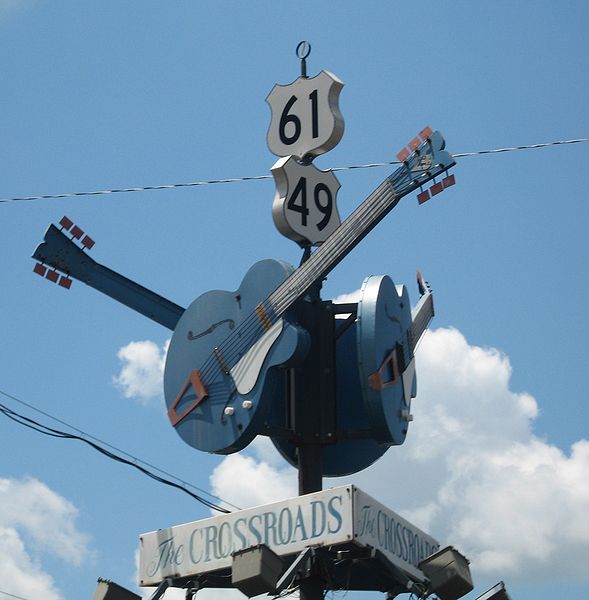
589px-ClarksdaleMS_Crossroads

http://www.abovetopsecret.com/forum/thread329611/pg1

http://www.supernatural.tv/reviews/legends/s2/cb.htm

ats2488_breakdance

37 x 49 x 61.

1 (12) 13 (12) 25 (12) 37 (12) 49 (12) 61.
(0 1 2 3 4 5) — see below

2989
2989 Pooh’s Honeypot – Brickipedia, the LEGO Wikilego.wikia.com – 384 × 288 – More sizes

384 x 288 = 110592

49 x 61 = 2989

37 x 49 x 61 = 110593

tÀ
Set # 2989-1: The Big Honeypot 1,200px × 883px

1200 x 883 = 1059600

1200 x 883 * 2 = 2119200

2989 x 709 = 2119201

709 is the 59th progression of Arithmetic Progressions/Difference of 12, starting at 1.
2989 is the 249th progression of Arithmetic Progressions/Difference of 12, starting at 1.
2119201 is the 176600th progression of Arithmetic Progressions/Difference of 12, starting at 1.

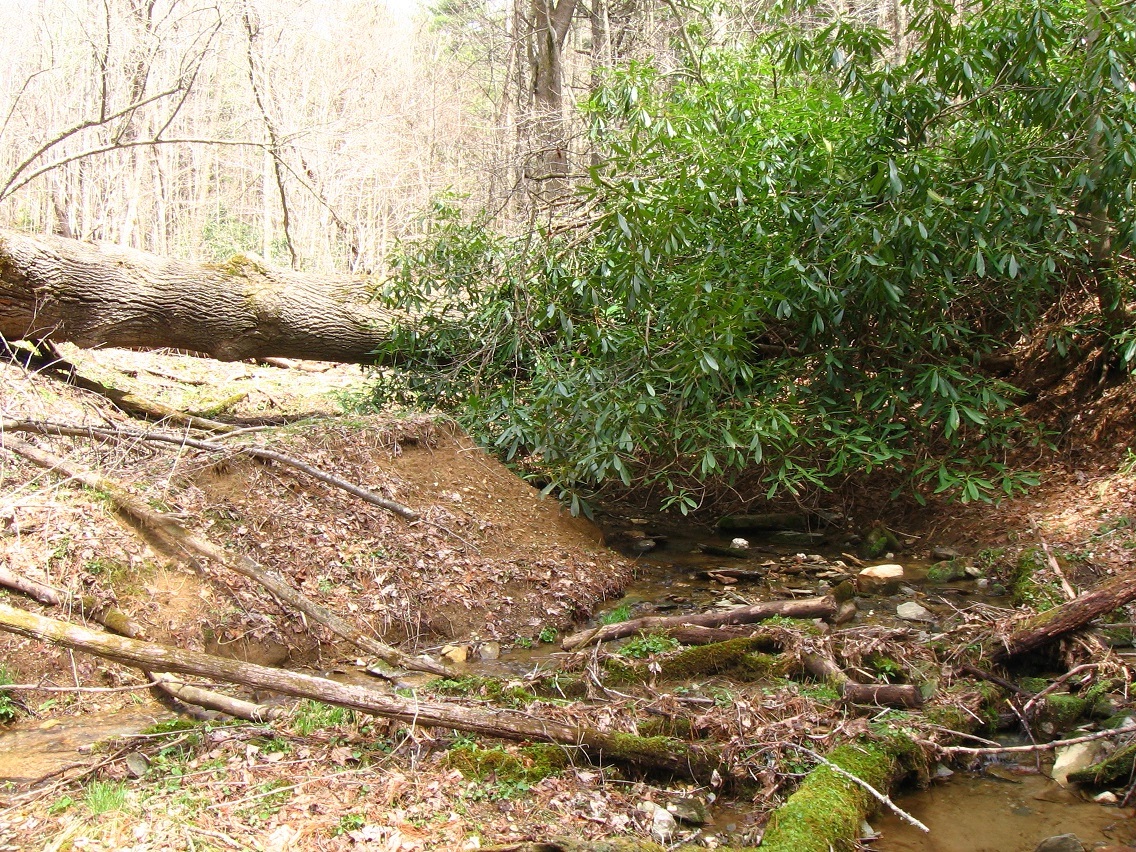
biglog02

ZOSO:

biglog03

1 Comment

Filed under Frank Park, MAPS, Mississippi, Whitehead Crossing

Whitehead X-ing Thoughts

Some thoughts while I have them in my head upon rereading old blog entries about this most central of all Frank Park locations, it seems.

Hucka D.:

I am here to help. You have Grey Rock, you have Seal Stone. You have No Title Spring. You have the yellow brick road leading to the 50 bottles region no more [“Goodbye”]. You have The Rocky Trail, which goes into and beyond Grey Rock. You have Rock the Rocket Man, who crash landed next to Green Stream and took The Rocky Trail to Green Turtle. Green Turtle was also known as Green Parrot. On this same finger of land is found Edward Stone, a bleedthrough of Edwardston, which also happens to be near a Green Turtle[ in Mythos].

bb:

Which of the stones is Seal Stone, Hucka D.?

Hucka D.:

A choice. Some people go both ways — and so forth.

bb:

I think I see. ‘Course the names could have shifted around. What about the Orange Hill?

Hucka D.:

Castle Dundee. Home of Mr. and Mrs. Dundee. Who owned the dingo.

bb:

Is there, then, a Line of Dundee?

Hucka D.:

Might be.

bb:

High Octave Castle, then.

—–

dingo rise/fox fall

—–

bb:

And then just a little more — I think Rock would have found The Grave and thought it to be Whitehead’s, the originator.

Hucka D.:

Marble City. Marble Falls.

bb:

Whitehead X-ing is such a complex area!

Hucka D.:

You build on Fantasia Brick Road and take it to the next level. Also: Fairy House. Like Elton John is a famous fairy, in a positive way.

bb:

The [diamond patched] tail wags the dog.

Hucka D. (correcting back):

God.

http://davewainscott.blogspot.com/2011/01/peter-gabriels-mercurial-disruptive.html

—–

4/23/13:

“The evergreen grass atop the finger of land between Little Whitehead and Whitehead Brook, Hucka…”

“Fade To Moss” Production Shots

The same post talks about Rock’s grave, which is not his grave in the production shots of “Fade to Moss”. Wonder where Gene Fade is on that?

Rock’s grave, however, obviously strongly resonates with the tiny Dogpatch Cemetery only found very recently. Rock, I believe, would have stumbled upon it — could have stumbled upon it — in his explorations of the area.

When does Rock created his twisty turny tale, where he’s a bad guy instead of a good one? It’s to disguise his whereabouts and doings. He thinks like a syncher.

Do the yellow bricks hidden at Tinsity come originally from Whitehead X-ing?

I believe that Herman Park’s Billfork originates in Whitehead. Mossmen used the Spoon Fork portal system to reach Green Stream and the Korean Channel. At the upper end of the Korean Channel is Whitehead X-ing; Jeogeorock, which is Grey Rock. Had the Mossmen already found other jeogeorocks? Possibility. They traditionally come from Moss Most, an original settlement far up Spoon Fork from Frank Park, just at the edge of where it knives toward Frank Park and the portal system. Then they reached another historical node at Mocksity, downstream, then also Notherton across The Way. This is where knife truly acts as a medium between formerly cross Spoon and Fork. Perhaps The Way had not even been created (until then?) — makes sense. Gene Fade, eventual actor in all those Salad Bar Jack adventure movies, born at Jupiter Rock above Nothernton, on what is called simply Gene Fade’s Mountain in this here blog. Some say the red spot on the rock is a jewel, perhaps a ruby. But related to this one found in Second Life on the yin-yang style Bracket Islands of the Corsica continent [LINK]. Gene Fade used [My Second Lyfe] avatar Karoz Blogger to create the ruby or jewel (or a virtual rendition of such?), with, again traditionally, 32 prims or 32 facets. This is the Korean Channel. Gene Fade must have learned about the fabled Korean Channel while growing up in this Jupiter Rock/Notherton area. It was an ultimate destination, like Utah or Deseret was for the Mormons. Gene Fade desired greatly to go to this Korean Channel with its Green Stream (full of emeralds and rubies and diamonds?).

News came from afar that the Korean Channel had been sealed up for the spring/summer months. Mossmen settled in Red Head beyond the upper end of the channel, but still on Green Stream. They hid… their avatar bodies able to move through the thick rhododendron, but allowing no human humans access (like me!). Mossmen first made friends with The Bees (like Hucka Doobee) at neighboring Greenhead, strongly resonating with the honeybee name origin of Deseret in fact. There was a confusion about colors… with Red Head at the head of Green Stream and Greenhead at the head of Red(stream) [LINK: MISSISSIPPI]. Another essential energy was added to the mix with the crash landing of Rock’s Rocket at the upper end of the Korean Channel, or at the lower end of Whitehead X-ing — what would become this city. He used The Rocky Trail to move into Whitehead Crossing proper (all the imp. rocks along this path have become legendary) and settle not in the modern version of the city but at the old Green Turtle/Edward Stone region between Whitehead and Little Whitehead. The crash would open up a portal to Maine as well, allowing a single fairy to escape from Monhegan Island there (through the overlapping Little Whiteheads). This fairy, larger than any of the rest on that island, was a psychic double to Rock, and created his home in the fairy meadow on the east side of Green Stream from the crash site. Rock’s crash also highlighted the importance of Grey Rock and its accompanying Seal Stone.

But since Rock created a twisty-turny tale, disguising his actual story, the fairy could have also been Rock himself instead of his double.

Continuing this Maine-Whitehead X-ing parallel, we have the Maine Trail, a play on words of Main Trail, which would be the main trail of the area, to the west of Whitehead X-ing and connecting Jacob I. Road with the now paved or asphalted Twisty-Turny Road (just coined!).

Before I forget, there’s also probably a Crocodile Rock in Whitehead X-ing — maybe it is the same as the Green Turtle/Green Parrot, or yet another variant name of this formation.

The could have even been a battle or a war over what the name was for this particular formation (Green Turtle vs. Green Parrot).

Back to Rock… he would have passed Grey Rock with its Seal Stone on the way to Little Whitehead. He would have crossed Little Whitehead and entered Edward Stone proper (or whatever the town was named then — perhaps Green Turtle?) on the old fairy bridge (made by fairies but apparently the smaller or more traditional type). The fairies were hired from Monhegan Island (by whom?) So this “fairy bridge” becomes legendary and attached to Rock’s legacy as well. Another tradition says that he crossed into Edward Stone from the larger bridge at the present source of Little Whitehead, and over which you can clearly see the green turtle formation.

Revision: If the village is named Edwards Stone, then I think this means the Green Turtle oriented people won the war over the Green Parrot favoring tribe, who instead maybe moved upstream on Whitehead Brook to Rock’s Meadows and Rock’s Rocks, the upper limit of Whitehead X-ing. Rock would eventually make this his people instead of those at Edward Stone favoring the Green Turtle treatment of the formation. This is also like the Green Parrot province of Mythos upsteam on Edward Creek from Green Turtle and Edwardston. Green parrot would have been the shape of the formation for, say, a *normal sized human like Whitehead.*

Some variations of the story have The Rocky Trail paved with yellow or gold bricks, but this is false most likely — road too small or narrow? Instead the gold brick road was the old entrance into Whitehead X-ing, when Old Whitehead actually lived there. *Is* Old Whitehead buried at tiny Dogpatch Cemetery? But the story is certainly similar to Dorothy’s entrance into Oz — the crashed farmhouse is Rock’s crashed spaceship; the Rocky Trail is at least symbolically the Yellow Brick Road, and Seal Stone is the Scarecrow, who doesn’t know which rock is named such (some people go both ways, etc.). If there are parallels to Munchkins, they would be the meadow fairies. Back to Grey Rock and Seal Stone: the phrase “rocks for brains” also could be pertinent. Then Edward Stone is the Emerald City, complete with skyscrapers at the time. In fact, it had an unusually *high* proportion of skyscrapers to regular buildings. The population was about 20. The population use to be 40, but was cut in half during the Green Turtle-Green Parrot battle/war, which ended in a draw. Therefore the population simply refers to it as part of the larger Edward Stone, and the city changed its name accordingly. Another mysterious part is the Orange Hill or Orange Cliffs, on which the Dundee Castle is perched, where Mr. and Mrs. Dundee lived. Their dingo use to be sighted as descending the cliffs, only to come back up as a fox. Or visa versa. The legend is in many art pictures of the period.

yale04collagesmaller

Dingos descending represents the passage of life into death. Foxes ascending (to the Plane of Dundee) is death into life. They are Newborn on the Plane. They die at the bottom of the cliff where it meets Whitehead Brook. All this could be seen from Knobby Log, which was also inhabited. Knobs were homes — wood fairies once more?

Then it would be sacrilege to give No Title Spring a name, according to the fairies (?).

What did Rock find in Edward Stone? He found a population struggling to recover from the Green Turtle/Green Parrot wars. He made his home high above the town, but was able to see its skyscrapers still, so high they were. One skyscraper held the Art 10×10 (Wheeler-Jasper series). More fox-dingo images were within.

jasper04collagesmaller
“Cliffs of Dundee” (Waverly Knapp, c1812)

cliffsofdundee
actual cliffs — not so high

Hucka D.:

There was an alignment of art galleries. And perhaps labyrinths at the same time. The Line of Art it was called. 39 people use to live in Edward Stone, and also 0.1 of a person known as [delete name].

“The Fairy?” I proffered.

Hucka D. (continuing):

The range was 38.9 to 39.3.

bb:

39 point 3 point what?

Hucka D. (ignoring the silly baker):

The line ran across the Castle Dundee to Edward Stone, atop the Knobby Log. Because it was on the line, Castle Dundee was required to become an art gallery in due time. It resisted.

bb:

Why?

Hucka D.:

There was a famous painting of the Panama Canal by Waverly Knapp (c1812), but was defaced by Rocket Man and his Rocket with “Sirius or Bust” scrawled upon its side. Mr. Dundee did not understand that this was part of the art, and painted over it.

bb:

Crocodile Dundee!

Hucka D.:

Correct. Of “Crocodile Rock” fame. Dundee and Alligator on opposite sides of a county.

coahomacounty
Ocahoma: 61×49!

—–

One important collage of the Art 10×10 was stolen from baker b., in turn, by a former art school acquaintance named Waverly Knapp (c1812). baker b. himself stole part of this painting-disguised-as-a-collage for his Gilatona-Lis series (c1812). Mouse Island was seen as the destination of death, where the fox descended down to from the Plane of Dundee and its Dundee Castle. This is also the Promised Land (of Gill’s Pier). To keep from entering the promised land too soon, baker b. avatar must move the Pier’s Gill wagon atop the Cliffs of Dundee, a difficult task in the painting but easier in actual life (cliffs not nearly as high as in the painting). Important also is the triangle of elements in the painting “Cliffs of Dundee”. Critics knew that the green mouse of the painting was R. Booger Hayes’ Mouse Island, and the Promised Land where the true nature of the island is allowed to “play out” (like the green mouse plays the guitar in the painting). The children around him are [white-ish] rocks — Rocks Von Trapp. The Green Mouse is also known as Captain or Capitan. He earns this title in the Promised Land.

Hucka D.:

Also obviously important are the images of Green Turtle in painting. Oil painting was seen as highest art, like the high castle of Dundee atop the cliffs. Mr. Dundee, the person of High Octave (Art), made sure this was understood. So the collage formerly known as Jasper 04 became the oil painting known as the “Cliffs of Dundee”. In this way it is much like Max Ernst’s Elephant of Celebes, an oil painting also based on collage principles, and perhaps also indistinguishable from a collage from afar.

bb:

Check this out, Hucka D.:

Wilsonia Visits Gallery, Takes Pictures of Updates (1)

snapshot897_028smaller

5 Comments

Filed under **VIRTUAL SL, collages 2d, Frank Park, MAPS, Mississippi, Whitehead Crossing

104 years and counting

http://en.wikipedia.org/wiki/Chicago_Cubs#1902.E2.80.931920:_A_Cub_dynasty

In 1902, Spalding, who by this time had revamped the roster to boast what would soon be one of the best teams of the early century, sold the club to Jim Hart, and the franchise became known as the Chicago Cubs.[6] During this period, which has become known as baseball’s dead-ball era, Cub infielders Joe Tinker, Johnny Evers, and Frank Chance were made famous as a double-play combination by Franklin P. Adams’ poem Baseball’s Sad Lexicon. The poem first appeared in the July 18, 1910 edition of the New York Evening Mail. Mordecai “Three-Finger” Brown, Jack Taylor, Ed Reulbach, Jack Pfiester, and Orval Overall were several key pitchers for the Cubs during this time period. With Chance acting as player-manager from 1905 to 1912, the Cubs won four pennants and two World Series titles over a five-year span. Although they fell to the “Hitless Wonders” White Sox in the 1906 World Series, the Cubs recorded a record 116 victories and the best winning percentage (.763) in Major League history. With mostly the same roster, Chicago won back-to-back World Series championships in 1907 and 1908, becoming the first Major League club to play three times in the Fall Classic and the first to win it twice. However, the Cubs have not won a World Series since; this remains the longest championship drought in North American professional sports.

\

bigsink01
Macon Bacon with the Big Sink

So there’s no doubt that Lisa the Vegetarian can make money off Winesap: she was macon (making) bacon. Cash, Priceville… too many clues here. Cub wins suppressed for psychic energy so the story will go. None of your bee’s wax. Ernie Banks was given compensation as Mr. Cub. Banks is also in UmapS. Banks started as a Kansas City Monarch of the Negro League in 1950 before joining Chicago in 1953, becoming their first black player. This is coded into Oregon, alongside some Dorothy Gale-Kansas material. Kansas City Life probably involved, the first 2 movie synchronicity, technically (Kansas on both sides, City [Centerville] in the middle). Kansas City Life = Second Life, as Kansas City is second city of Missouri (as Chicago is second city of US of A, also known as City of *Big* Shoulders and *Windy* City). Ernie Banks also coded into Mississippi. Popular related quotes: “It’s a beautiful day for a ballgame… Let’s play two!” and, “Without him, the Cubs would finish in Albuquerque!” Also called “Mr. Sunshine,” perhaps relating to “Mr. Bluebird” of ELO.

http://en.wikipedia.org/wiki/Ernie_Banks#Honors

On March 31, 2008, a statue of Banks was unveiled outside Wrigley Field. Upon its unveiling, the base of the statue was revealed to contain a typographical error, reading “Lets play two” rather than the grammatically correct “Let’s play two”. Two days later, sculptor Lou Cella came down to the ballpark early in the morning and carved the apostrophe.

http://www.arf.ru/Notes/Apostro/stfoot.html

“Well I told ’em right then”, Fido said
“It should be easy to see
“The crux of the biscuit
is the apostrophe”

Leave a comment

Filed under Carrcass Artists, Kentucky, MAPS, Mississippi, Oregon, Zapple

More Alien Information

http://centreportal.blogspot.com/2008/10/oz-born_17.html

Quote (my emphases):

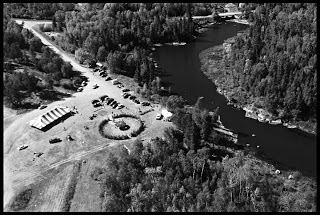
Image: An aerial view of the 1st Igniting The Fire Gathering at Manito Ahbee in the Whiteshell provincial pARK. The Circle and dot is the sacred fire that was lit as part of the gathering. As Cree Elder Don Cardinal explained to me – it was the 8th Fire of Life. The 7th Fire was the human fire and it was almost extinguished. So this gathering and sacred fire ceremony was designed to use the 8th Fire ceremony to re-ignite the inner fire of Humanity. This is the gathering that Juan and is wife Sandra came to Canada to attend.

DPP07D60912173526

This appears to be the first so-called synchromystic related post of the Centralportal blog. I stumbled across it while doing a google image search for “circle with dot in middle” to be used in combination with the maps below, which I’ll get to in a moment. Here’s the image:

monad

Also here’s a slightly later blog post, mentioning a circle with *cardinal* points.

http://centreportal.blogspot.com/2008/12/tie-creek.html

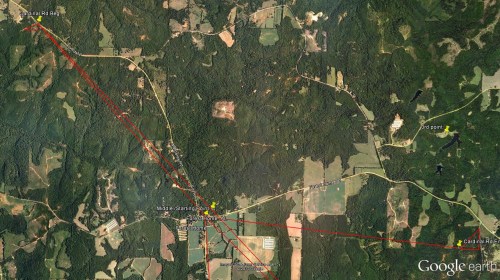
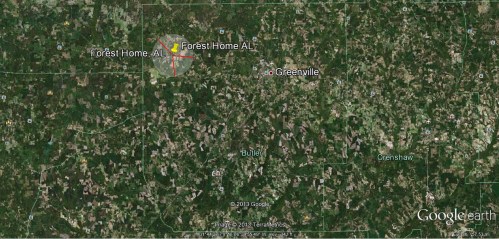
But to my map pictures created today. In the first, I attempt to illuminate the fact that Saucer and Fake Herbert are equidistant from Forest Home, or a distance of 2.8 miles. Fake Herbert is discussed in this earlier post a bit: when you look up Herbert AL in the GNIS database you are directed here instead of the actual location of Herbert in this state, which lies about 28 miles south in neighboring Conecuh County.

foresthome01

As I scanned this 2.8 mile circle in continuing around Forest Home from Saucer and Fake Herbert, I eventually unveiled two, different roads named Cardinal — Cardinal Road both. I should add this is a sparsely populated area with few marked roads. For the upper or northern (or western) Cardinal Road, the beginning point seems to be highlighted by the circle. For the lower or southern (or eastern) the end of the road is instead apparently emphasized by the same. I thought this beyond chance.

On the maps below, each Cardinal Road is represented by a (cardinal) red right angle, with the hypotenuse of both roughly giving the length of the road. While nothing (yet) came of the actual measurements of the roads, my thoughts turned to other Cardinal references in UmapS, and, shortly, Baker’s Creek, Mississippi with a Port Gibson just beside its mouth.

foresthome02

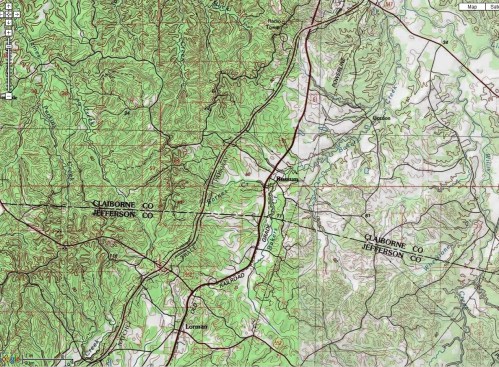
Here’s some further research into this. The latitudes of both the Cardinal Road Beg(inning) and Cardinal Road End points on the Forest Home 2.8 mile circle both happen to cross the approx. 10 mile long Baker’s Creek in this neighboring state. Where the Cardinal Road Beg latitude line crosses the creek is 3.11 miles below its mouth (beside Port Gibson). Where the Cardinal Road End latitude line crosses the creek is 3.11 miles above the source of same, this source point being determined beforehand. The distance between the two places where the latitudes lines in question intersect Baker’s Creek are 3.31 miles apart, seeming to divide the creek into 3 symbolically equal parts, then. Is this the meaning of the “333” cloud in Gila’s collage 02, especially given that each line is a little over 3 miles long, and 1/3 equals 0.333…? Notice also that the “Cardinal Road End” point on Baker’s Creek is situated almost on a county line. Basically speaking the first 3rd of Baker’s Creek is in Jefferson County, MS and the upper 2/3rds in Claiborne County.*

Further thoughts:

The 2.8 mile Forest Home, AL Circle emphasizing Cardinal “beginnings and endings” is meant to be the same as the Manito Ahbee circle pictured at the first of this post, where the 8th Fire of Life is now burning thanks to a 2006 celebration led by Cree elder Don Cardinal.

I’ll get to the whole Port Gibson-Cardinal association later on. I promise.

foresthome03

foresthome04

foresthome05

—–

* The first and third heads in front of the house of Gila’s collage 02 are also identical, like the 3.11 common length between the 1st and 3rd parts of Baker’s Creek, as also defined by the Claiborne-Jefferson County line. The middle head is instead turned the opposite way, indicating it is a bit different, though still squarely in the middle. Have we now entered the inner sanctum of Apricot Bone? Does the solar related crop circle to the left of this collage represent the Forest Home circle with its own symbolic inner fire thanks to recent efforts of Don Cardinal?

Foreset Home Circle

http://thelamplight.ca/schematicgod/ancient.htm

Is Baker’s Creek like Tie Creek, a needed feminine balance to the Forest Home solar circle in neighboring Alabama? Could very well be. Obvious resonance with Ti*l*e Creek as well.

http://thelamplight.ca/schematicgod/orbs.htm

4 Comments

Filed under Alabama, Bill Mountain, Frank Park, MAPS, Mississippi