Another reasons to rename the town to Tungaska or Tungaske:
http://www.tugaske.com/history.shtml
Meanwhile, when the Moose Jaw to Outlook (Macklin) railroad grade went through in 1908 and the tracks were laid, the north-east quarter of section 13, range 3, township 22, west of the third meridian, was set apart by the Canadian Pacific Railway as a townsite, and the CPR assigned the name “Tugaske” to this location. There were already businesses in operation here in anticipation of the coming of the railroad. Indignant citizens met to protest the name, which had a Russian sound, but the CPR pointed out that they had already printed maps, timetables and tickets using the name “Tugaske”, and it would be very inconvenient to change it. It was explained that the word “Tugaske” was a Cree Indian name meaning flat land. (Some claimed it meant good land or good water). The Tugaske Board of Trade immediately seized on this explanation and posted a sign near the railroad, just outside the town, where it could be read by passengers on the train as it went by, reading – “Tugaske means good land, good water and good people.”
Another possible name for the town: Goodwater.
Then this has also come up: Nederland, Colorado was formerly named Tungsten Town (T-Town again) and is located in *Boulder* County.
Hmm.
To complete another circuit of logic, Neal Stephenson’s metaverse described in “Snow Crash” is sometimes called a primary inspiration for the virtual world Second Life (setting of the “12 Pound Mouse Mound” collage), but which has been denied by founder Philip Rosedale.
https://en.wikipedia.org/wiki/Second_Life#History
In 1999, Philip Rosedale formed Linden Lab with the intention of developing computer hardware to allow people to become immersed in a virtual world. In its earliest form, the company struggled to produce a commercial version of the hardware, known as “The Rig”, which in prototype form was seen as a clunky steel contraption with computer monitors worn on shoulders.[13] That vision changed into the software application Linden World, in which people participated in task-based games and socializing in a three-dimensional online environment.[14] That effort eventually transformed into the better known, user-centered Second Life.[15] Although he was familiar with the metaverse of Neal Stephenson’s novel Snow Crash, Rosedale has said that his vision of virtual worlds predates that book, and that he conducted early virtual world experiments during his college years at the University of California, San Diego, where he studied physics.[16]
—–
So let’s just leap into it, shall we?
First up is Boos 01 or “Bossmo”, the introductory collage of the series. We have the return of boxed and unboxed Boss Moss of Freakies cereal fame, first seen I believe in the 2013 Falmouth series. The Google Earth background image comes from Boss, Missouri, which can be shortened to Boss MO (MO being the proper abbreviation for the state). These are the same first 6 letters, then, of Boss Moss, a natural association.

The Boss Moss title on the lower part of each creates a rightwards linear extension of the yellow pin labeled “Boss MO” from the Google Earth image, the initial impetus for the collage. The box can even be seen to block or hide the ending “ss” of “Boss MO”, if there were such letters.
To further cue this up, I decided that both boxed and unboxed Boss Moss should be pointing to a particular thing with their indicating fingers. Boxed Boss Moss points to a camper parked behind a rock house we’ll see better in the next several collages. More prominently, unboxed Boss Moss points to a small square; it almost appears to be balanced on the end of his finger. In Streetview this turns out to be a parked car, perhaps a junked or broken down one. A little later on in the series, this becomes understood as a kind of “seed”. It is also symbolically a Buick, if not one in reality. I couldn’t tell by the limited vision I had of it in Streetview.
I should also state here that the, to me, unusually green pond directly above unboxed Boss Moss also acted as a hint to the cueing.
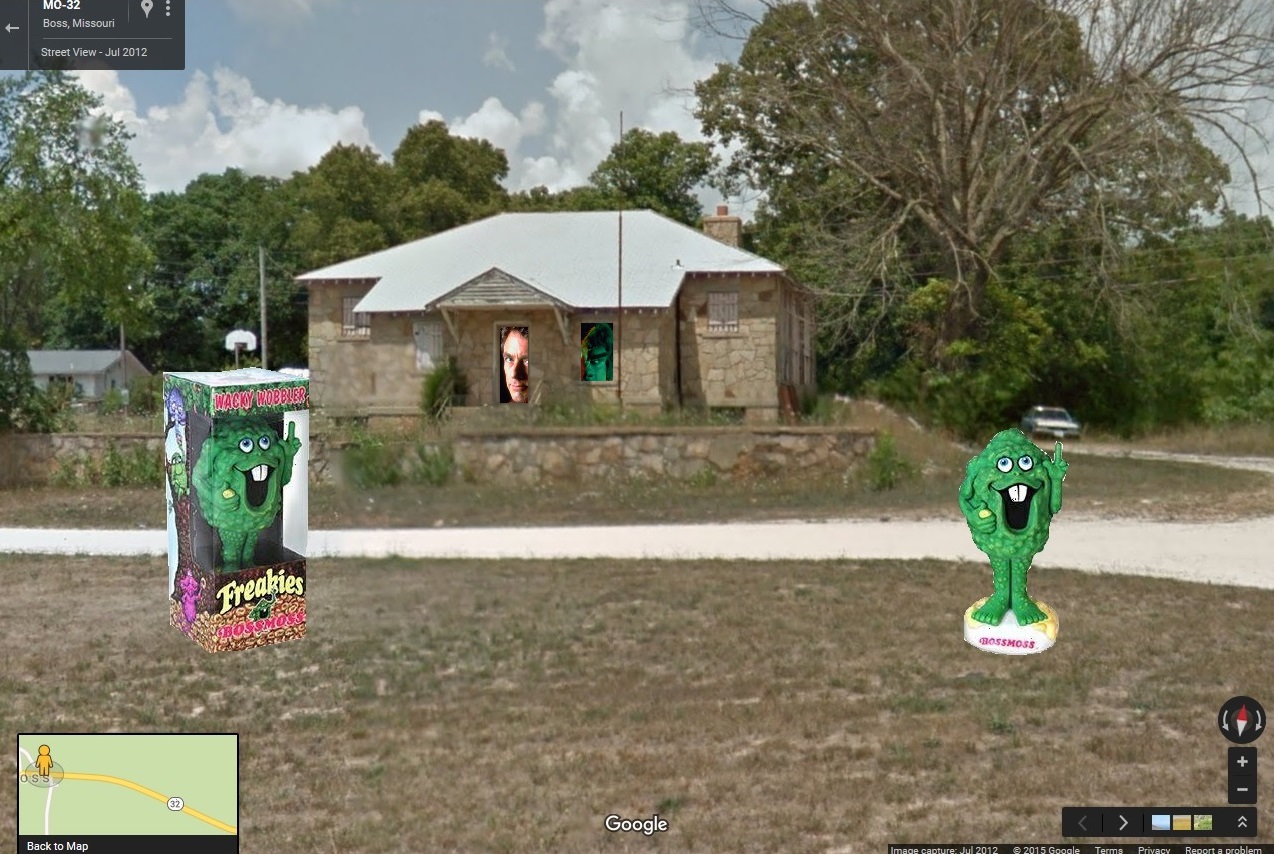
In Boos 02, “Bixby Shuffle 01”, we have a direct continuation of “Bossmo”. We’ve simply gone “into” the map depicted in the first collage by activating the Streetview option for this location. We can now understand that the square Boss Moss is pointing to in collage 1 is the front end of a car, partially hidden by a tree in the aerial view. It was logical to have unboxed Boss Moss just point to it again in the second collage. Similarly, boxed Boss Moss is again pointing to the camper, although his box obscures most of it. Notice also that the white rectangle forming one side of the box is precisely aligned with the same white-ish driveway in both collages.
The only really new pictorial element of “Bixby Shuffle 01”, understanding all this, comes in figures appearing in the windows of the rock house centering the collage. In collage 01, the overhead image of this house is basically blocked by the torso of unboxed Boss Moss. In the now exposed openings of the house appear two images culled from the 1978-1982 tv series “The Incredible Hulk”, starring Bill Bixby. To the left, through the opened or removed front door, we have Bixby appearing as David “Bruce” Banner, a well respected physician and scientist who works at a research company. Perhaps also playing a role here is the fact that the character’s wife died in an *automobile* accident, a tragedy that directly leads, in a chain of associations, to Banner turning into the green hulk monster (The Incredible Hulk of the title) when his negative emotions are stirred. The monster appears in the window to the right of the door. The “Bixby Shuffle” of the title, framed through these two openings, refers to Banner’s constant back and forth transformations from normal human to hulking monster in the tv show.

new image introduced in “Bixby Shuffle”
(to be continued)


 Sunklands