Category Archives: COLLAGES

Carr. Speak

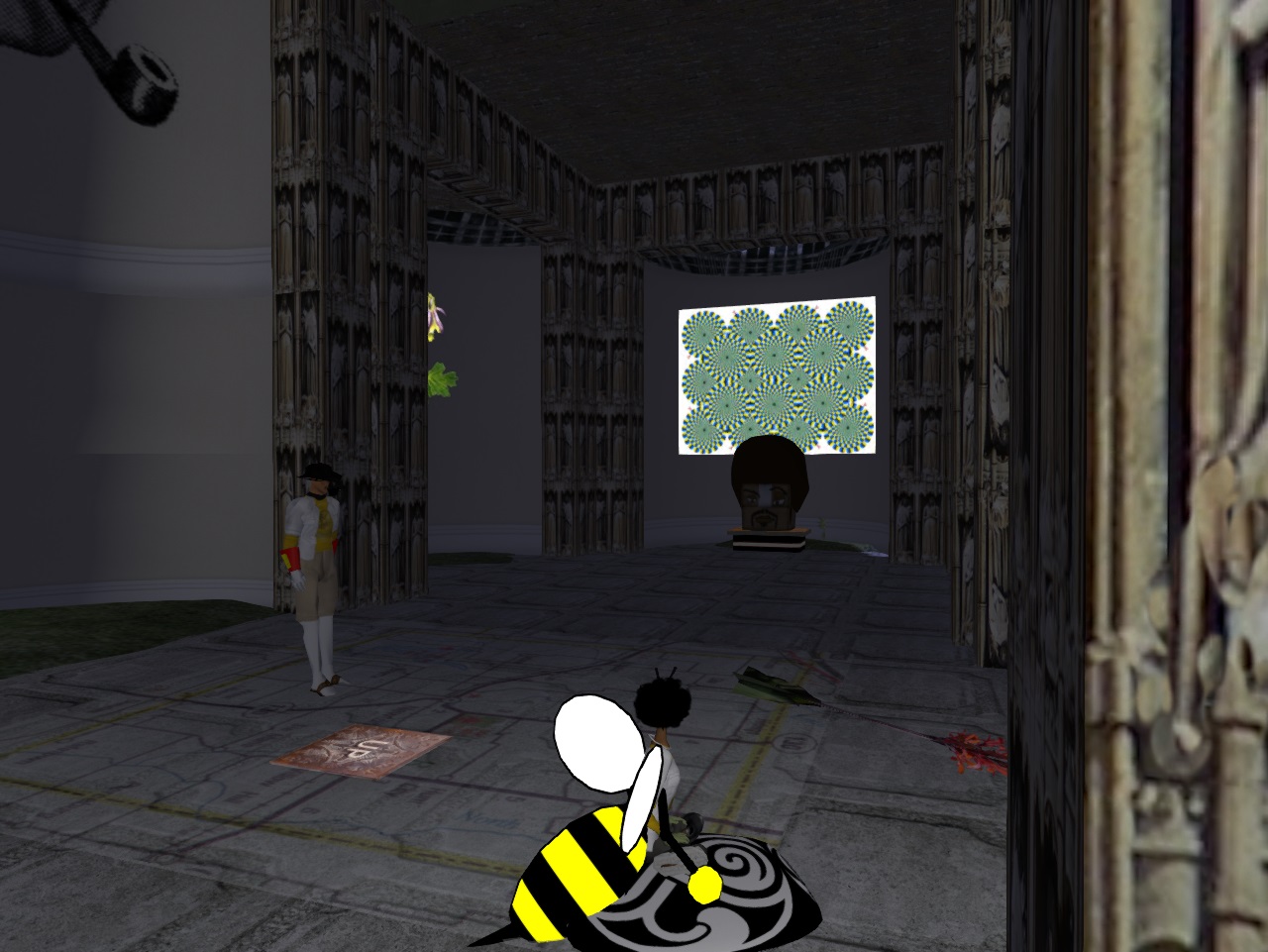
Baker Bloch teleports down to the Red Umbrella. In looking over at this corner, he’s reminded he needs to ask Carrcassonnee about the UmbrellaStar fellow over in the Pond District who visited Collagesity the other day.

Snapshot1129_001

But upon checking in at the Temple, Baker finds Carrcassonnee busy with Hucka Doobie again. Yeah, he’s been inworld more lately. I’ll speak further about that a little later on.

Snapshot1129_002

Snapshot1131_007
Hucka Doobie notices Baker Bloch

—–

bb:

Carrcassonnee, they’ve taken away my classic view in WordPress. I don’t like.

Carr.:

Ahh, you’ll get use. (smile)

bb:

Thanks for the encouragement. How’s Hucka Doobie doing? He left suddenly when he saw me.

Carr.:

He’s asking important questions about SID’s 1st Oz, I know.

bb:

That’s another thing I want to ask about. Obviously I’m heading toward SID’s 1st Oz in the 6 part baker b.’s journey through the golden age of synching.

Carr.:

Good.

bb:

But I’m not sure yet that I can really focus in on SID.

Carr.:

No.

bb:

So I’m thinking about Uncle Meatwad instead.

Carr.:

Yes (!)

bb:

So that’s…

Carr.:

Yes.
Snapshot1129_006

—–

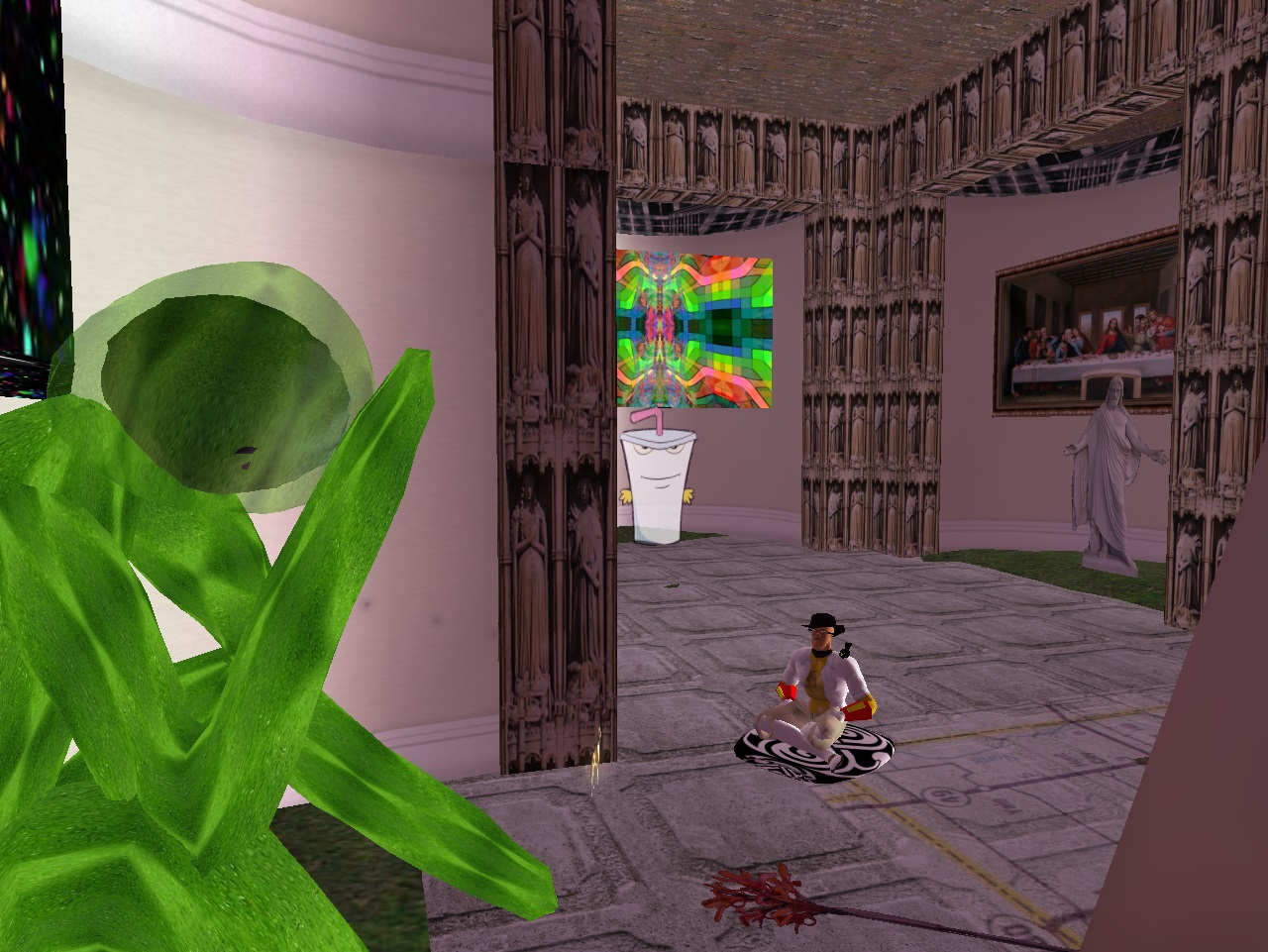
I figured Jesus knew all about sacrifices. “Jesus?”

Carr.:

Yes?

bb:

Not you Carr. Jesus.

Carr.:

I am all deities now in Collagesity. I am the Speaker. Capitalize that in the blog.

bb:

Alright, *Carr.*, let’s talk about sacrifice.

Carr.:

You do not know much about that[ yet].

bb:

I’m thinking of sacrificing Uncle…

Carr.:

Do it. Sacrifice. Jesus concurs as well.

bb:

Ramifications?

Carr.:

None.

—–

A little later on I found out that Hucka D. was diving deep into SID’s 1st Oz instead. Replacement.

Leave a comment

Filed under **VIRTUAL SL, Carrcass-00, Heterocera, Rubi^

WSF2K

Part iv of vi relaying baker b.’s personal journey through the golden age of synching (1997-2003 or so). Parts i-iii are here…

https://bakerbloch.wordpress.com/category/carrcass-artists/

Our trip brings us now to Walt SIDney’s Fantasia 2000, which represents another step up for me at least in terms of producing an obviously synchy and quite watchable work. Like Pink Vertigo, this is an attempt to tile a complete or equivalent complete movie with audio. Unlike PV, devoted to Pink Floyd alone (albeit tracks from a number of their albums), WSF2K cracks open the barn door a bit more to allow artists like Nirvana, Stevie Wonder, Radiohead, Paul McCartney, and Electric Light Orchestra to enter and join in the fun, in addition to, yes, a pretty hefty dose of Floyd at the end.

I was pleased to find an old website on the subject last night, so perhaps I won’t have to yammer on as much about this one. Check it out here if you wish…

http://www.appstate.edu/~brittanma/oldersites/wsf2k.html

http://www.appstate.edu/~brittanma/oldersites/wsf2k1.html

Here are the lyrics for the various tracks…

http://www.appstate.edu/~brittanma/oldersites/wsf2klyrics.html

Some key ideas:

WSF2K evolved directly out of Shared Fantasia, the latter which I consider a pivotal work in the golden age of synching for certain. I was pretty shocked to find out I could create a virtual double or twin in so short a span (3 nights). 10 cues are involved, with the last cue spanning 2 animation segments and playing right over the gap where Angela Lansbury is introducing the last one. Interestingly, that final animation, dubbed by the Floyd song “Sorrow” (original music: Igor Stravinsky’s “Firebird Suite.”), may represent the best stretch of synchronicity in WSF2K and one of the best I’ve been able to produce in my own work. Yet since the cue of this tile comes in the animation before it (which also works quite well in and of itself), the section can be viewed as being further away from manipulation or *synchronization* than anything else in WSF2K; ironic juxtaposition, then. Synchronization and synchronicity become more mixed up here and hard to surfacely differentiate.

The weakness of WSF2K, and by association, Shared Fantasia, is the lack of an overall storyline, like we had in Pink Vertigo. The animation blocks in both Fantasia and Fantasia 2000 are separate from each other and do not weave together in any way except through commentary. We’ll deal with this issue more in the next part of my personal journey through the golden age of synching: “Rock Operas”. See you then!

password: synch
https://www.dropbox.com/sh/f7q60xyq2hptrmy/AADpis9nsx6KLPKrwsALedr8a?dl=0

Leave a comment

Filed under Carrcass Artists

Pink Vertigo

Facebook:

Previously:

part i:
https://bakerbloch.wordpress.com/2015/03/10/23204/

part ii:
https://bakerbloch.wordpress.com/2015/03/11/messiaen/

Part iii (of vi, I believe) of baker b.’s personal journey through the golden age of synching brings us to Pink Vertigo, a still solid looking early synch from late 2001. PV represents my first attempt to tile, with various cued regions, a whole movie or equivalent whole movie. This would be Alfred Hitchcock’s enigmatic Vertigo, which some rate his best. Personally I would select Rear Window for that title, but — apologies to Nightmare Before Christmas and The Wizard of Oz — Vertigo is still probably the best film I’ve worked with on a synch to this point. I think the jump up in complexity here is, in part, an attempt to match or resonate with the energy Hitchcock put forth in this masterwork.

We have not 1 cue (MessiaenSphere/ Piper’s Nightmare Xmas), not 2 (Full of Secrets), not 3 (Messiaen Trek), but 9 now in Pink Vertigo. The first tile I found in the synch would be the cue between the title sequence of Vertigo and the 1st track from Pink Floyd’s soundtrack album “Obscured by the Clouds”, which many consider the best among their several offerings of this kind. This would also become the first tile of the completed Pink Vertigo synch. The following 8 cues/tiles came in a bunch a bit later. These are their conditions:

1. Use the *first track* from all of Pink Floyd’s pre-Dark Side of the Moon *studio* albums *except Ummmagumma* to equivalently tile the movie Vertigo in a front to back fashion.

In order, these early Pink Floyd studio albums (minus soundtracks) are: 1) Piper at the Gates of Dawn, 2) A Saucerful of Secrets, 3) Ummagumma, 4) Atom Heart Mother, and 5) Meddle.

2. Start at Atom Heart Mother (no. 4 studio album) instead of Piper at the Gates of Dawn and work in chronological fashion to Meddle (no. 5) then back to Piper (no. 1) and Saucerful (no. 2). Again, in the middle of the synch, as it were, we “skip” Ummagumma (no. 3), which has already been used in a baker b. synch I might discuss later.

3. Repeat the process twice in round robin fashion.

4. Although divided into a number of sections to increase royalties, I’m counting the entire Atom Heart Mother title composition as track 1 of the album. When you repeat its use in Pink Vertigo, you simply pick up exactly where the first part left off. So part 1 of Pink Vertigo employs sections 1-3 of this title track, and part 2 of Pink Vertigo uses sections 4-5. Section 6, the last, is left out of the mix.

5: One last condition: Instead of using the 1st track of A Saucerful of Secrets we are using the *last* track in this synch (“Jugband Blues”) — in both parts. This is the also the track ending parts 1 and 2 of the synch.

Sounds complex I know but it’s pretty straightforward when you look at it and if you know the Pink Floyd albums involved. Oh… one more trick. There’s a dialog bleedthrough in part of the second Atom Heart Mother tile.

See what you think. Next up: Walt SIDney’s Fantasia 2000. Thanks for reading!

Password: synch

https://www.dropbox.com/sh/s5ncax5ukodo28e/AACNM12xwdwzNLp2Vp91OHRua?dl=0

1 Comment

Filed under Carrcass Artists

Messiaen

Facebook:

Part ii of baker b.’s personal journey through the golden age of synching. Part i can be found here now… link up for several days more on that one. https://bakerbloch.wordpress.com/2015/03/10/23204/ Regarding the newest batch, we have two movies dubbed by the late music of 20th Century composer Olivier Messiaen. Classical music synchs were rather uncommon in 2000 and 2001, when these were created. Messiaen is one of the giants of the last century, and ranks pretty high on the list, I would assume, among all composers by now.

Messiaen Trek starts out with an accessible piece from Concert à quatre called Vocalise, akin more to Messiaen’s early work. This is overlapped with the Enterprise entering the gargantuan V-jer cloud in Star Trek The Movie. As Kirk then roars out an additional command to go further into the cloud after some debate with others (mainly visiting Comm. Decker) we ride along accompanied by Un Sourire (A Smile) from 1989, composed by Messiaen for the bicentenary of Mozart’s death. The track is suppose to run unbroken in the synch. However, two pieces of the movie are employed here, with the second starting right as Spock’s stolen jetpack fires, flinging him toward the heart of the cloud and the encounter with an emotionless deity.

MessiaenSphere is the natural counterpart to Messiaen Trek. It’s not one I’d recommend for introducing an outsider to the world of synchronicity. It’s not as openly synchy as Messiaen Trek either (which *might* be a good introduction). But MessiaenSphere’s the complement nonetheless. At about 42 minutes it’s almost triple the time of MT. We also travel through water instead of space, but in each there is a critical and climatic encounter with an alien being, a sentient golden sphere from the future in the case of MessiaenSphere. MSphere also involves just one cue, but with some added tricks. The music is Illuminations from the Beyond (1994). Only tracks 1-2, 4-5, and 7-8 are used in the synch, with 3 and 6 cut away. The second trick is the bleeding through of 6 stretches of dialog, with the music still playing in the background.

I’ll leave it at that — see what you think. I’d definitely start with M Trek here, and then move on to MSphere if you enjoy the music and find the concept interesting. Otherwise I’d save your eyes for other synchs — don’t force the enjoyment. smile emoticon This will be up for about 7 days, once more. Enjoy if you can and if you wish!

https://www.dropbox.com/sh/16e82o7pxx6snzo/AAAnNslt1EKGk8Xya8_Qqnhka?dl=0

1 Comment

Filed under Carrcass Artists

Early Floyd

Facebook:

Okay, here’s the first batch of historic synchs by baker b. during his journey through our golden age of synching. I’ll leave the links up for about a week at a time. Again, I post these for EDUCATIONAL purposes only… I’ve NEVER made a cent off of the synching hobby that I recall. It’s a labor of luv.

To disappoint some, perhaps, I’m going to leave out the DSotR/Rainbow Sphere tension story that takes place at the beginning of my synching experience in the later 90’s, and jump into the next century with…

Piper’s Nightmare Christmas, Full of Secrets (2000, 2001)

These were created about 8 months apart as I recall, but yet they can be treated as a set. PNC is one of the first synchs that I knew about using early Floyd for the audio, in this case the Piper at the Gates of Dawn album, their first and also Syd Barrett’s showcase work. We start not at track one, however, but five: Pow R. Toc. H. This synchs quite nicely with the opening of the film. This is, in Randy T.’s words, a one drop synch in that you cue the audio and video together at a certain spot and just sit back and enjoy. You’re finished with the manipulation aspect. Let the album just play till it’s ended, through tracks 6-11. Now this is a bit different from DSotR in that I used an internal cue where the movie shifts in focus during the bridged transition between tracks 7, the fabulous Interstellar Overdrive, and track 8, The Gnome. The tracks on the far side of this are lyrics oriented, and music slanted on the near side, so the tone of the synch changes considerably as well at this midpoint.

I watched PNC yesterday again for the first time in quite a while. Like I said track 5 still works pretty great, but track 6 doesn’t have much to match with in the video. We rebound in track 7 with a nice opening, and I think that one works all the way through if you imagine that we are continually following Jack during his journey toward and into Christmastown. I personally see Jack Pumpkinhead, the star of the movie, as a Syd Barrett figure, successful as an underground star in The Pink Floyd Sound but falling into the traps opened up by more commercial success with Pink Floyd. Jack’s crazy attempts to merge Xmas and Halloween mirrors Barrett’s inability to blend fame with creative purity.

I see Full of Secrets as a direct follow up/culmination, with Twin Peaks Black Lodge as the place of descent. Like doppleganger “bad” Agent Cooper catches and replaces the good Cooper at the end of the synch/video, so Barrett loses the battle with sanity at the end, mirrored in the strange structure of “Jugband Blues” from the Saucerful of Secrets album. The center of Full of Secrets, however, is the superb title song from this 2nd Floyd album, the followup to Piper but with limited Barrett input. Again we do not start at track 1 for the synch, but 4 in this case (Corp. Clegg), and also skip track 6, See Saw, to reach the end of the synch and the album and the tv series.

See what you think. Keep in mind again this is a rip from a VHS Tape and also any editing is done the old fashion analog way.

You should be able to see both synchs in full using “previews” with this link:

https://www.dropbox.com/sh/m7bmp31zy42ozwl/AACNj8gBlbnH83_YTQu8UETXa?dl=0

Let me know if these don’t work for anyone and I’ll attempt another route.

Leave a comment

Filed under Carrcass Artists, Sink Floyd/Roger Pine Ridge, Twin Peaks

Carrcasses 06

I deleted my last post about The Rainbow Sphere, SID’s 1st Oz, etc. (I saved it to my blog, however). I’m going to attempt to tie theories more into information from existing posts here, and also material in the newer podcasts. Karl has the most exhaustive theories and reviews so far. Thank you Karl for continuing to be such a strong supporter for the film/album synchronicity phenomenon. It seems we kind of have a shared canon of works coming from the early 2000’s. I would definitely include Being Geddy Lee in this mix even though it is highly manipulated, and I’m looking forward to Dave’s upcoming, reshaped podcast as previously stated.

I was going to make a couple of comments about Karl’s “Simultaneity II” post, but I don’t think we can progress much further than we already have until some future podcasts are cleared. Afterwards we might have a better perspective for moving forward. I would greatly urge Karl to create a new podcast as well — it would help shape and refine his theories on a/v synching, allowing others to better understand what he’s attempting to convey.

An idea popped in my head while thinking about this whole synchronicity vs. synchronization debate: a “looking glass” particle linking the two. On one side you have the viewer and on the other side the creator. But there’s a blend or continuum between the two; they’re not separate entities. And the viewer can shape what is being viewed — become part of the creator — and visa versa. How about that theory? Any thoughts? What do you think Karl Tune, Mirror Living? This would be akin to the quantum physics idea of viewer/viewed interaction on a sub-atomic level. The basis would be heightened emotions. It’s very interesting how strongly we are affected by certain synchronicities. This would apply to group viewings (of the same synch) and group creations as well. We must better define the creator, the created, and the viewer.

Some of the speculation on this would sound a little crazy. I’ll give an example. Is it possible that Randy and I were subconsciously affecting each other across time through a “shared” synch involving “Sing’n in the Rain”? Look at the components, and how we were drawn to similar, matching tracks for similar reasons. We both found “wow moments” and backtracked to a beginning cue. We both let it stand as is otherwise (the “1 drop synch” — great term again!). Was it fate at this point in time that this matching was found? What is it saying; what are the deeper implications? Or is this just a randomly occurring confluence, deserving no additional attention?

We can see this particular configuration as a triangle:
Sing’n in the Rain (shared video segment; top of triangle) – Dancing with Myself (Randy’s audio) – Standing in the Rain (my audio).

I’m going to add one more thing here. The concept of tiling as I’ve been practicing it for over a decade now absolutely *shatters* any a/v synching theory based exclusively on synchronization. There’s no turning back from this.

Then a follow up in the same thread:

Additional note: I’m on for a new podcast. Karl, like I said… just do it. I’ll have an example work to demonstrate the process of tiling and high oddness without possible “synchronization”. 🙂 If you would like to see this work, actually a 2 parter composed of 1 hour mixes each, let me know and I’ll drop you some links. This 1st part is called Empire Strikes Brak, and the second half is Uncle Meatwad. It’s a mixture of funny and tragic. I’ll also give out a blog post link on the subject soon. I’ll also catch up on all the podcasts asap. Look at websites, etc.

So the cats kind of out of the bag now. 🙂

Empire Strikes Brak = Carrcass+0
Uncle Meatwad = Carrcass-0

These audiovisual synchronicities work either together or as separate pieces. The second begins where the first ends (“into the light”). I’ll have more details about these works soon. They’ve been referred to quite a lot on this blog lately, and that’s why I thought they’d be good candidates as example synchronicities in my projected podcast coming up. Many characters from Collagesity also appear in the synchs (and visa versa of course), or, more specifically, Carrcass-0/Uncle Meatwad. Here are some pictures of what I’m talking about. Excitement!

Snapshot1050_003

Snapshot1050_008

Snapshot1091_003

Snapshot1091_001

Leave a comment

Filed under **VIRTUAL SL, Carrcass-00, Heterocera, Rubi^

Carrcasses 05

Facebook:

Merk Coolie Brighton posted in Film Album Synchronicities.

I’m not sure I want to create the “posts” here but now that I understand you can preview 15 minutes of *any* synchronicity that’s on a DVD through dropbox, I can explain “tiling” in a much more comprehensive and understandable manner. I’ll soon share a link with one of the four sections of SID’s 1st Oz for demonstration, probably part 2 of 4, and perhaps contrast it with the neighboring part 3 of 4. At this point I would call SID a “historic” synch, since it is over 12 years old. It didn’t have quite the impact I imagined when I first found it, and part of this is that I don’t think about half of the tiles in part 1 of 4 were properly aligned — made a bad 1st impression on some — and also because it came after the demise of the Film/Album Synchronicity Board and members of the synching community were starting to really drift away from each other… creatively at the least. Tape trading was becoming increasingly rare. Also I think people were getting a little tired of Floyd based synchronicities in any shape and form, and that would include me (kind of ironically). And on top of this, Return to Oz is not a classic classic movie, although I would consider it the truest follow-up to The Wizard of Oz that we have. Still in looking back and analyzing our golden age of synching, or the period of maybe 1999-2003, I see SID as my most original if misunderstood synchronicity contribution, along with The Rainbow Sphere, which I also want to talk about somewhere soon… probably sooner than SID. Both of these works were mentioned in my 2007 podcast. According to the front to back flow of the Oz/Floyd Paradox document (2003), SID is a kind of logical output of The Rainbow Sphere seed idea — the alpha and omega of the delineated paradox.

I’ll begin with The Rainbow Sphere asap. TRS presents us with the seeming conundrum that The Wizard of Oz *synchs with itself* and does not need “outside” help from Dark Side of the Moon. This also seems to mirror the original album/audio vs. movie/video tension, and the question about which claims the upper hand (silver vs. gold tiling in other places). Dark Side of the Rainbow is an album oriented synch. An e.t., say, armed with just the 1 play version of DSotR, would have to guess about the remainder of The Wizard of Oz movie while having complete knowledge of the album. The Rainbow Sphere is purely a movie synch, since no album of any kind is involved. The same e.t. watching this and deciphering it as 2 signals fused into 1, would be able to understand the movie in a considerably more complete manner than even just with the unmixed, full video, I feel, and also would need no prerequisite knowledge of DSotM.

Does any of this sound interesting to others? 🙂

The Rainbow Sphere concept is about 17-18 years old.

Leave a comment

Filed under SID's 1st Oz

Carrcasses 04

From facebook again:

In tune with Karl’s “Simultaneity II” post presently just below this one, I’m going to throw out some ideas that may represent a replacement for a new podcast. However, unlike the 2007 podcast I think I can share some digital synchs this go around, and if so that makes the prospect more attractive. Various people seem drawn to the idea of my “tiling” so I’ll have a go at that again.

Resonance is so important. I was reading up today a bit on Randy T.’s theories about setting up synchs…

http://viralmediaart.blogspot.com/…/viral-media-art-what-is…

Randy synchs the famous Sing’n in the Rain sequence with Billy Idol’s Dancing with Myself. He calls it a 1 Drop Synch, “in other words, like “The Dark Side of Oz” it has only one start point and runs the continuous length of the piece.”

In my terminology, when I talk seriously about synching every once in a while, this can be called a tile, with one cue point — the one degree of manipulation (cuing music with video) that creates or reveals the synchronicity. One can call this a tile because it can be fitted into a larger concept composed of several or even many such cued regions. For example, I’ve also created a tile using Gene Kelly’s dance in the rain, a “1 Drop Synch” (drop… rain… good one Randy!). The track is ELO’s Stand’n in the Rain, and I found it about a year and a 1/2 ago after some experimentation with the Sing’n in the Rain movie as a whole down through the years now. It’s one that I knew would work even before I mashed them together in reality. It’s also a tile in the relative middle of a larger work of tiles — central in several ways.

Randy also talks about centerpoints in discussing his Sing’n in the Rain synch: “Like most of my syncs I have what I call a center point and my ultimate goal is to edit the video or music as little as possible. I look for a major “wow moment” where both mediums connect into something more than just a random moment of coincidence and line them up in my video and backtrack from there. In the case of what I call “Dancing In The Rain” the center point comes near the beginning just as Gene opens his arms in that big Ta-da moment and as Billy Idol’s song hits the 1st title chorus… “Dancing With Myself.” A true 1-drop sync, no editing just that one start point, wind it up and watch it go!”

I believe this is a natural way to cue up these 1 Drop Synchs or straight synchs as Karl may call them. These natural cues can come at the beginning, the end, or anywhere in-between in the tile or “cued region”.

So let me go back to DSotR (aka Dark Side of Oz) since that’s the one people will be familiar with. The standard cue for this most popular of all a/v synchronicities is the 3rd roar of MGM mascot Leo the Lion. However, to me if we look at it closer we have a nifty internal cue (this is what I’d call a “”wow moment” to use Randy’s word turn) where the bike riding Gulch appears right as the cacophony of bells begin in the DSotM track “Time”. If DSotR was crafted on purpose, this seems like the primary cuing point.

So is Leo’s 3rd lion roar just a kind of random element that someone traced back to or backtracks from Gulch-Bells to properly align DSotM with TWoO? This appears *not to be the case*, and that’s where we can pass from conscious creation by the syncher (or possibly the musician or group of musicians who consciously created the synch, if you’re using that angle) into something else. Logically a tile does not have 2 natural cues or 2 degrees of manipulation. It has one: “1 drop”.

From here we can go into the differences between synchronicity and synchronization.To me, tiling is still synchronicity through and through. Each tile is a “1 Drop”, but also linked to others to create a kind of *rain* of drops. There — I figured out where *that* was going.

gene_kelly_singin_in_the_rain-e1412587012495

Leave a comment

Filed under Carrcass Artists

Carrcasses revealed 01

I hate to be an old fogie but I guess I am. I’m old school when it comes to audiovisual synchronicities. I like to watch them on the tellie with the speakers cranked loud. I do not yet have a home stereo system directly linking digital and analog sources together in an easy manner. Plus I’m stuck in some kind of no man’s land between synching and mashing, with no way to easily share my work. I’d like to reintroduce the idea of levels in synching sometime. No level of the 3 (I know) is worse or better than the others. Just level 3 is more complicated than level 2 and level 2 methods produce more complicated work than level 1. It is difficult for me to justify level 3 without examples, however. Each level builds one on top of the other in a logical manner. I’m about on the verge of sharing a synching work that at least starts to move from level 2 to level 3 for me called Billfork. This was over 10 years ago. I have not taped that one all the way through, but have the bits and pieces fixed, to collage together. The next large one I created, also almost 10 years old, is Head Trip, and this is moving much more into level 3 territory. That had limited exposure to what remained of the synching community at the time, but already we were far into the process of splitting apart after the Shared Fantasia peak. SF, by the way, is level 2 in my definition, but not a peak level 2. Stegokitty’s Darkest City is another example. My SID’s 1st Oz also represented a level 2 sync, and the most dead center example I know of. I would call Billfork, perhaps, an “aged” level 2 sync or synch.

My next large one after Head Trip — again we’re talking 9 1/2 years ago still — was a full level 3 project, a task I wasn’t really ready for at the time in retrospect. Whatever true creative connections with the community I had, they were broken by then. I was on my own. The thing is that after this huge work I went back to level 2 for the next project (spring 2006). But I never really went back to level 1. I would consider all levels audiovisual synchronicity, as each is built on a single cued region or collection of such. If you would like to know more about this I’ll be glad to share what I can. I might also be able to produce some more Head Trip DVDs soon… perhaps.

There was what we determined as a golden age of synching from about 1999-2003, when people as a group were moving beyond Dark Side of the Rainbow and Pink Floyd and exploring new synching ideas and crystallizing many new synchs. It was an exciting, blooming period. If you listen to Mike Johnston’s original set of synching podcasts created in 2007-2008 I believe, you can get a sense of Shared Fantasia’s central role in all this.

As I’ll always see Dark Side of the Rainbow and attached phenomena as the seed or even core of film/album synching I’ll always be a part of any synching community as it exists through time, larger or smaller. DSotR, traditional style, is level 1. It is the ur synchronicity. A very different type of synchronicity analysis can be created from matches within, and I don’t think that analysis is done by a long shot. A study called, let’s say, *rainbowology* could be created even now.

All levels I speak of are technically a mashup, even DSotR. But it’s especially in levels 2 and 3 where a distinction should be set up. I don’t consider myself a filmmaker, yet, ironically, it can be said I have made many films by now, a good number being feature length and sometime beyond. Synchronicity penetrates the levels top to bottom.

If anyone is interesting in all this I can write more about the subject. Thanks for your continued support of the film/album synching community. 🙂

I appreciate your continued ventures outside of the realm of the easily replicatable. It’s the same reason I love Zaireeka, which is predicated on the in-the-moment experience and the openness to randomness.

Thanks for the like and comment MA. I printed out my post here to read on a break. My thoughts are that level 2 and 3, without going into detail yet about them, are actually more replicatable in ways than level 1, which usually involves longer, sometimes much longer single cued regions, or what you probably remember I personally like to call “tiles”. On the other end, when you start breaking apart video and audio sources to smaller and smaller discreet parts, you also move more into mashup territory (art for art’s sake, in a way), although not necessarily. I’ve telescoped down to breaking apart or faceting, I suppose you could call it, a single song into 4 different cues for audio overlap, but that’s about it. Billfork contains an early example for this (perhaps the earliest in my stuff), and I may be able to youtube that particular section. It’s a funny one, because it involves a surreal tv show based on gluing impossible things together on the audio side, which should be “glued together” as one audio tile in the synchronicity. On the video side, we also have a kind of single narrative, but still nonlinear according to movie order. In other words, the video is broken down into 4 related but still chronologically separated parts according to movie order, and arranged to match a continuous audio track. Since the audio resonantly references gluing (or collaging, as it were) the combination of the 2 can be called archetypal in a manner, like it was meant to happen or appearing as such.
Randomness is another exploration of synchronicity that has much promise, however. And there’s the whole debate or potential debate over whether you can actually, successfully “fix” an audio and video source together in a single tile. Is the whole process random, one could ask, for example. I personally don’t think it is, but that doesn’t mean there can’t be multiple ways to create a single tile, or variations thereof. This can be traced back, in ways, to the different lion roar starts of Dark Side of the Rainbow. Ok, I really need to end my break. 🙂

Leave a comment

Filed under SID's 1st Oz

More The Bill 02

Dam and lake in Northfork movie subconsciously influenced (consciously?) by Norfolk Lake (or Lake Norfolk) in Baxter County, Arkansas, which flooded a hamlet called *Hand*. Check here for original blog information on this location, and connection with a “hand map” of same county. Queer indeed. Hand connected to 4H of heart, head, hand, health, all locations or former locations in Arkanasas. Indeed, just below Baxter County lies Hand Valley, which has variant name of Head Valley, combining 2 of 4 4H aspects. The hand map’s index finger is pointing directly to this anomaly.

http://en.wikipedia.org/wiki/Norfork_Dam

Built on the North Fork River, Norfork Dam was one of the six largest concrete dams in the country at the time of its construction.

Clyde T. Ellis, who defeated Claude Fuller in 1938 to become the representative for the third district, envisioned a smaller Arkansas version of the Tennessee Valley Authority. Ellis made Norfork Dam his personal project and fought for it until construction began in the spring of 1941. Having won the election with the promise of cheap hydroelectricity, he hoped the dams would give rise to industry and lift the region out of the depths of depression.

The completion of the dam had an immediate effect; with freedom from the fear of floods many people began to reoccupy farms downstream of the dam. Ironically the areas most affected by seasonal flooding were those covered by the reservoir, and the dam had little effect on flooding of the White River. However, not everyone was happy with the construction of the dam, nearly four-hundred people had to be removed from one of the most heavily populated and prosperous regions of Baxter County to make room for the reservoir. The government only paid people for their land if they had structures on it. As a result many people did not get paid for their land when it was covered. In fact, one man who thought he had lake front property paid taxes on it until 2004 when he realized that his property was underwater (Andrewson).

http://files.usgwarchives.net/ar/baxter/cemeteries/hand.txt

The Hand Cemetery is located at Halls Chapel, 1/4 mile beyond Jordan
on the Jordan Landing road, which is Baxter County Road #64. The ACE
named it New Hand Cemtery in their files.

The Hand Cemetery is located along Hand Road in NW 1/4 Township 19 N.
R-11 W. This cemetery was extablished by the Army Corp of Engineers
during the construction of Lake Norfork Dam and contains burials from
the Kerley Cemetery, which contained 3 marked and 13 unmarked graves,
the Etheridge Cemetery which contained 8 marked graves and the
original Hand Cemetery, which contained 115 marked and 5 unmarked
graves.

Leave a comment

Filed under Arkansas, Carrcass+08, MAPS