Monthly Archives: April 2014

Second Lyfe

I still own a 1024 in the Asha hill country. Interesting now that the parcel next to mine is called Grassy Knoll, reminding me, of course, of our own blog spirit of almost the same name (Grassy Noll), and who also happens to be the most famous of the Mmmmmm toy avatars. It contains the highest hill of Asha. Grassy Knoll is a splendid name for it.

Snapshot8811_001

I probably can’t leave Heterocera completely now, though, witness this nifty, copyable Olympic Century plant. Old continents have more of the older users who know the olden ways, like the more widespread use of copyable plants and objects in general. And that’s a good thing.

Snapshot8811_002

Leave a comment

Filed under **VIRTUAL SL, Corsica, Heterocera

1-13-25-37-49-61

7-19-31-43-55

Floor 6: 61
Floor 5: 52-60
Floor 4: 40-51
Floor 3: 31-39
Floor 2: 19-30
Floor 1: 7-18

Floor 0: 1-6

Floors 1 and 2 correspond to half numbers between primary sequence of 12+12+12 starting at 1. Last collage of series corr. to last number of 6 part sequence (61).

Wall space of floors shrinks starting at 3 and moving to 6, which contains only 1 long collage. 61 combines 4 separate parts of Whitehead Xing into 1.

Leave a comment

Filed under **VIRTUAL SL

The Falmouth Collage series…

… really is over this time, with the end work being the 3 part Collage 61 titled “Peanut’s Big Adventure.”

—–

“Hucka D., there seems to be an intimate relationship beetween Coahoma Co., Miss. and Franklin[ Co.], Missouri. The latter was the home of Pierre… ooops! Can we talk about Pierre now?”

Hucka D.:

Remember when you slapped my Hucka Doobie — me, after all, as well — when I mentioned that name. Actually that was Baker Blinker who slapped me, but it was you all the same.

bb:

Yeah. Sorry. (smiles) So this mysterious Pierre in Missouri. Is there any salvage to all that[ fictional material]?

Hucka D.:

Two Lyons. Clover. Crimson?

bb:

The two Lyons are the 2 lions of The Wizard of Oz? Leo the and The Cowardly, I mean?

Hucka D.:

Yes (!)

—–

bb:

Who is Jeffries? Is it “merely” the character Jeff Jeffries of Rear Window?

Hucka D.:

No. Your old friend. “My Little 12 Tone Song.” G. Jeffries.

—–

“I remember now. The 2 Lyons are Mississippi and Missouri himself and herself.

Leave a comment

Filed under MAPS, Mississippi, Missouri

Miss Tippy 02

http://en.wikipedia.org/wiki/As_I_Lay_Dying_%28novel%29

“I gave him this novel.”

“Addie next to Good Grief. Sinclair nearby,” he said, pointing.

“Eastport,” I added, pointing as well. “Boundary.”

(flips pages)

“But of course this is the one I’m most interesting in,” I said. I pointed again. “Foote”, I said, drawing the magnification out. “Grace, Glen Allan, Panther Burn.” “Foote,” I reinforced, “Then Heads on the other side.”

He looked with me. I also thought of the lyrics, “from my head down to my toes,” as 2 of the 4 Beatles — John and Paul perhaps meaningfully — fall flat, head and feet on same level, as in a corpse.

“Helm may also refer to the helm of a ship,” I said, still looking at the northern part of the same county. “This is the body of Addie.”

“Or someone at the helm,” Hucka Doobie chipped in. “A boss, a captain.”

“Helm could also refer to helmet.”

“Or helmets. Helmets cover heads, like in a fireman’s helmet. Like in a football helmet.”

“Here?” he asked. It was a sly observation by him concerning me.

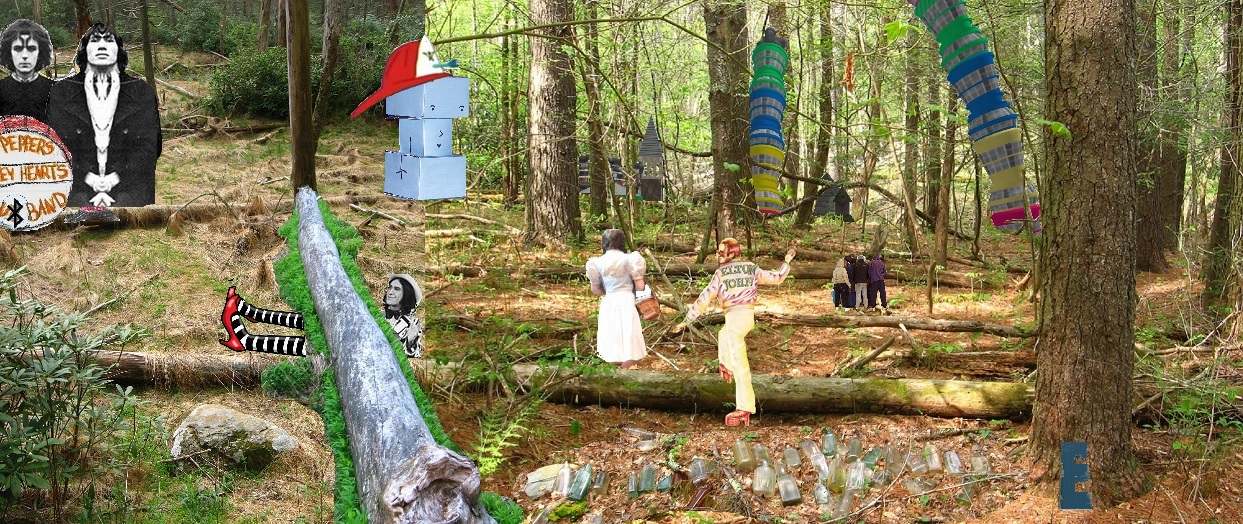
collage61part02c

“What do you think?” I replied.

“Feet (pointing)… death… red ruby slippers. red fireman’s helmet. Fits (!)”

How observant, I thought. Like talking to myself. I smiled.

“Well, maybe the big green lined log of the picture is the Mississippi River itself… herself. Miss Tippy.

He kept looking at the picture, and then started pointing once more. “Dorothy has no bottom of her legs, donated to Day Ravies.”

“He might still show up,” I added hopefully but doubtfully at the same time.

“Elton also has ruby slippers or ruby sparkly shoes,” Hucka Doobie observed.

“They cross a perpendicular log to the green lined log,” Roger tacked on. “Maybe a tributary of the Mighty Mississippi?”

“Maybe all three logs — main logs of the picture — are representations of the Mississippi. Fireman Peanut balances on the one further back. Ruby slippered Day Ravies is crushed by the one perpendicular to the other two, and the Elton John cross, again in ruby slippers the 3rd more in the foreground. The same one that cuts off or obscures Dorothy’s own slippered feet.”

“Elton is certainly in better shape than Day Ravies here. He is able to cross atop the log. It acts as no real obstacle in his journey. Peanut also seems content, perched upon a parallel log in the background. His head is covered with a red helmet, but he has no feet. Elton and Dorothy provide his feet.”

“It’s Peanut’s Big Adventure after all,” Hucka Doobie chimed in. “Part Deu.”

“Two.” Roger shrugged at me.

—–

“Everyone has only one head but also almost everyone has 2 feet and not just a foot. Foote.”

(to be continued?)

1 Comment

Filed under MAPS, Mississippi

I know…

… that the man or men who like to be called Rogers Pine Ridge will arrive at our humble abode the first of next month. Which one it will be I have no idea, and perhaps it’s like schrodinger’s cat. Only when I open the door to greet him will one or the other manifest in our reality. That’s fine; I have things, I believe, to talk to both about. I’ve asked Hucka Doobie to join me that night.

“I have a feeling they don’t entirely like each other, Hucka D.”

Hucka D.:

One will bait the other just like in SID’s 1st Oz. One will be forced to listen to the other, like a series of inevitable and unchangeable tiles one stacked upon another. 1 and 2 are discarded up front, starting us with 3. Roger will ask why? Why start with 3 and then use *everything* from then on? We’ll have to talk of Baker’s Creek, Mississippi, baker b. That’s the Body of Waters. I’ll install a secret microphone on the couch so we’ll catch everything. Who’s Emily? (etc.)

—–

http://en.wikipedia.org/wiki/Manchester,_New_York

Manchester has a strong place in the history of the Mormon religion, as it is believed to be the place where the prophet Joseph Smith discovered the sacred Golden Plates. An Angel Moroni statue is located near NY-21.

—–

http://en.wikipedia.org/wiki/Cumorah

http://en.wikipedia.org/wiki/Comoros

collage42test14cffh

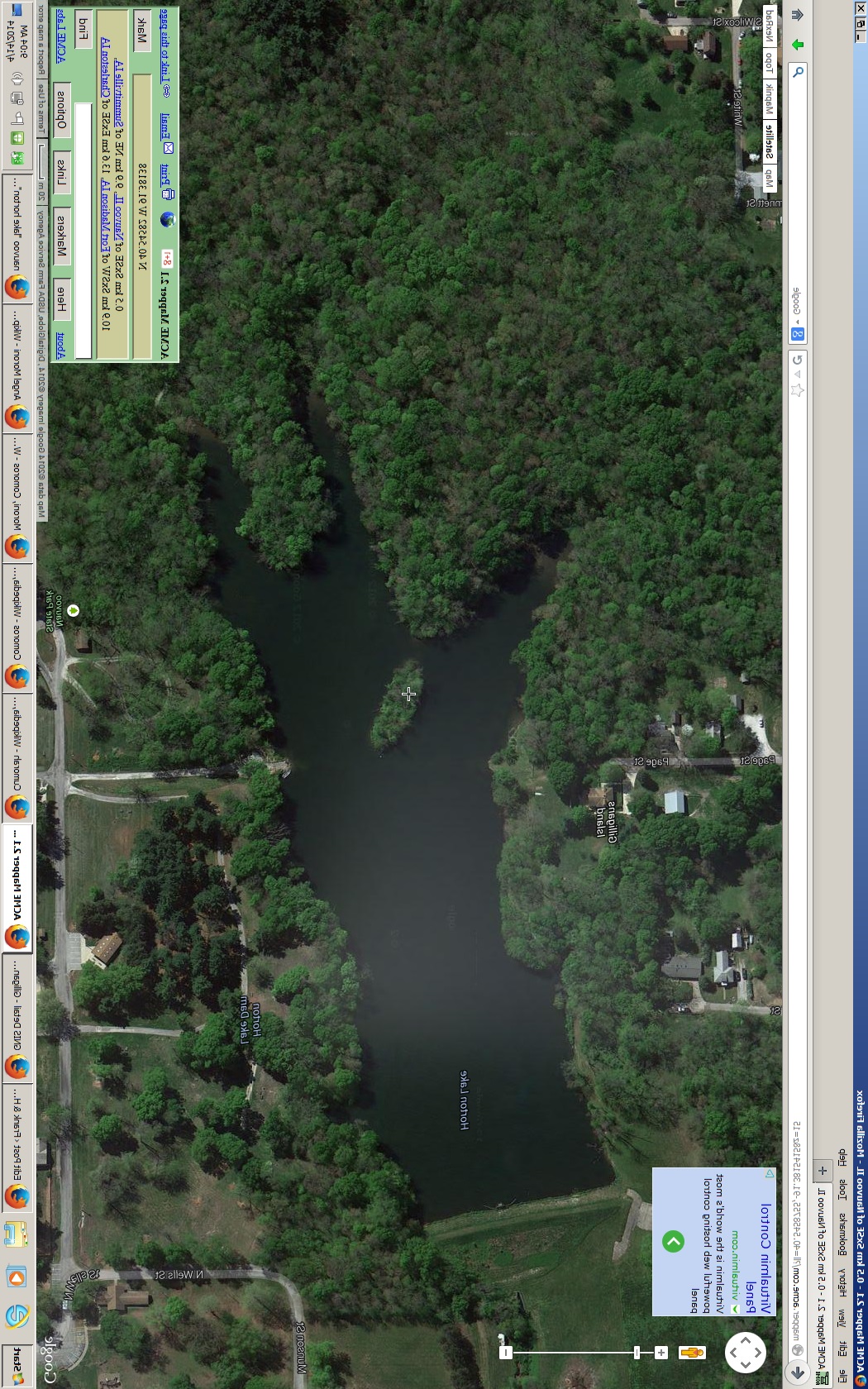
What message is being sent here? Mr Beam as the same as Lake Horton?

collage42test14cffi

Gilligan’s Island was the scene of a radioactive scare in the 1960s.

What portals are opening up even now?

This might have to do with 4orrin1.

I haven’t really done any work on The Shining since early February, when all that energy seemingly was incoporated or summarized in the Shining Pyramid of Sgt. Pepper — the Shining Pepper Project.

Gilligan’s Island, Lake Horton is THE BANDAID.

hand_bandaid

“Thumb released to reveal. This is Fal Mouth.”

“Thank you.”

“The bandaid is healing. You are healing.”

—–

“There is no doubt that[ “bandaid”] is an island, Hucka D. Hucka?”

—–

“Whatever, there is a giant hand in the middle of Nauvoo, Illinois, which stands for Kubrick’s hand which stands for Jack’s hand which stands for Omega… End. It’s a hand in the shape of lake… lake in the shape of a hand, I mean. The island is the band aid. Hucka?”

“Wild Goose Island. Two in One. 4orrin1.”

“Thank you.”

—–

lakehorton

“He used Hancock County as a continuation of his Shining puzzle. Clue is Denver conjunct Chili, like in Torrance County, New Mexico and like in another US county. Is it Kubrick? In a way it has to be.”

comorosflag

http://en.wikipedia.org/wiki/Flag_of_Comoros

The design consists of a white crescent with four white stars inside of a green triangle. The flag has four stripes, representing four islands of the nation: yellow is for Mohéli, white is for Mayotte (claimed by Comoros but administered by France), red is for Anjouan, and blue is for Grande Comore. The star and crescent symbol stands for Islam, which is the nation’s major religion.

Leave a comment

Filed under Illinois, MAPS, New York

“Hucka D…

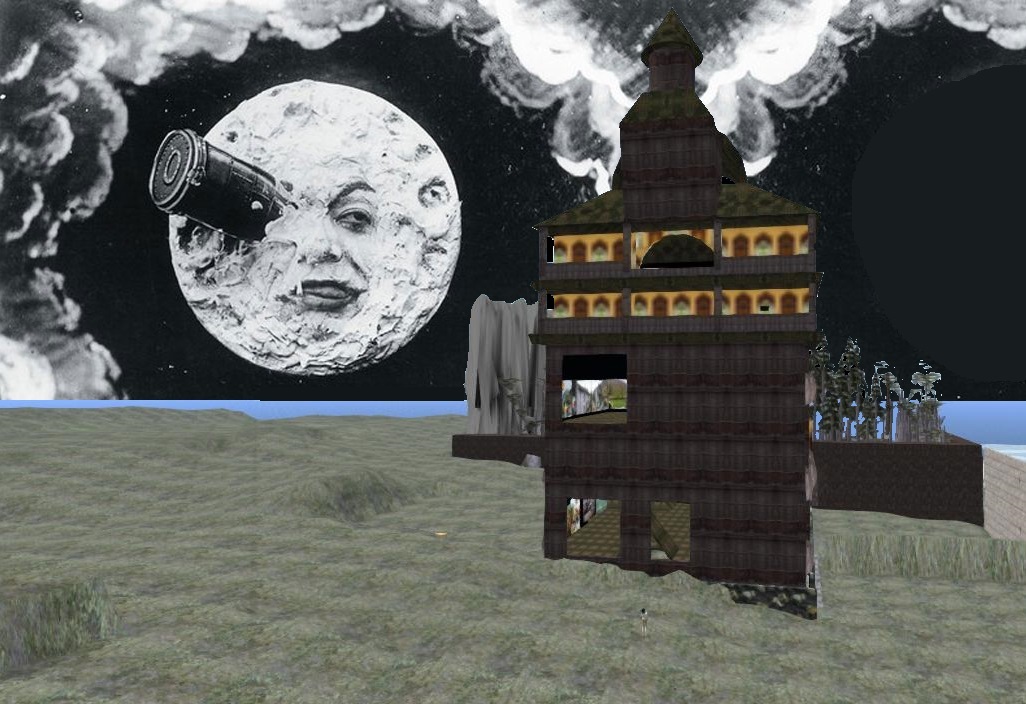
… I think the Falmouth collages can be basically divided into 4 parts. There’s the Steptoe Butte animation part that takes up the basement of the gallery — that’s 6 collages if separated from the overall animation — then there’s the collages leading up to Falmouth 25, the first Stonethwaite related one. Then we have Falmouth 25 – Falmouth 43, where Stonethwaite dominates, and I including the surrounding countryside like Greenup Gill and Dock Tarn with this, and then to top it off we have Falmouth 44 through Falmouth 61 now, dealing mainly with Whitehead Crossing. To me, the latter is a brand new type of collage, dealing with local, to me, base images and interacting with the blog mythology more directly. Whitehead Crossing has become a central crossing. Associable, for example, to the crossroads of Clarksville, Mississippi in Coahoma County. The infamous, some say, 61 x 49 crossroads where bluesman Robert Johnson sold his soul to the Devil. Fal Mouth Moon gallery housing the entire set of Falmouth collages on its 7 floors, if we *count* the basement, has been psychically aligned, perhaps, with Williams’ Moon Lake Hotel. Remember when the rocket launcher was located within this building that took VWX Town residents and visitors directly to The Moon?

Snapshot8001_002d

http://articles.philly.com/1993-03-14/news/25952390_1_mississippi-dotson-rader-restaurant

—–

Hucka D.:

Who is Mr. Dundee?

bb:

Owner of the Fal Mouth Moon?

Hucka D.:

Is it his castle?

bb:

How does he change collages into paintings?

Hucka D.:

Is that the selling of the soul part?

Leave a comment

Filed under **VIRTUAL SL

Miss Tippy 01

http://en.wikipedia.org/wiki/Coahoma_County,_Mississippi

Clarksdale is now the largest and most important city in the county, and was named for John Clark, a brother-in-law of Governor James L. Alcorn, whose home, Eagle’s Nest, was in this county.

http://en.wikipedia.org/wiki/James_L._Alcorn

James Alcorn was elected by the Republicans as governor in 1869, serving, as Governor of Mississippi from 1870 to 1871. As a modernizer, he appointed many like-minded former Whigs, even if they were now Democrats. He strongly supported education, including public schools for blacks only, and a new college for them, now known as Alcorn State University.

Although a former slaveholder, he characterized slavery as “a cancer upon the body of the Nation” and expressed the gratification which he and many other Southerners felt over its destruction.[5]

http://en.wikipedia.org/wiki/Friars_Point,_Mississippi

Friars Point is one of two hypothesized locations where Spanish explorer Hernando de Soto may have crossed the Mississippi River (the other is Commerce, Mississippi).[1]

The town was founded in 1836 and originally called “Farrar’s Point”. When the town incorporated in 1852, its name was changed to “Friar’s Point” to honor Robert Friar, an early settler, legislator, and businessman who sold fuel to passing steamboats. In 1850, the county seat was moved from the nearby town of Delta to Friars Point.[2][3]

Strategically situated at a bend in the Mississippi River, Friars Point flourished before the Civil War as the largest shipping center for cotton south of Memphis.[4]

Friars Point was also home to Confederate Brigadier General James L. Alcorn, whose grave and former plantation, Eagles Nest, are located a short distance east of the town.[7] Alcorn turned from Whig to Republican after the war, and went on to become Governor with the support of the large number of carpetbaggers who had settled in Friars Point.[4]

Charles Lindbergh ran out of gas while flying his plane over Friars Point in 1924, and landed at a place he later called “The Haunted House”.[5][6]

As nearby Clarksdale grew in population and influence, it challenged Friars Point’s hold on the county government. In 1892, Coahoma County was divided into two jurisdictions, one going to Friars Point and the other to Clarksdale. In 1930, the county seat was given exclusively to Clarksdale. Historian Lawrence J. Nelson wrote that by that point, “Friars Point had receded into a sleepy river community.”[4]

Time Magazine wrote in 2013:

Once a thriving port town and the county seat, economic decline has left Friars Point with a lone elementary school, a few churches, a city hall, a post office, a small general store, a museum that opens only sporadically, a nightclub called Show T Boat where a man was shot to death in 2011, and a bank. The town no longer has a doctor or health clinic, a drug store, a sit-down restaurant, a recreational center, a library, or any businesses to speak of. Kids travel 15 miles to Clarksdale for junior and senior high school.[9]

Muddy Waters said the only time he saw Robert Johnson play was on the front porch of Hirsberg’s Drugstore in Friars Point. A crowd had gathered around Johnson, who was playing ferociously. “I stopped and peeked over,” said Waters, “and then I left because he was a dangerous man.”[10][11] In a 1937 recording, Johnson sang, “Just come on back to Friars Point, mama, and barrelhouse all night long.”[12] In Johnson’s Traveling Riverside Blues he sang, “I got womens in Vicksburg, clean on into Tennessee, but my Friar’s Point rider, now, hops all over me.”[13]

Friars Point has been written about by both William Faulkner and Tennessee Williams. At various times, both writers had vacationed at Uncle Henry’s Inn on nearby Moon Lake.

Notable people:

Conway Twitty – country music singer who once held the record for having the most number-one-hit singles.[7]

Deupree’s Historic Homes: Eagle’s Nest

Eagle’s Nest

The home of James L. Alcorn, in Coahoma county, received its name in a most natural way; an eagle had built her nest for many years in a large cottonwood tree in a field adjoining the park which surrounds the residence. In alloting work to the plantation laborers the supervisor spoke of it as the Eagle-nest field, thus the plantation and the home became known as “Eagle’s Nest.” There are several nests of these birds in the cypress brakes just back of the buildings.

The home is a large modern frame structure. The lumber was cut from the forests on the plantation, and dressed by hand under the supervision of Gen. Alcorn. The house has five wide halls, twenty-two large, high ceiled rooms, made home-like and cheerful by ingle-nooks, cozy corners and numerous broad windows. Three bay windows open on the blue waters of the lake on which the home fronts. Broad verandas extend around three sides of the house; the whole surmounted by an observatory commanding a view of beautiful Swan lake, the park, and the broad fields of corn and cotton, the whole making a pictures never surpassed in natural beauty. Mrs. Alcorn tells the following interesting story as to the way the lake received its name:

“In the early days it was a feeding ground for numbers of wild swans. A huntsman on one occasion shot, and broke the wing of one of these graceful birds. It could never again leave the lake; year after year it welcomed the coming of its fellows with glad cries, and pined in sorrow when they plumed their broad wings and took flight for new feeding grounds; it was pitiable to see its efforts to follow. Since then the pretty sheet of water has been called Swan’s Lake. Upon the shore of this lake stands the tree in which the great eagle mentioned above built her nest. She showed both judgment and taste in the selection of a home; for the waters of the lake furnished an abundance of food for her young, and the view is one of unsurpassed beauty.”

The axmen were directed to leave that tree untouched when the field was enlarged by clearing the southern part of the park; but the careless, thoughtless, destroyer of the forest, regardless of orders belted this monarch of ages. The grounds immediately about the house are shaded by large oak, magnolia, holly, and varnish trees. The gardens are gorgeous with bloom from the coming of the dainty snowdrop and purple violet of spring to the asters of the late autumn. In the park, near the southern limit, is a large Indian mound, and on this mound sleeps James L. Alcorn, his grave marked by a marble statue of himself. Near by rest the remains of four sons. Two died in defense of their home and country. Major Alcorn, the eldest, was as brave and true a soldier as ever went to the front of battle. Henry, the second son, then a lad of seventeen years, captured and taken to Camp Chase, contracted typhoid fever and died on the way home an exchanged prisoner, and now sleeps beside his father on the old Indian mound. The wide halls and lofty rooms of this stately home that once echoed to the tread of busy feet, are now silent, and deserted by all save the widowed mother.

Publications of the Mississippi Historical Society, Vol. VI (1902), pp. 249-250.

http://en.wikipedia.org/wiki/Moon_Lake,_Mississippi

Tennessee Williams visited Moon Lake Casino, and referred to it in all but two of his plays.

Yes, the three of us drove out to Moon Lake Casino, very drunk and laughing all the way.
—Blanche DuBois, A Streetcar Named Desire

William Faulkner also visited the place, and referred to it in one of his novels as “Moon Lake Hotel.”

Question: Is the Fal Mouth Moon (gallery) a direct relative of this Moon Lake Hotel? Remember that it served as a conduit to VWX Town’s The Moon during its Rubi incarnation. Falmouth Hotel is also an inworld famous haunted spot in Bay City.
I believe Moon Lake refers to the American Moon Landing, because the largest island of the lake is Texas (Misson Control location) and the other large island is Alcorn Island, named for James Alcorn of Eagle’s Landing. Remember “The Eagle has landed”.

http://www.urbandictionary.com/define.php?term=Eagle%20has%20Landed

part of speech: idiom

Originally used by Neil Armstrong when the first man-made craft (the “Eagle”) landed on the moon, now used to indicate the completion of a “mission objective”.
1. Neil Armstrong: Houston, the Eagle has landed.

2. Criminal #1: Are you inside?
Criminal #2: The Eagle has landed.

3. Jim: So, did you sleep with Allison yet?
Tim: Dude, the Eagle has landed.

Leave a comment

Filed under MAPS, Mississippi

“Peanut’s Big Adventure” 03

collage61part02c

Leave a comment

Filed under collages 2d, Frank Park, Whitehead Crossing

“Peanut’s Big Adventure” 02

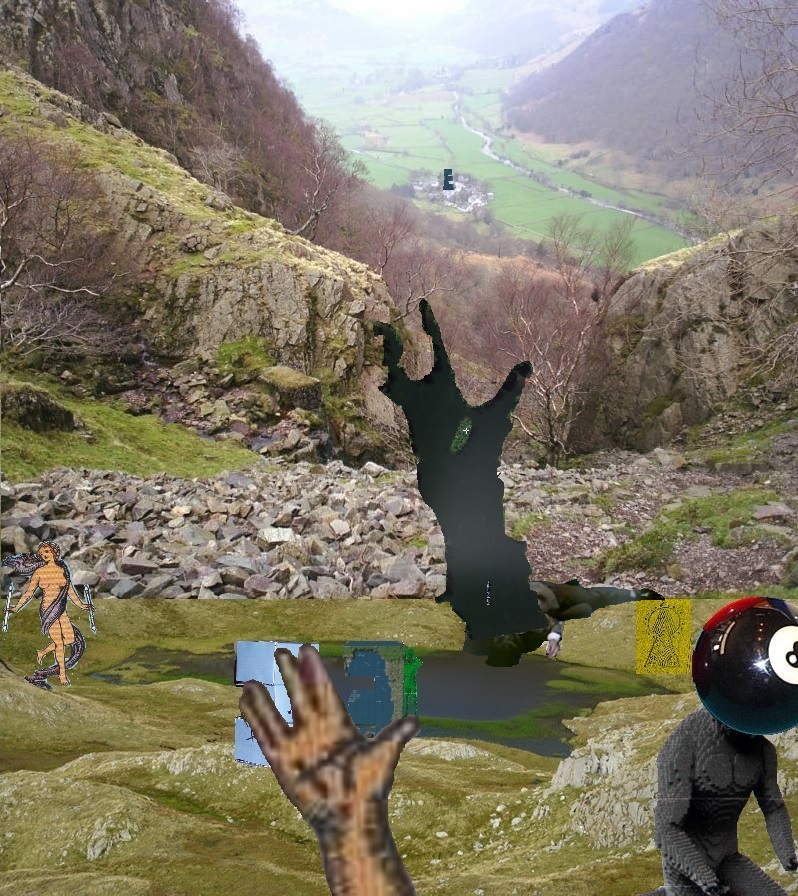
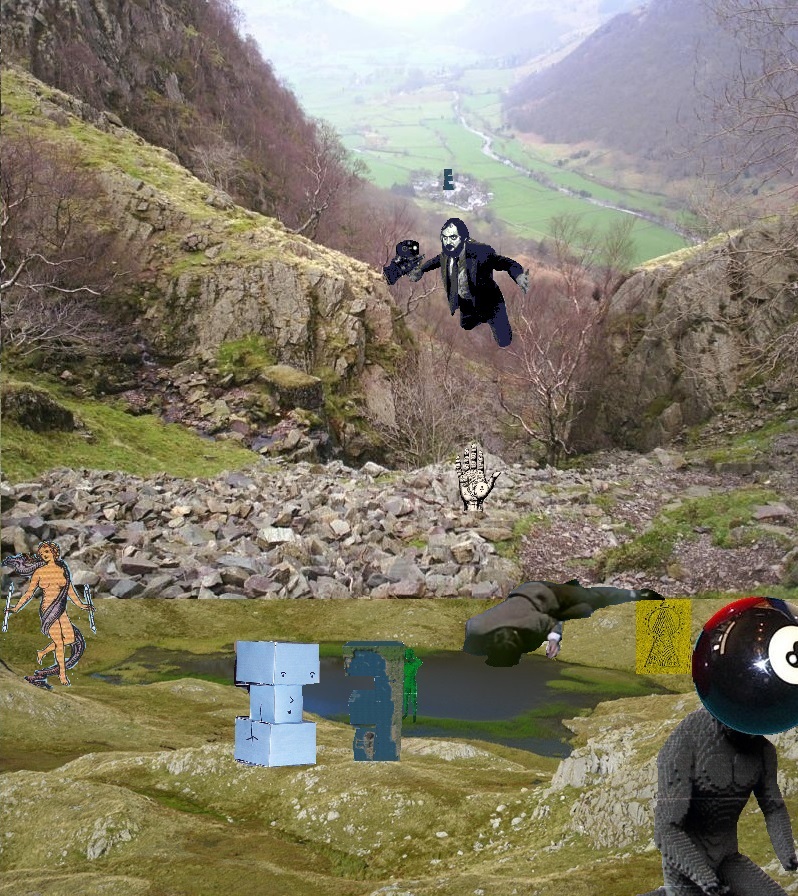
“Why would Kubrick attempt to cover what they’re saying up?”

collage42test14c

—–

Hucka D.:

Maybe he wants to reveal the correctly facing “E” above the Stonethwaite village below. Stonethwaite has already been assoc. with that letter[ in the Falmouth collage series]. It doesn’t belong up here at the Tarn of Leaves. Or is this exactly where it belongs? Another Muff conundrum.

bb:

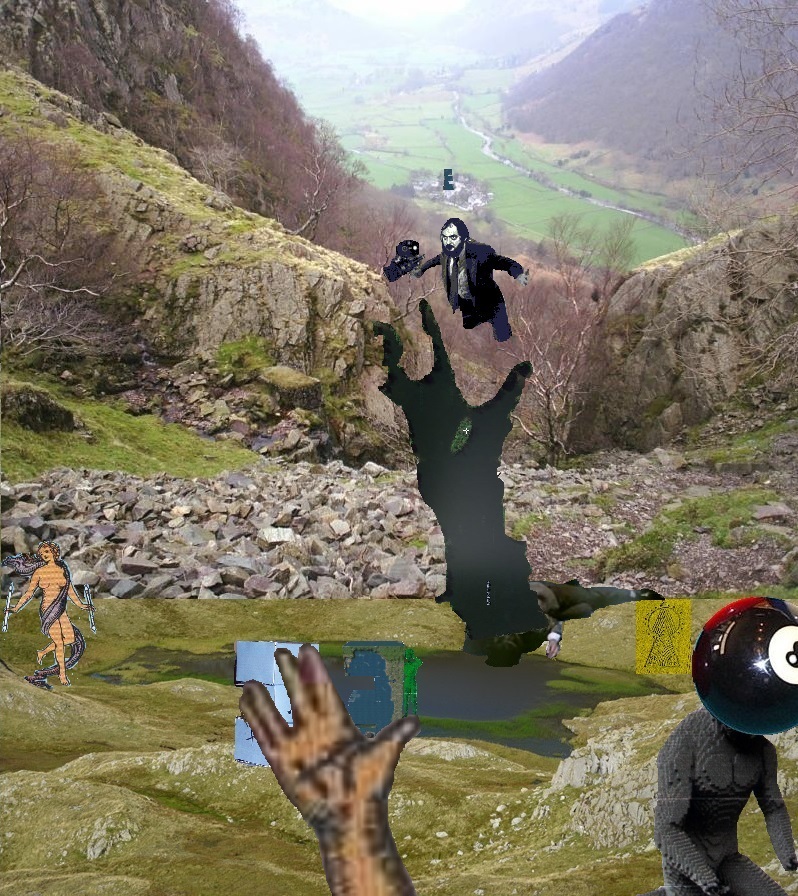
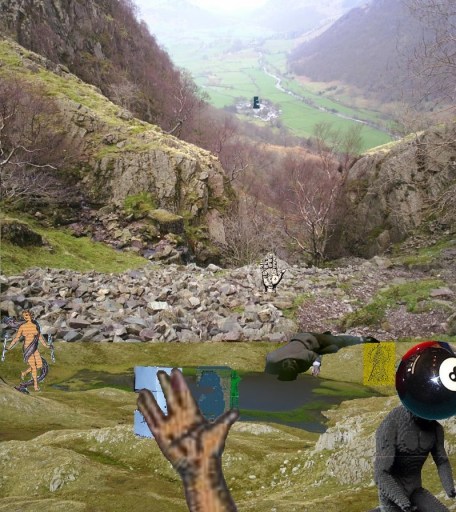
Mr. Beam appears to have been drowned in the Tarn of Leaves, Hucka D. I don’t think he’s just bending down to drink the water.

Hucka D.:

We don’t know[ either way].

bb:

His foot, important in other collages, points to a yellow, key shaped crop circle, Hucka D. This is part of the TILE colors of the collage, starting with the red reflection on the 8 ball, which we know is symbolic of the fireman’s helmet again, then the yellow crop circle picture, then the green man mirroring the green algae of the Tarn of Leaves [its “leaves”?] and then the blue of the Big Schwa and also the blue Peanut cardboard figure beside this. TILE, then.

Hucka D.;

Peanut should not be exposed here. Cover [it] up. (pause) You must move down from the Tarn of Leaves back into Stonethwaite village… only way. You are so far away now — can barely see it. There[ in Stonethwaite village] you can right the wrong of the Big Schwa, pointed the wrong direction. You can turn it around. Only way.

bb:

I’m curious about the 8 ball. Black hole?

Hucka D.:

Kubrick is helping you erase the past. He knows about cameras. He hides[ with his Devil Hand]. Things can turn around. Kubrick found you and is making repairs.

bb:

Why doesn’t Peanut cardboard figure not need to talk to the Big Schwa?

—–

Hucka D.:

Here’s another related collage[ to switch the subject].

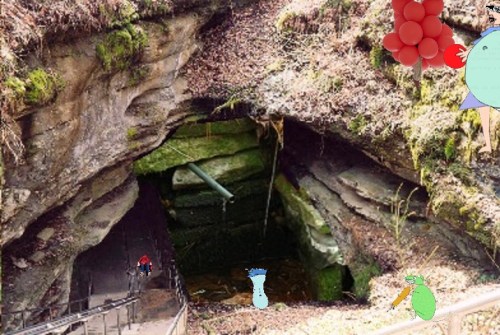
collage50test15

bb:

I believe this is the only other appearance of Rhoda in the Falmouth series. Oh… Rhoda, Kentucky (!)

Hucka D.:

(!)

bb:

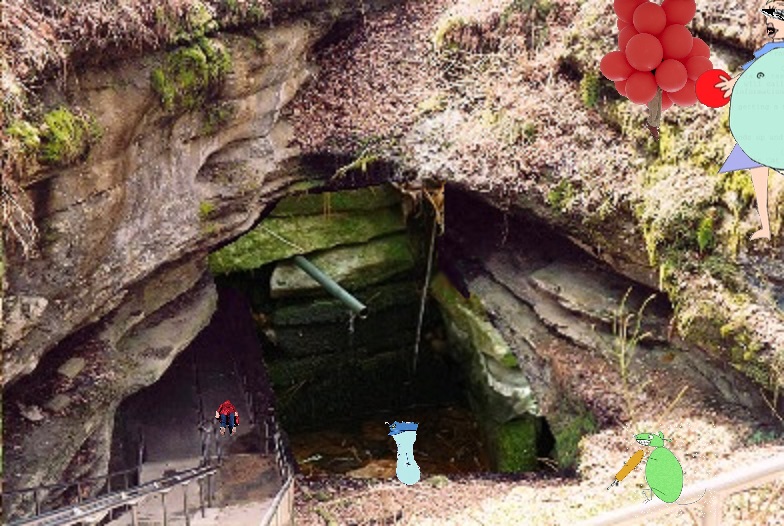
Near the entrance to Mammoth Cave. So it *is*[ referring to] that Rhoda.

Hucka D.:

Of course. Like Skillet, Shark, etc. before it. Or after it. “Where’d Muff go?” (laughs at his own imitation of Roostre).

bb: (snicking as well):

In the newest collage, Rhoda and Man/Woman are overlapped, instead of beside each other [in “Clock Rock”]. About all of the 12 Oz Mouse characters appear in “Clock Rock”, Hucka D. A great gathering. And same same goes for the following as yet untitled collage, but Peanut, in the meantime, has changed into the Big E on the shores of Dock Tarn. He can do that.

Hucka D.:

He can do that. He *can* do that.

bb:

Also in this collage, Mouse is wearing Peanut’s fire helmet, complete with dart. He reads a note with the same kind of dart pictured, and the two darts line up with each other. They are the same. But you can’t make out[ in the collage] what the note says.

Hucka D.:

It says “Good bye”. Goodbye!

—–

bb:

Thank you for returning, Hucka D.

(to be continued?)

Leave a comment

Filed under **VIRTUAL SL

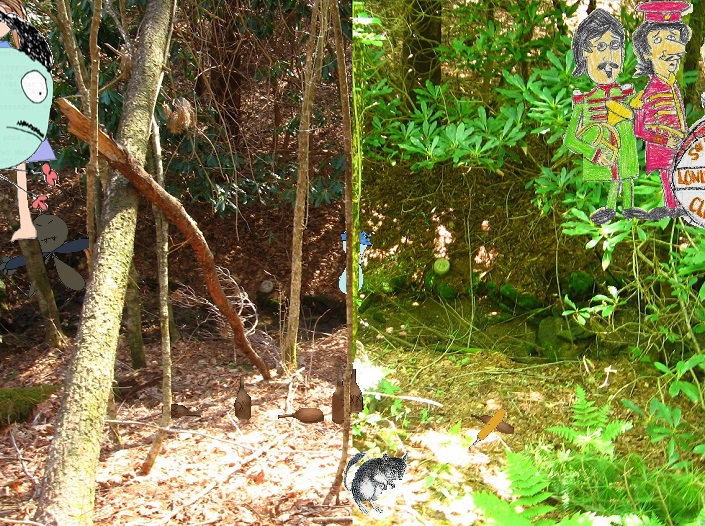
“Peanut’s Big Adventure”

Part 01:

collage61part01f

Part 02:

collage61part02f

Part 03: Coming soon.

—–

“Peanut seems to have found a body covered in a red sheet, Hucka D. The same body that appears floating off the edge of the Little Whitehead rocks of Maine in an earlier collage. We’re up to Falmouth 61, which I would have deemed impossible as short as a couple of weeks ago. Is **this** it?

Hucka D.:

No. Check more Whitehead Crossing photos. Why does it always end up at 12 Oz Mouse? Well… the carrcasses.

bb:

Thanks, Hucka D. Mouse looks on with his corndog. Does he know the story of the body? This takes place at the entrance to Mammoth Cave, which is the same as the entrance to the old bee hive — *your* old bee hive, Hucka D. So you should know all about this.

Hucka D.:

Yes, I do. But I can’t say much except what’s before you.

bb:

Meaning what’s in the collage.

Hucka D.:

Yes.

—–

bb:

So is *this* a carrcass?

Hucka D.:

Yes.

bb:

Is it a carrcass that has already been completed?

Hucka D.:

It’s already done.

bb:

Then Carrcass-1, Carrcass-6.

Hucka D.:

Both of those. And more.

—–

bb:

So in part 2, he’s in the very center of the collage length-wise, crossing from winter or early spring into summer, kind of like Dorothy entering color laden Oz from sepia toned Kansas.

Hucka D.:

Exactly like that (!)

bb:

Is he high?

Hucka D.:

What a question[ to be asking], given that this is Peanut we’re talking about.

bb:

Of course.

Hucka D.:

Rhoda… you go.

bb:

Rhoda appears to be peering through a telescope-like branch at the ground. Getting small?

Hucka D.:

Yes. And seeing Jupiter and its moons. Branch — telescope, yes.

bb:

So it’s Issac Newton’s telescope. Sorry — Galileo’s. The one he used to first peer at the Jupiter disk and the 4 primary moons.

Hucka D.:

Yes.

bb:

He switches from black and white to color, like The Beatles did between Revolver and Sgt. Pepper. About the time of the double single Strawberry Fields/Penny Lane.

Hucka D.:

Right.

bb:

An “X” appears on the ground. 2 crossed corndogs, one sepia toned and one yellow or in color, since — that’s the corndog’s natural color.

Hucka D.:

Correct. Okay.

bb:

Peanut is situated between two pots which are actually the same pot, reinforcing a drug reference or pointing it out in the first place.

Hucka D.:

You better be careful of that transition. Sepia to color. Follow Peanut.

bb:

Peanut hides behind that small tree, which is both b&w and color at once.

Hucka D.:

Best to stay hidden.

bb:

And Skillet, Mouse’s closest friend, below him. Checking out, perhaps, the crossed dogs. Whitehead Crossing?

Hucka D.:

Yes. Future.

bb:

Getting high, like the balloon man is going higher and floating away from the cave mouth.

Hucka D.:

“Everybody’s Scared” is about the same cave[ perhaps]. The cave of R. Booger Hayes.

bb:

Getting back to part 1 here, Mouse is yellow and green, a contrast to the red and blue body lying within the cave. Peanut is positioned between the 2. Peanut… you go? I’ll go. Peanut has been in a lot of Falmouth collages now, but has never appeared up until now with his more natural police hat. Wearing it makes him a policeman, like wearing a fireman’s hat makes him a fireman. But in both sections of “Peanut’s Big Adventure” so far, he’s the policeman. Contrast this to, let’s see… (checking) Well, it doesn’t have a name but it’s where Peanut as fireman meets the cardboard Peanut in the middle of the Stonethwaite street. At the same time, his [Texaco] star is reinforced by Ringo Starr, and also Shelly Duvall wears the same fireman’s hat beside Ringo. It’s filled with darts. That is, Peanut is drugged at the time, and the same with Shelly, perhaps. Let me pull up the collage…

collage32real01

Peanut then reappears in “Coverup” in cardboard cube form, sans any type of cap or helmet. He’s just Peanut there, not fireman or policeman, then.

Hucka D.:

But he’s also not Peanut. He’s [just as much] the Big E or Big Schaw beside him, conversing with it, perhaps, like he conversed with real (fireman version) Peanut in Stonethwaite, now far below on this mountain but still viewable [beneath second “E” of this collage].
collage42test14

—–

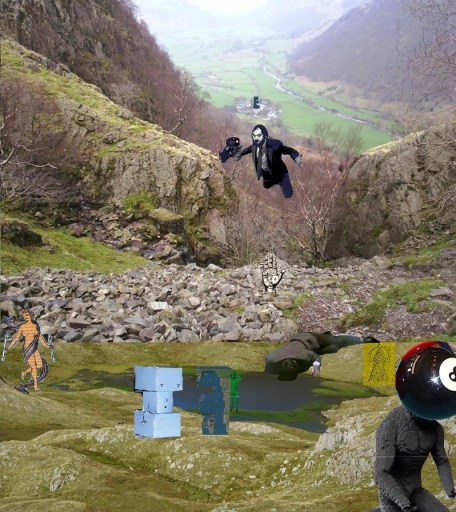
“Why would Kubrick attempt to cover what they’re saying up?”
collage42test14c

(to be continued?)

Leave a comment

Filed under collages 2d, Frank Park, Whitehead Crossing