Category Archives: Carrcass Artists

SID’s 1st Oz

baker b.’s personal synch journey through the golden age of synching, part vi of vi (we’re done!)

I wanted to go ahead and finish the series off this morning if possible. I’m sorry to disappoint some of you but I’ve decided not to post a link to the video files this go around. I can send them to you individually through messaging if you wish. I watched most of SID’s 1st Oz yesterday while the wife was in class, but fell asleep before reaching the end. I was still impressed by the power of the first half, however. It’s just that I had a full stomach and also was drinking some wine. You know how that goes.

A little bit of background. I served as administrator for a co-op forum called The Film/Album Synchronicity Board from about June 2000 until Sep 2002. I remember the last month especially because it was when my father died. An end in more ways than one. Walt SIDney’s Fantasia 2000 and Horton Hears The Who lie on the near side of this end, while The Point of The Wall and SID’s 1st Oz came after it, or Nov. and Dec. 2002 approximately. In looking at SID yesterday and seeing Dorothy re-enter Oz after crossing the Deadly Desert again to the accompaniment of Jethro Tull’s A Passion Play album, I was reminded what this synch might be most about, and that’s the subject of death. Namely Oz = death, The End. Or, more specifically, the afterlife.

I don’t have a SID’s 1st Oz website to fall back on in this case, unfortunately. I’ll have to describe it as briefly as possible. We’re dealing with 26 base tiles here, or almost 3x the amount of what I’d used in any synch up to this point. Four artists are employed: Jethro Tull, Queen, Roger Waters (1st solo album; with Ron Geesin) and Syd Barrett (1st solo album as well, plus 3 of his Pink Floyd tracks). The works of these artists are not isolated in big blocks this time, like Walt SIDney’s F2K, but are woven into each other to create a larger whole. And like with Pink Vertigo, Horton Hears The Who and The Point of The Wall, an overall storyline is highlighted. Aiding this cause are numerous bleedthroughs of dialog from the Return to Oz movie, many more than what appeared in MessiaenSphere. I’d say there might be close to 50 of these without an actual count.

Center is strongly emphasized, carrying forth or transposing the strong center of the Passion Play album (the enigmatic Hare Who Lost His Spectacles tale). That’s different as well. And unlike Horton Hears The Who and The Point of The Wall, I didn’t just pick and choose tracks to match the video. They are inserted into the synch in almost the same chronological order that they are found on the albums. 1 artist is bonded to 1 album in this manner (except for Barrett and the early Pink Floyd stuff). SID’s 1st Oz is also divided into 4 “regions”, each with similar qualities. It’s a difficult synch to describe without illustrations. I’ll direct the more curious here until further notice:

http://www.appstate.edu/~brittanma/paradox/paradox15.html

I was also speculating this morning about “what ifs”. What if I decided to keep The Film/Album Sync Board going and attempted to push the envelope and raise audiovisual synching to a higher ground. Perhaps a more polished, more accessible SID’s 1st Oz could have helped some. If we hadn’t been beaten down by copyright issues… But I decided it all had to be let go of. And I believe a part of me died there as well. Slowly but steadily, you recover and move on. That’s another series altogether, probably for a different arena.

So let’s just see what happens next, shall we? πŸ™‚

Thanks a bunch,
baker b.

Leave a comment

Filed under Carrcass Artists, SID's 1st Oz

Rock Operas

Part v of vi of the series describing baker b.’s personal journey through the golden age of synching… coming at ya! Former parts here:

https://bakerbloch.wordpress.com/category/carrcass-artists/

We remain in 2002 for the twinned synchs Horton Hears The Who and The Point of The Wall, created about 4 months apart during the second half of the year. Both employ a famous rock opera on the audio side, and perhaps the 2 most famous: The Who’s Tommy and Floyd’s The Wall respectively, both double albums. The dubbed videos are “Horton Hears a Who!” and “The Point”, two lower grade animations from 1970 and 1971. In each case the album is edited to scenes from the film. The main difference is that the base film for Horton Hears The Who remains unbroken and whole in the synch, while The Point is edited to fit The Wall as well as visa versa. Otherwise the two synchs are quite similar to each other, with parallel climactic moments.

Horton Hears The Who has 6 separate tiles. The Point of The Wall is a bit more complicated with 9. Each are similar in length (approx. 25-30 minutes). These are more compact and somewhat less ambitious works that either Pink Vertigo or WSF2K. The strength is an attempted fused storyline between audio and video. The editing is a bit rough as this is all analog generated still, so apologies for that — hope it doesn’t detract from the overall experience. See what you think.

Next up: the final part featuring SID’s 1st Oz; where it was all heading…

password: synch
https://www.dropbox.com/sh/642ntpd6l3zh7lc/AAASpdCW6W8IGjC2GNgvFz04a?dl=0

Leave a comment

Filed under Carrcass Artists

WSF2K

Part iv of vi relaying baker b.’s personal journey through the golden age of synching (1997-2003 or so). Parts i-iii are here…

https://bakerbloch.wordpress.com/category/carrcass-artists/

Our trip brings us now to Walt SIDney’s Fantasia 2000, which represents another step up for me at least in terms of producing an obviously synchy and quite watchable work. Like Pink Vertigo, this is an attempt to tile a complete or equivalent complete movie with audio. Unlike PV, devoted to Pink Floyd alone (albeit tracks from a number of their albums), WSF2K cracks open the barn door a bit more to allow artists like Nirvana, Stevie Wonder, Radiohead, Paul McCartney, and Electric Light Orchestra to enter and join in the fun, in addition to, yes, a pretty hefty dose of Floyd at the end.

I was pleased to find an old website on the subject last night, so perhaps I won’t have to yammer on as much about this one. Check it out here if you wish…

http://www.appstate.edu/~brittanma/oldersites/wsf2k.html

http://www.appstate.edu/~brittanma/oldersites/wsf2k1.html

Here are the lyrics for the various tracks…

http://www.appstate.edu/~brittanma/oldersites/wsf2klyrics.html

Some key ideas:

WSF2K evolved directly out of Shared Fantasia, the latter which I consider a pivotal work in the golden age of synching for certain. I was pretty shocked to find out I could create a virtual double or twin in so short a span (3 nights). 10 cues are involved, with the last cue spanning 2 animation segments and playing right over the gap where Angela Lansbury is introducing the last one. Interestingly, that final animation, dubbed by the Floyd song “Sorrow” (original music: Igor Stravinsky’s “Firebird Suite.”), may represent the best stretch of synchronicity in WSF2K and one of the best I’ve been able to produce in my own work. Yet since the cue of this tile comes in the animation before it (which also works quite well in and of itself), the section can be viewed as being further away from manipulation or *synchronization* than anything else in WSF2K; ironic juxtaposition, then. Synchronization and synchronicity become more mixed up here and hard to surfacely differentiate.

The weakness of WSF2K, and by association, Shared Fantasia, is the lack of an overall storyline, like we had in Pink Vertigo. The animation blocks in both Fantasia and Fantasia 2000 are separate from each other and do not weave together in any way except through commentary. We’ll deal with this issue more in the next part of my personal journey through the golden age of synching: “Rock Operas”. See you then!

password: synch
https://www.dropbox.com/sh/f7q60xyq2hptrmy/AADpis9nsx6KLPKrwsALedr8a?dl=0

Leave a comment

Filed under Carrcass Artists

Pink Vertigo

Facebook:

Previously:

part i:
https://bakerbloch.wordpress.com/2015/03/10/23204/

part ii:
https://bakerbloch.wordpress.com/2015/03/11/messiaen/

Part iii (of vi, I believe) of baker b.’s personal journey through the golden age of synching brings us to Pink Vertigo, a still solid looking early synch from late 2001. PV represents my first attempt to tile, with various cued regions, a whole movie or equivalent whole movie. This would be Alfred Hitchcock’s enigmatic Vertigo, which some rate his best. Personally I would select Rear Window for that title, but — apologies to Nightmare Before Christmas and The Wizard of Oz — Vertigo is still probably the best film I’ve worked with on a synch to this point. I think the jump up in complexity here is, in part, an attempt to match or resonate with the energy Hitchcock put forth in this masterwork.

We have not 1 cue (MessiaenSphere/ Piper’s Nightmare Xmas), not 2 (Full of Secrets), not 3 (Messiaen Trek), but 9 now in Pink Vertigo. The first tile I found in the synch would be the cue between the title sequence of Vertigo and the 1st track from Pink Floyd’s soundtrack album “Obscured by the Clouds”, which many consider the best among their several offerings of this kind. This would also become the first tile of the completed Pink Vertigo synch. The following 8 cues/tiles came in a bunch a bit later. These are their conditions:

1. Use the *first track* from all of Pink Floyd’s pre-Dark Side of the Moon *studio* albums *except Ummmagumma* to equivalently tile the movie Vertigo in a front to back fashion.

In order, these early Pink Floyd studio albums (minus soundtracks) are: 1) Piper at the Gates of Dawn, 2) A Saucerful of Secrets, 3) Ummagumma, 4) Atom Heart Mother, and 5) Meddle.

2. Start at Atom Heart Mother (no. 4 studio album) instead of Piper at the Gates of Dawn and work in chronological fashion to Meddle (no. 5) then back to Piper (no. 1) and Saucerful (no. 2). Again, in the middle of the synch, as it were, we “skip” Ummagumma (no. 3), which has already been used in a baker b. synch I might discuss later.

3. Repeat the process twice in round robin fashion.

4. Although divided into a number of sections to increase royalties, I’m counting the entire Atom Heart Mother title composition as track 1 of the album. When you repeat its use in Pink Vertigo, you simply pick up exactly where the first part left off. So part 1 of Pink Vertigo employs sections 1-3 of this title track, and part 2 of Pink Vertigo uses sections 4-5. Section 6, the last, is left out of the mix.

5: One last condition: Instead of using the 1st track of A Saucerful of Secrets we are using the *last* track in this synch (“Jugband Blues”) — in both parts. This is the also the track ending parts 1 and 2 of the synch.

Sounds complex I know but it’s pretty straightforward when you look at it and if you know the Pink Floyd albums involved. Oh… one more trick. There’s a dialog bleedthrough in part of the second Atom Heart Mother tile.

See what you think. Next up: Walt SIDney’s Fantasia 2000. Thanks for reading!

Password: synch

https://www.dropbox.com/sh/s5ncax5ukodo28e/AACNM12xwdwzNLp2Vp91OHRua?dl=0

1 Comment

Filed under Carrcass Artists

Messiaen

Facebook:

Part ii of baker b.’s personal journey through the golden age of synching. Part i can be found here now… link up for several days more on that one. https://bakerbloch.wordpress.com/2015/03/10/23204/ Regarding the newest batch, we have two movies dubbed by the late music of 20th Century composer Olivier Messiaen. Classical music synchs were rather uncommon in 2000 and 2001, when these were created. Messiaen is one of the giants of the last century, and ranks pretty high on the list, I would assume, among all composers by now.

Messiaen Trek starts out with an accessible piece from Concert Γ  quatre called Vocalise, akin more to Messiaen’s early work. This is overlapped with the Enterprise entering the gargantuan V-jer cloud in Star Trek The Movie. As Kirk then roars out an additional command to go further into the cloud after some debate with others (mainly visiting Comm. Decker) we ride along accompanied by Un Sourire (A Smile) from 1989, composed by Messiaen for the bicentenary of Mozart’s death. The track is suppose to run unbroken in the synch. However, two pieces of the movie are employed here, with the second starting right as Spock’s stolen jetpack fires, flinging him toward the heart of the cloud and the encounter with an emotionless deity.

MessiaenSphere is the natural counterpart to Messiaen Trek. It’s not one I’d recommend for introducing an outsider to the world of synchronicity. It’s not as openly synchy as Messiaen Trek either (which *might* be a good introduction). But MessiaenSphere’s the complement nonetheless. At about 42 minutes it’s almost triple the time of MT. We also travel through water instead of space, but in each there is a critical and climatic encounter with an alien being, a sentient golden sphere from the future in the case of MessiaenSphere. MSphere also involves just one cue, but with some added tricks. The music is Illuminations from the Beyond (1994). Only tracks 1-2, 4-5, and 7-8 are used in the synch, with 3 and 6 cut away. The second trick is the bleeding through of 6 stretches of dialog, with the music still playing in the background.

I’ll leave it at that — see what you think. I’d definitely start with M Trek here, and then move on to MSphere if you enjoy the music and find the concept interesting. Otherwise I’d save your eyes for other synchs — don’t force the enjoyment. smile emoticon This will be up for about 7 days, once more. Enjoy if you can and if you wish!

https://www.dropbox.com/sh/16e82o7pxx6snzo/AAAnNslt1EKGk8Xya8_Qqnhka?dl=0

1 Comment

Filed under Carrcass Artists

Early Floyd

Facebook:

Okay, here’s the first batch of historic synchs by baker b. during his journey through our golden age of synching. I’ll leave the links up for about a week at a time. Again, I post these for EDUCATIONAL purposes only… I’ve NEVER made a cent off of the synching hobby that I recall. It’s a labor of luv.

To disappoint some, perhaps, I’m going to leave out the DSotR/Rainbow Sphere tension story that takes place at the beginning of my synching experience in the later 90’s, and jump into the next century with…

Piper’s Nightmare Christmas, Full of Secrets (2000, 2001)

These were created about 8 months apart as I recall, but yet they can be treated as a set. PNC is one of the first synchs that I knew about using early Floyd for the audio, in this case the Piper at the Gates of Dawn album, their first and also Syd Barrett’s showcase work. We start not at track one, however, but five: Pow R. Toc. H. This synchs quite nicely with the opening of the film. This is, in Randy T.’s words, a one drop synch in that you cue the audio and video together at a certain spot and just sit back and enjoy. You’re finished with the manipulation aspect. Let the album just play till it’s ended, through tracks 6-11. Now this is a bit different from DSotR in that I used an internal cue where the movie shifts in focus during the bridged transition between tracks 7, the fabulous Interstellar Overdrive, and track 8, The Gnome. The tracks on the far side of this are lyrics oriented, and music slanted on the near side, so the tone of the synch changes considerably as well at this midpoint.

I watched PNC yesterday again for the first time in quite a while. Like I said track 5 still works pretty great, but track 6 doesn’t have much to match with in the video. We rebound in track 7 with a nice opening, and I think that one works all the way through if you imagine that we are continually following Jack during his journey toward and into Christmastown. I personally see Jack Pumpkinhead, the star of the movie, as a Syd Barrett figure, successful as an underground star in The Pink Floyd Sound but falling into the traps opened up by more commercial success with Pink Floyd. Jack’s crazy attempts to merge Xmas and Halloween mirrors Barrett’s inability to blend fame with creative purity.

I see Full of Secrets as a direct follow up/culmination, with Twin Peaks Black Lodge as the place of descent. Like doppleganger “bad” Agent Cooper catches and replaces the good Cooper at the end of the synch/video, so Barrett loses the battle with sanity at the end, mirrored in the strange structure of “Jugband Blues” from the Saucerful of Secrets album. The center of Full of Secrets, however, is the superb title song from this 2nd Floyd album, the followup to Piper but with limited Barrett input. Again we do not start at track 1 for the synch, but 4 in this case (Corp. Clegg), and also skip track 6, See Saw, to reach the end of the synch and the album and the tv series.

See what you think. Keep in mind again this is a rip from a VHS Tape and also any editing is done the old fashion analog way.

You should be able to see both synchs in full using “previews” with this link:

https://www.dropbox.com/sh/m7bmp31zy42ozwl/AACNj8gBlbnH83_YTQu8UETXa?dl=0

Let me know if these don’t work for anyone and I’ll attempt another route.

Leave a comment

Filed under Carrcass Artists, Sink Floyd/Roger Pine Ridge, Twin Peaks

Carrcasses 04

From facebook again:

In tune with Karl’s “Simultaneity II” post presently just below this one, I’m going to throw out some ideas that may represent a replacement for a new podcast. However, unlike the 2007 podcast I think I can share some digital synchs this go around, and if so that makes the prospect more attractive. Various people seem drawn to the idea of my “tiling” so I’ll have a go at that again.

Resonance is so important. I was reading up today a bit on Randy T.’s theories about setting up synchs…

http://viralmediaart.blogspot.com/…/viral-media-art-what-is…

Randy synchs the famous Sing’n in the Rain sequence with Billy Idol’s Dancing with Myself. He calls it a 1 Drop Synch, “in other words, like “The Dark Side of Oz” it has only one start point and runs the continuous length of the piece.”

In my terminology, when I talk seriously about synching every once in a while, this can be called a tile, with one cue point — the one degree of manipulation (cuing music with video) that creates or reveals the synchronicity. One can call this a tile because it can be fitted into a larger concept composed of several or even many such cued regions. For example, I’ve also created a tile using Gene Kelly’s dance in the rain, a “1 Drop Synch” (drop… rain… good one Randy!). The track is ELO’s Stand’n in the Rain, and I found it about a year and a 1/2 ago after some experimentation with the Sing’n in the Rain movie as a whole down through the years now. It’s one that I knew would work even before I mashed them together in reality. It’s also a tile in the relative middle of a larger work of tiles — central in several ways.

Randy also talks about centerpoints in discussing his Sing’n in the Rain synch: “Like most of my syncs I have what I call a center point and my ultimate goal is to edit the video or music as little as possible. I look for a major “wow moment” where both mediums connect into something more than just a random moment of coincidence and line them up in my video and backtrack from there. In the case of what I call “Dancing In The Rain” the center point comes near the beginning just as Gene opens his arms in that big Ta-da moment and as Billy Idol’s song hits the 1st title chorus… “Dancing With Myself.” A true 1-drop sync, no editing just that one start point, wind it up and watch it go!”

I believe this is a natural way to cue up these 1 Drop Synchs or straight synchs as Karl may call them. These natural cues can come at the beginning, the end, or anywhere in-between in the tile or “cued region”.

So let me go back to DSotR (aka Dark Side of Oz) since that’s the one people will be familiar with. The standard cue for this most popular of all a/v synchronicities is the 3rd roar of MGM mascot Leo the Lion. However, to me if we look at it closer we have a nifty internal cue (this is what I’d call a “”wow moment” to use Randy’s word turn) where the bike riding Gulch appears right as the cacophony of bells begin in the DSotM track “Time”. If DSotR was crafted on purpose, this seems like the primary cuing point.

So is Leo’s 3rd lion roar just a kind of random element that someone traced back to or backtracks from Gulch-Bells to properly align DSotM with TWoO? This appears *not to be the case*, and that’s where we can pass from conscious creation by the syncher (or possibly the musician or group of musicians who consciously created the synch, if you’re using that angle) into something else. Logically a tile does not have 2 natural cues or 2 degrees of manipulation. It has one: “1 drop”.

From here we can go into the differences between synchronicity and synchronization.To me, tiling is still synchronicity through and through. Each tile is a “1 Drop”, but also linked to others to create a kind of *rain* of drops. There — I figured out where *that* was going.

gene_kelly_singin_in_the_rain-e1412587012495

Leave a comment

Filed under Carrcass Artists

Found again.

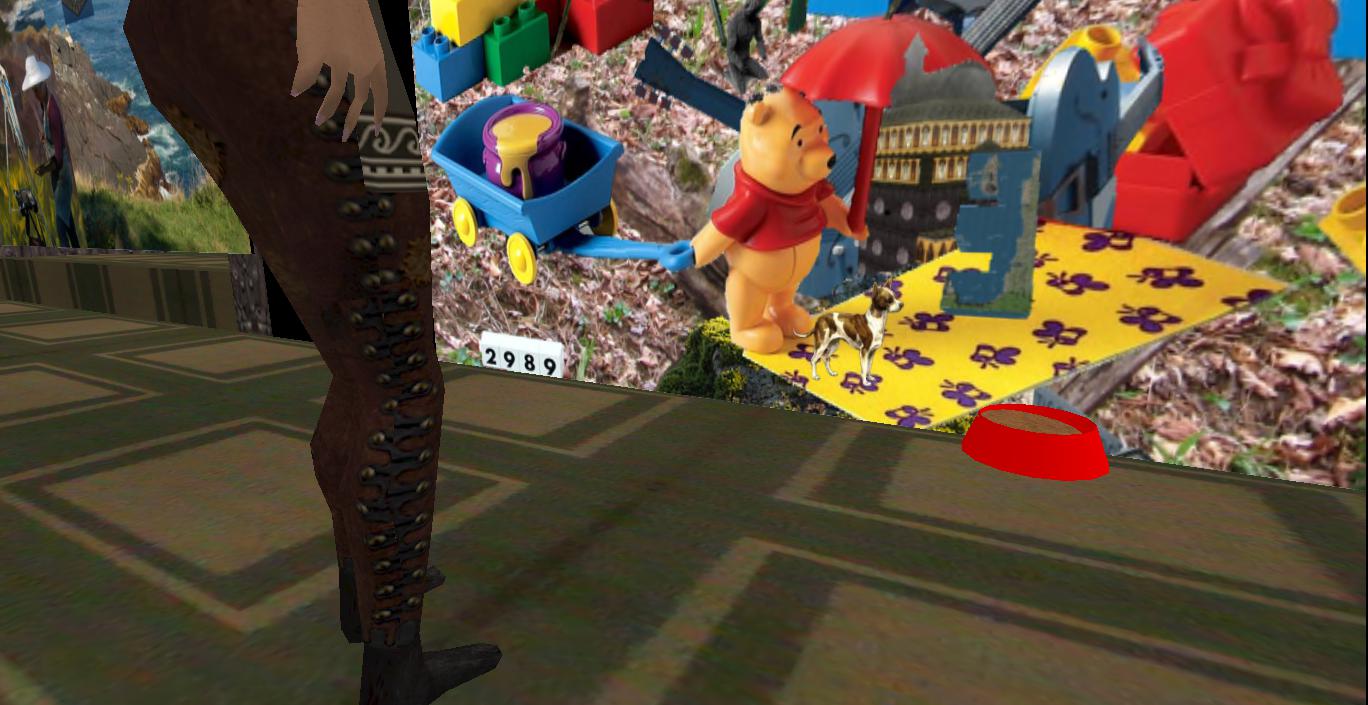
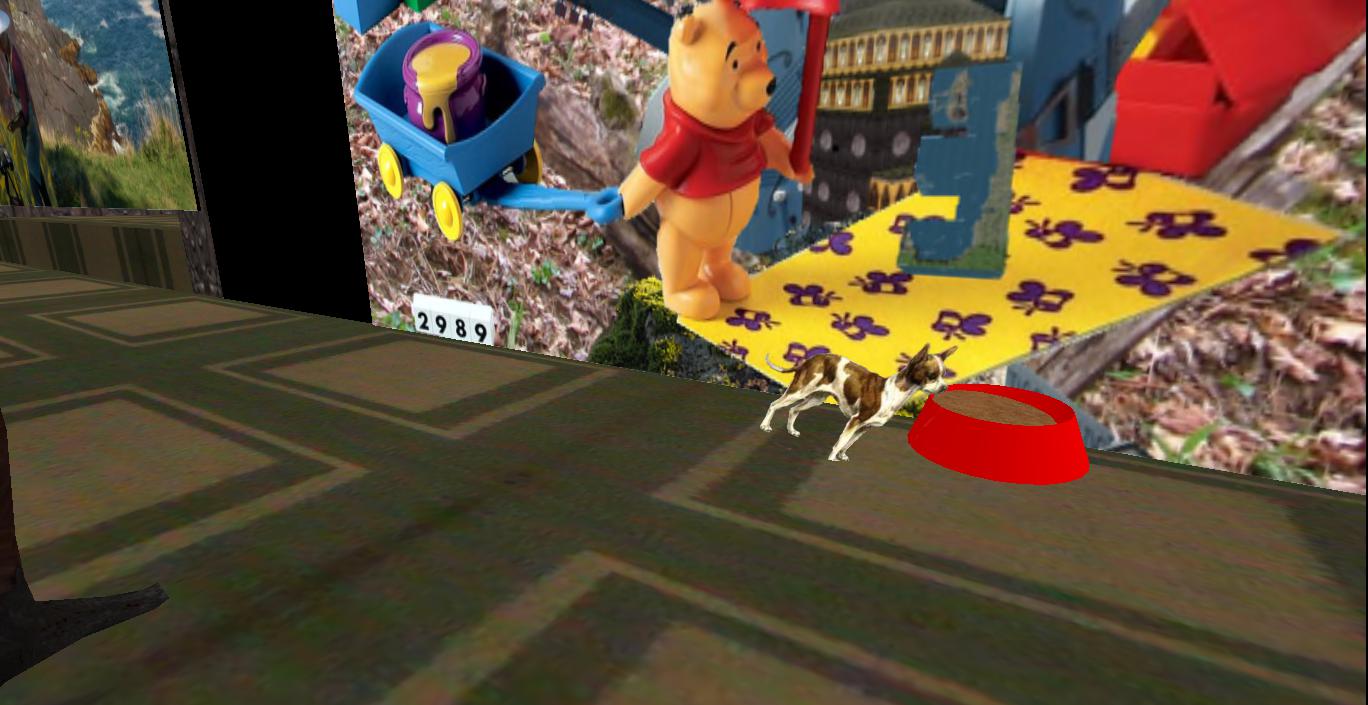
Of all people, it was Starbuccaneer Barista that found Spider. Ridiculously clever, she had lured him out of a Whitehead Crossing related collage in the Fal Mouth Moon with a bowl of dog food.

Snapshot1289_005

“Uhmmmm, yes: eat it up my precious Spider dog,” the resurrected Star said slyly. For she knew that a position of power would soon be in store for her because of this. She must speak to Baker Blinker asap; tell her of what she saw in the corridor. Share notes.

Snapshot1289_007

—–

“So that’s where I come from,” said Queen Alma I from the future, peering in again. “A merger of Starbuccaneer Barista and Baker Blinker.”

“And Carrcassonnee,” Hucka Doobie added. “She was strong at the time, having just absorbed the 11th. Tasted like chicken again to her.” He smiled slyly slightly.

“But little Spider would go back into the collages to be lost again. And again. And yet again and again.”

“And again!” Hucka Doobie added again. “You see, he was mistakenly rewarded for entering the collages. Dog food, sticks, squeeze dolls. All these lured him out but also kept him going back, knowing the endpoint.”

“How did it end?” the Queen asked. “Is he still in the collages even now?”

“Yes,” came Hucka Doobie’s answer. “He eventually became All Collages.”

Cardboard Derek Jones suddenly slid his way into the room through the seams of the closed door. “My Majesty. And… um, sire. The dog has reappeared again!”

“What synchronicity!” Hucka Doobie exclaimed.

“Too much so I would say,” says a more cautious Queen Alma I, reading out of a red book that had appeared in her hands. “I’m checked the script now. Spider has learned how to traverse time.”

“Then we’re all in big, big trouble,” returned a suddenly worried Hucka. “Big big trouble.”

Cardboard Derek Jones slides quickly toward them, holding forth a picture, which turns out to be an animation as the Queen and Hucka jointly stare in disbelieve. In it, Baker Bloch and Master Shake also jointly stare in disbelieve as a giant dog turns into a horse before their very eyes.

Snapshot1289_012

Snapshot1289_013

Snapshot1289_014

“That’s it,” Hucka Doobie says in finality, seeing Spider being fed/rewarded from “within”. “We’ve got to speak to Story Room about the 11th.”

Snapshot1289_015smallest

Leave a comment

Filed under **VIRTUAL SL, collages 2d, Jeogeot, Noru^, Story Room

Notes

A Carrcass-11 appears to have begun. Excitement! A strange one… but all seem strange at the beginning. It will evolve. But it will also take energy from Second Life development now.

For that reason and others (prim limits comes to mind) I might simply table the Jeogeot Through Art and Word exhibit and fill the X-Spot Gallery just with collages. The art of Andy Burgess and his crazy quilt cityscapes might be a good choice, and seems to mesh with the idea of Collagesity as a large montage in and of itself. I had Baker Bloch fly around the old area of Middletown yesterday and some interesting things perhaps remain but most is now vacant land. I’m not sure an archelogical dig into that region will be successful in uncovering significant stories about its past. But I’ll keep trying. So I think I’ve about decided that JTA&W will have to go, and I won’t enlarge it instead.

I’ve positioned several one prim buildings on a parcel next to Southside that remains vacant. I’ve im-ed the owner and stated that if he wants to remove them it’s fine with me, and I just erected them as transient eyecandy. I even have a name for the small neighborhood: Arrowtown. The bow of the statue Diana aims an arrow directly into its heart, with 3 lone, snoozing residents — friends, as it were — as focused-in targets.

Overall town goverment remains vaguer. I don’t think Westend’s Confluence Place will be demolished now, as I found out I can cut its prim numbers almost in half. But Westend as a whole has little personality, and contains no galleries as such. The planned Stairs Gallery No. 2 at the end of the main path cutting through the suburb remains empty, as does the town hall. As does the Confluence Place mainly, subtract the several jungle animals positioned on the bottom level just in front of its large, square waterfall. Oh, and the small dog named Spider still standing and spouting out permutations of the number 2130 in his recess on the top floor. The House of True Lies appears to remain a place where townspeople resurrect when they die, but I’m not totally sure. What direction is Westend headed, if any?

I always want to have about a spare 200-220 prims to work with when I reduce back to just Collagesity and Westend. Yes, I’ll have to “give up” Southend in about a month, although the possibility remains that I can turn over the land to a rental agency like Lama Estates. But even if so, Southend’s prims will be separate from the land I own, so I’m going to have to reduce anyway. Unless I shift my sky sandbox over to Southend — I have plenty of prims left to work on that parcel presently.

Anyway, just an update for those who are curious.

Leave a comment

Filed under **VIRTUAL SL, Carrcass Artists, Jeogeot, Noru^

Collagesity Mysteries 01

About a week and a 1/2 ago, an avatar named Tseten Thokmey bought my Hector land for a sum I deemed just barely adequate for the transaction. I loved that land! Still do. I could live around the Rubi forest once again. But look at what Tseten has done: he’s essentially extended the forest into his farm! A bucolic existence he has carved out. More power to him, and I’ll probably have some things to say about Tseten later on. Just yesterday or the day before, land came up for sale bordering the lower part of his farm. Was I tempted to, once more, buy next to the Great Rubi Forest? Yes, a bit. But I realize that I’m committed to Noru, and the hard fought battle is now over with. Time to heal the wounds and not open them up again. Tseten would have made a fantastic neighbor, and, yes, we could have extended his farm and the forest as a whole even further…

Snapshot1101_007

… but, then again, I have a fantastic new neighbor in Noru now! My previous neighbor in Philudoria, Veyot, during the original incarnation of VWX Town there last summer, has decided to commit to a piece of the excitement happening in Collagesity, purchasing a 512 parcel just behind the Power Tower Gallery. Her purchase basically extends the town in a westerly direction, making Collagesity almost run the entire 256 meter east-west extent of Noru. Not quite but fairly close. I’m continually surprised how synchronicities like this work, and I view the neighbor quandry, quickly resolved mind you, as a kind of residue energy of the whole Noru-Rubi “battle”. Instead of Baker Bloch becoming the neighbor of Tseten in Rubi, Veyot becomes Baker Bloch’s neighbor in Noru. Another red-blue exchange, then.

And her parcel is very nature oriented as well. πŸ™‚ A nice East End park for certain. And I’ll have more to say about Veyot later on as well, as things continue to develop in the new town. What up with all those things going on in the Confluence Place??

Snapshot1101_009

Snapshot1101_010

Baker also recently visited the village he created in Yeot this past spring. Presently, he has no way to further alter the strange, little burg, but he’s just come up with a name: Gong. Or Gongsity. More recently he went there to copy Edward’s Building/Gallery to place in Collagesity.

Snapshot1103_002

Snapshot1103_003
Gongsity.

Snapshot1103_006
Gongsity, with namesake Gong’s waters made transparent.

—–

So, returning to Collagesity, there are many mysteries yet to be solved or even revealed, like the fact that the red and blue robots on either side of the Coolie Building (since moved) lie directly north and south of each other, and on Hi Way and Lo Way respectively. I didn’t plan this alignment; I didn’t plan a lot of Collagesity’s alignments that just *happened*.

I just received a text message that Carrcassonnee has suggested we call her home the Cardinal Place instead of the Confluence Place. I’ll add it to the original town meeting’s docket, which should be happening pretty soon.

“Red/Blue”:

Red/Blue

Snapshot1103_007

Snapshot1103_009

Along with Carrcasssonnee, we’ve already talked to ballerina Dona in this blog, apparent twin to the very similarly colored flower directly behind her as seen in the camera angle below. And we’ve actually already talked to this “flower” in the blog, as a blog spirit I mean (think: Hucka D., primary blog spirit). I wonder if Dona and/or Flower know Carrcassonnee? I would imagine so.

Snapshot1103_011

Snapshot1103_012

Looking up Tired Falls toward the heart of the village. The buildings around this falls are among its oldest, originally forming a smaller settlement called Tired Falls itself. This according to several of our blog spirits, including Hucka D., Carrcassonnee, and maybe Dona/Flower. I’ll certainly have more to say about this original settlement soon.

Snapshot1103_018

I’ve noticed a resemblance between Collagesity and the fairly similarly sized Lake District village of Stonethwaite, England, the latter being the subject of a good chunk of my most recent and also largest collage series called Falmouth, housed in the Fal Mouth Moon gallery in town. And, yes, I’ll have more to say about that soon as well.

Snapshot1103_019

Check this out: my collage reinvented Stonethwaite and Noru’s Collagesity both have blue bikes (!) Are they the *same* bike? Could be. Perhaps the super band Story Room will have some things to say about that. The blue man next to the bike is one of its 3 members that I know of, although a fourth is rumored. But I can hear Hucka D.’s talk echoing in my head, as he says, “there’s always a rumored 4th [about groups of 3].” He’s probably right.

Snapshot1103_004

In the largest Falmouth collage, Story Room’s red member balances out the blue one on its opposite side. But since the collage goes ’round in a big circle, the red and blue beings are also actually next to each other. Why is blue upright and red sideways? Why does “Red’s” ruby red feet impossibly project through the corner of a Stonethwaite building? More blue-red mysteries for certain!

Snapshot1103_020

Leave a comment

Filed under **VIRTUAL SL, collages 2d, Jeogeot, Lake District, Noru^, Story Room, United Kingdom