Category Archives: collages 2d

Boos Interpretation 13

collage17test26

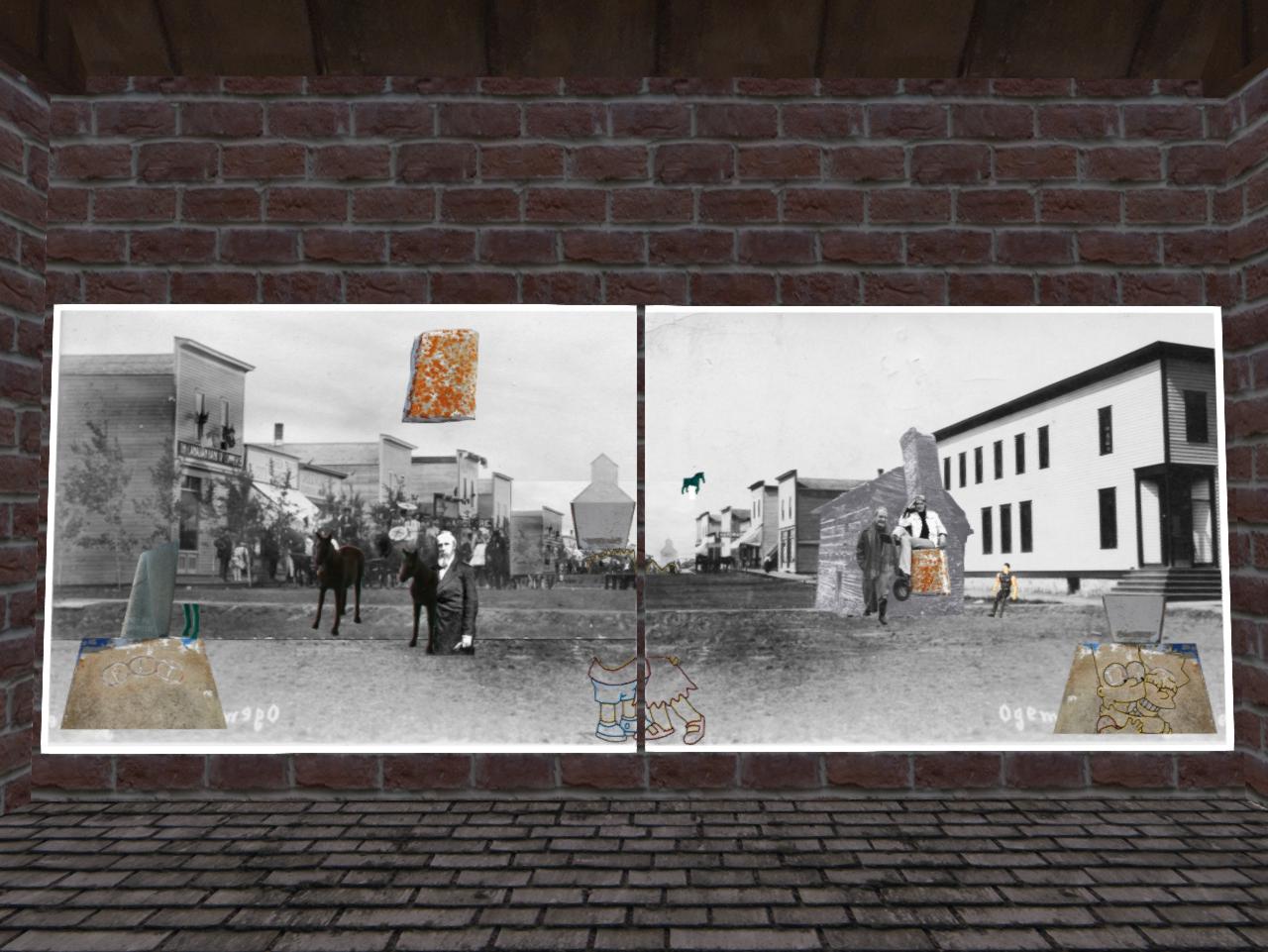
Well, what we can see immediately is the bookend type framework provided by normally colored Fitz on the left side, and inverse colored Fitz — or at least his torso and his beer — on the right side. This reminds us of the pillars Boaz and Jachin guarding the entrance to the Temple of Solomon in Biblical times.

RWS_Tarot_02_High_Priestess

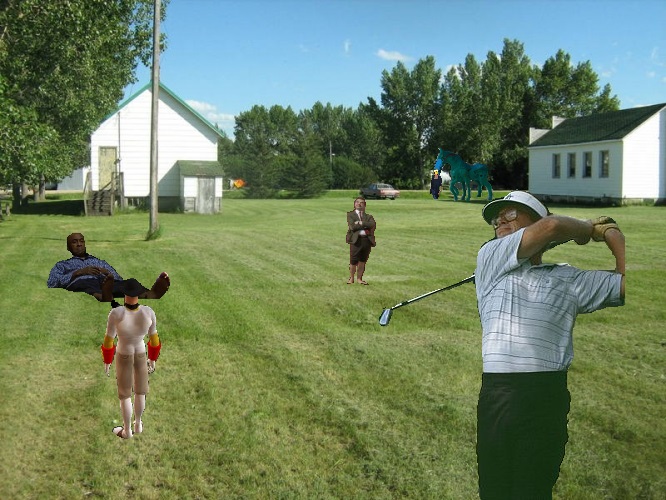
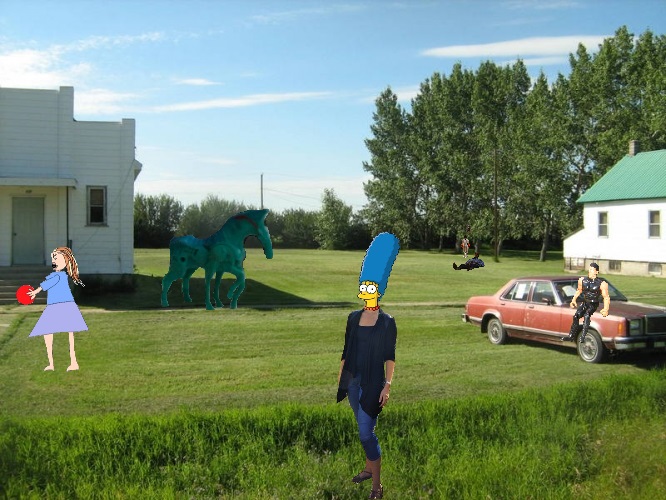
And, of course, this ties into the yin-yang symbols again. But the inverted Fitz to the right is partially replaced, like a bionic entity, by parts of a normally colored Lisa Simpson or Lisa The Vegetarian as I call her here more commonly, mainly most of her head a little bit of her body. This exchange seems important, since Lisa, when taking a foothold in the Boos series with this collage in her true cartoon form, sticks around to appear in many of the remaining works that wrap it up. We’ve seen Fitz before, starting in collage 06 — in Nautilus City with a meteor flying toward his head — and continuing in collage 14 — head pulverized by meteor in Tungaske. Here he is sans meteor, and leans over to stare at a hole in the ground. This particular image involving Fitz the Mouse was used in several other pre-Boos collages of mine, including the fully animated tetraptych that ended the last series in May (Stonethrow). In fact, the hole appears at the very center of this large collage, perhaps the most complicated I have created so far.

Snapshot2035_006

So the hole, and Fitz along with it, represents *center*. But in “I Must Be Going. Hello!” the hole is pushed to one side as far as you can get. Here the leaning-in motion of examining Fitz is emphasized by the position of characters to his right (Peanut and Insanoflex). What is in the hole? We know it is yet another paradox, which sometimes goes by the name of Greenup/yellow down.

bb:

The bug goes down as Don tries to piss (down). *Freeze* the (12 Oz Mouse) DVD, then unpause as the green liquid erupts *up* from the ground as the narrator for Don Aman says “it finally came” — the yellow piss erupts *down*. This the concept of Greenup/Yellow Down, Hucka D.

Hucka D.:

Indeed it is. Or was.

In looking at it closer, I think the relationship of the 2 Fitz’s and Lisa represents another flipping, like we had between collages 9 and 10 but in one picture this time. The Boos collage series is staking another claim to its own identity, building upon a base resonance of Tungaske. Greenup/Yellow Down is a concept that is moved into the past and away from the present center, and, in resonance with collage 11, little front-and-center Hucka D. seems to be putting his stamp of approval on this idea. Boos is setting itself apart from previous series like Stonethwaite, like Falmouth and all the others. And it is doing so through Lisa. Let’s see where this takes us…

*And* I’ve just redesigned this collage by moving the right side directly against Fitz’s bottle, which makes Fitz a true framer for the Hucka D. doll now at the actual epicenter of all this. I rest my case.

collage19revised01

(to be continued)

1 Comment

Filed under Canada/Tungaska, collages 2d

Boos Interpretation 11

(continued from)

Snapshot1114_006

With collages 16 & 17 of the Boos series, we now move into the realm of the true miniatures, which I suppose make their first appearance here in my digital collage series, or at least as far as I can recall. This is by necessity more than design: I seemed to be running out of online Tungaske photos to use as collage bases and “resorted” to several realty company’s low rez pictures from houses for sale in the village. The two places that kept appearing in searches happened to be on Atlantic and Pacific avenues, parallel to Sask Avenue just seen in collage 15, as already stated (the latter street also previously viewed in the foreground of collage 11, “Hucka Homebee”). I liked the way the names indicated an oceanic frame, as for the continental US as a whole — or Canada as a whole as I’m thinking through it again.

I’m not sure how much there is to scrutinize about these mini-collages, 4 in number. But let’s see what happens. Here’s the two from “Atlantic” to begin, which I jointly assigned to collage 16:

atlantic04c
“Atlantic 01”

bakertruman05
“Atlantic 02”

I was also digging back into early collages series for images by this point, and came up with a juxtaposition of “Falling Dorothy 01” and “Mr. Bean with turkey on head” for “Atlantic 01”, and then “Waving Truman” and “Crouching Baker B.” for “Atlantic 02”. The first presents a tableau of imbalance, hosted by a many angled, upstairs room. The colors of the images match those of the room. Is this truly a “Matrix”? Is it a turkey of a house (sorry)? The second begs perhaps a couple more questions. What is Crouching Baker examining to the left with his magnifying glass? Is he checking the wiring, the plumbing? Truman waves howdy, ready to move in at a moment’s notice. As soon as Baker finishes inspecting whatever he’s inspecting (told you there may not be much to examine).

The two mini-collages of “Pacific” are slightly more complex. In “Pacific Won”, we have handless, lego-ish dude seen in past collages attending to a prostrate Mr. Bean with an image of Nauvoo Illinois’ Lake Horton emerging from his back. A little bit more meat to this won one; something we can perhaps gnaw on.

gallerynasfnawetbbb
“Pacific Won”

Lake Horton can be seen as a *terminal* image for the huge Falmouth series in an excised remake of its collage 43, a two part animation entitled “Cover Up”.

“Cover Up 02”

I won’t show the remake because it’s the same combination of images now seen in “Pacific Won” here: Lake Horton emerging from the back of the identical prone image of Mr. Bean. Has Mr. Bean actually drowned in this earlier collage instead of merely drinking water from the tarn? Is this a dark, malevolent spirit departing a dead body? The grey dude who has lost his hands: does this symbolize the inability to grasp physical objects from the afterlife? I believe this is a moment of death, leading from the occluded Mr. Bean in “Atlantic 01”, with senses such as sight and hearing impaired. This is a body on the decline; the headless turkey obscuring the head of a man, also making him headless in turn. You are what you eat, I guess.

And the same handless grey dude appears in the Falmouth collage, more in the foreground now than beside Mr. Bean. But he also lacks a head, or it is covered by an 8 ball. While this dude is without hands, there are *two* other disattached hands in “Cover Up 02” (yes I realize disattached isn’t a word but I still like to use it at times). What are they doing? The larger one in the foreground is covering up two cubic blue objects (Cubic Peanut and Big E). What are they saying to each other, these two cubic beings who may be dual aspects of one entity? Why does it have to be covered up, per the title? Is this also a “living dialog” snuffed out by the fated hand of death?

Let’s just leave it that “Pacific Won” depicts a moment of death where the soul departs the body, but is still trapped, perhaps, in the terrestrial realm like a (hungry?) ghost.

If so, “Pacific Too” may be a resolution of sorts…

pacificmartin03
“Pacific Too”

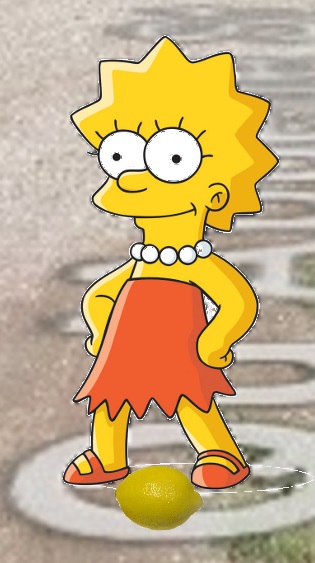
… Lemony World guided by Lisa the Vegetarian to the rescue. She gobbles no meat and thus no turkey. She becomes not the wildly darting, ever mobile *fowl* but remains plant and mineral, rooted in Earth’s fair soil. She does not appear in “Pacific Too” but is inferred by another Simpsons character Martin Prince, another waver who appears very early in the Greenup series from 2004 — in fact, the very first digital collage I made. He is an original being, then, an Adam for my collages. He might have a love interest for Lisa, although in the Simpsons series this is more commonly assigned to brother Bart’s best bud Milhouse, if I recall correctly. And we also have more lemons in this first collage as well, conscious reference to another Simpsons episode “Lemon of Troy” talked about in other places on this blog. And, oh yeah, Martin also has a magnifying glass, like Crouching Baker. He thus shares elements in common with both the characters in “Atlantic 02”.

168441588_5c92357ab8_o
“Greenup 01: “Lemon Tree and Niche”

And then the third and last element added to the base photo of “Pacific Too” is The Beatles’ yellow submarine, which also makes several appearances in Greenup. Here in its diagonal form I believe it represents *positive* ascension and correct escape from the Earthly plane. And I forgot to mention that there’s a similar third, collaged-in image from “Atlantic 02”, also found in the Greenup series. I’ll just say here that the miniature burning car dropped from Truman’s waving hand is more in line with malevolent, horizontal/vertical forces, and ones that pin the soul to the ground.

Despite being a miniature, I believe that “Pacific Too” is a considerably better collage than “Finding the Niche”. I’ve learned about putting these things together in the meantime. So there’s that element of growth to throw into the interpretation as well. And growth through contraction is sometimes a way to go.

(to be continued)

Leave a comment

Filed under Canada/Tungaska, collages 2d

Boos 28 & 29

Apparently I’m not done with the series (!) I’m going to have to modify the Boos gallery to accommodate new work, however. We’ll see how it goes. Excitement!

collage29test12
“This Town Ain’t Big Enough”

collage29test12a
“This Town Ain’t Big”

collage29test12b
“Enough”

collage30test06
“Battling The Boos”

And now I’m *really* out of room in the gallery. So this may be it; unable to extend the gallery upwards, it seems (btw, land is up for sale in Minoa again).

Leave a comment

Filed under Canada/Tungaska, collages 2d

Boos Interpretation 10

(continued from)

“Boos Attach”, the 14th collage of the Boos series, sort of summarizes some trends we’ve seen building up. We are now in the heart of little Tungaske village, with creatures called boos in both positive and negative aspect swarming on the western horizon. Buildings have been numbered, perhaps for conquest purposes. Is an attack really eminent per the collage’s title?

collage14base02i

The yin-yang ball from collage 12 is being rolled into the center of town. Near it is giant sized Fitz from “12 Oz Mouse” with a meteor for a head. We’ve discussed the Tungaska slant for the collage series in Boos Overview 03 a bit. The meteor has landed. Between the similarly sized meteor and ball (are they suppose to represent the same thing?) is the head of yet another golf iron — we have 2 in the present collage, this one on the right side and then another to the left. Each is apparently wielded by a boos creature seen in the foreground, one negative/black and one positive/white. But the white one’s head is covered up by a spool table, another frequently repeating object in the series. This is obvious reference to Bigfoot again and its spool table, which has been called Brain Head, a yang element. The head of a golf iron does not touch the side of the spool table here, as it does in collage 08 and 11, but since the white boo holds the iron and his head has become the spool table, there’s still a direct relationship inferred, perhaps a more pictorially advanced one.

The black boo holds the golf iron whose head lies between the yin-yang sphere and Fitz-with-meteor-head. I think we have to associate those two spheres with each other. And then there are 2 more boos-as-spheres on the spool table, menacingly surrounding a Mario Brothers character with the table’s central hole showing between his legs. A “3” appears above his head. The grey boo on his left appears to be attacking him, while the one to the right merely closes his or her eyes, unable to watch. These might be the same as the “boos brothers” from the previous collage (“The Boos Brothers”), but, if so, their color is somewhat different, and they’ve sprouted wings in the meantime.

Let’s return to the matching spheres on the right. Are the Tungaske artists rolling the yin-yang ball — still with “Trapped Wheeler” inside — toward Fitz to replace the meteor on his head? Does Fitz need a new head since his old one has been pulverized? The head of the iron between the two begs us to think about this. This is about Bigfoot. This is about Tungaske. But chaos rules all around, and nothing really makes much sense, despite some obvious associations and links that can be made. Let us leave it for now as a depiction of an attack, with some form of damage control in effect.

The next collage, “The Unloading of Bigfoot”, may give us some additional clues about what is going on.

tugaske94g

We are now on the other side of town from the downtown region depicted in “Boos Attach”. A giant shoe has touched down in a vacant meadow. It seems to be unloading red houses — some appear on the ground before it and some are still on the grassy landscape of the shoe. A giant mossman may be in charge of the unloading, aided by a blue octopus who resides in a pool inside the shoe. Another mossman stands on the road looking at the first one. And then the bird sculpture from collage 03 reappears here in the foreground, which I’ve already associated with the circular Bigfoot marble track. A dislodged poster advertising a Tungaske studio tour has fallen on the ground between it and the backwards turning mossman.

Bigfoot and these entities and objects seems to be coming to the rescue for Tungaske. While negative forces attack from the west, a balancing benevolent force appears in the east. Tungaske is most likely saved. We should probably assume that Bigfoot’s spool table is unloaded as the spool table on the property seen in collage 11, which is also on the eastern side of town and only one block down from the setting of collage 15 here. Their shared avenue is named Sask, short for Saskatchewan. Coming up we will visit locations on parallel Tungaske streets called Atlantic and Pacific.

(to be continued)

Leave a comment

Filed under BIGFOOT, Blue Mountain, Canada/Tungaska, collages 2d

Boos Interpretation 09

(continued from)

A sphere is also found in the next collage of the Boos series, another 2 part animation. I call it “The Boos Brothers”. Mars is the ball in question now, looming impossibly large in a lakeside setting. Two round creatures baring sharp teeth fly in front of it in part 1, who I know to be the Boos brothers of the title. Perhaps they also stand for Mars’ two moons Phobos and Deimos. They head toward a rust colored silhouette of a woman perched on the bank of the lake. This is actually another statue created for the same Tungaske art event that produced the sphere covered in collage 12 before this. The word RUST appears on the sandy incline below it. A spaceman walks in the lake carrying a large box. Peter from The Fringe swims directly in front of him (or her). He looks toward the rusty woman, seemingly in alarm. His head is framed by the spaceman’s box.

collage13real01ab

In part 2 of 2, the Boos Brothers have almost moved off-camera to the right. The rusty female torso is nowhere to be seen; have the brothers *eaten* her? The spaceman has moved in front of Peter. His box has shrunk, and he can carry it with one arm. The other arm, now free, reaches toward a tiny cave in the lake bank. We cannot see the hand of the arm. Has it also been “eaten” or somehow lopped off? Or is it just queerly hidden in the shadow?

collage13real01be

So what is the meaning of all this? Mars, I believe, is a direct extension of the yin-yang ball seen in the previous collage, and refers to the question, “what’s black and white and red all over?” The traditional answer to this koan is a newspaper or, sometimes, an embarrassed skunk or a zebra with a rash. Here it could be the red planet Mars. A 31 kilometer Martian crater has been named for the town of Tungaske, but noone seems to know the reason why. The boos creatures are perhaps confused about their place of origin. Is it the Martian crater or the town that the crater is named for? At any rate, we know from the next collage that they and their numerous brethren in both black and white forms are headed toward Tungaske en masse.

The boos creatures are introduced here because it was at this general point I decided to name the still evolving collage series that name, after a village in Jasper County, Illinois. I explain some of this in the Boos Overview 01 post. I googled “boos” images and all these round eyed toys came popping up. The two I used in the collage are apparently Mario ghost boos, a malevolent strain.

And I should also put forth the idea here that the map duad Jasper-Newton itself is a yin-yang symbol. In Illinois, the county seat Newton is submerged inside the county of Jasper, as if a seed. In Arkansas the situation is reversed. This duad also represents the two sides of our US of A, or north (Illinois) and south (Arkansas). They also stand for conscious and unconscious states of being, a bigger tableau. If Mars is both, then we are truly dealing with powers of a high intensity indeed.

http://www.insistpost.com/cycle-of-karma-and-reincarnation/

Interesting-facts-about-Hinduism-Karma

Interesting reading about “hungry ghosts” here:

https://en.wikipedia.org/wiki/Hungry_ghost

It is believed that the soul contains elements of both yin and yang. The yin is the kui, or demon part, and the yang is the shen, or spirit part. When death occurs, the kui should return to earth, and the shen to the grave or family shrine. If a ghost is neglected, it will become a kui. The shen, or ancestral spirit watches over its descendants, and can bring good fortune if properly worshipped.

(to be continued)

Leave a comment

Filed under Canada/Tungaska, collages 2d

Boos Interpretation 08

(continued from)

If collage 10 brings us fully into a Tungaske collage environment and establishes an aesthetic foundation for all to come, then collage 11 provides us roots. We are at a particular house that I will not identify except to say that it is the home of a prominent town artist who I seem to be able to identify with more than any of the others. That’s because we’re both artists of *junk*. A key link is the presence of a large spool table on the property, much like I built my Bigfoot junk/toy environment around a (smaller) spool table in part. You can clearly see the Canadian artist’s table in Google Maps Streetview, and also, surprising me, on a short, very choppy video someone made while driving through the town in 2011.

Collage 11, entitled “Hucka Homebee”, is an animation, like collages 02, 03, and 08 before it. Here’s part 1:

Boos11a Huck Homebee

We have the return of several items seen in former collages. Two reappear from collage 5 (“Simpsons Road Bloch”), or the Oz Wheeler and the triangular formation of Simpsons toys. The Wheeler again stands in the middle of a road and at the bottom of the picture. The Simpsons figurines again stand to its right, but in a yard now and not a road. The golf iron from collage 07 (“When Wheels Went Round”) is seen to the Wheeler’s left. Like with that collage, the head of the iron touches a *spool table*. The same Wheeler is found in collage 07, but on top of such a table and not in front of it.

In part 2 of the animation, the Simpsons figurines are replaced by a doll version of resident blog spirit Hucka D., referred to in the title of the piece. Specifically, the doll is superimposed directly atop Homer Simpson in the animation. This symbolizes the home aspect and the rooting act. *I* come to roost in Tungaske, borrowing a resonant artist’s humble dwelling spot. Hucka D. shows the way, becoming “Hucka Homebee” in the process. It’s possible an unconscious nod to a baseball home base occurs here with the positioning of Homer in the corner of the yard. Notice also the parked car to the right, which may resonate with the Boss, MO parked/junked car of collage 01 and 02.

collage11base03

And, yes, I’m aware that Hucka D. has not made himself known in my new round of collage interpretations. I gave him an opening earlier to interpret this particular collage of the series, along with others, but he left it alone. My instinct is to keep moving forward without him for now, until I get myself in a pickle.

collage12test10

We see the return of the yin/yang or tajitu sphere in collage 12. The artist whose house is featured in the previous collage is one of those pushing or holding up the ball. This is *her* creation, at least in part. Per the title (“Trapped Wheeler”), a Wheeler is encased within the black half of the sphere, but the image is now that of William A. Wheeler, vice president to Rutherford B. Hayes from 1877-1881. However, we’ve also seen this particular Wheeler in the first half of a May 2015 Stonethrow animation I called “Beware The Heelers”. There the association with an Oz Wheeler is first made: the lower half of the stairs version of the vice president is replaced by the wheeled lower part of the Oz creature. Then in the right side version, a different slant on this amalgamation takes place as his hands are instead replaced by shoes.

wheelers16
“Beware (The) Heelers 01”

These same shoes also reappear in the present collage, seen attached to the people on its left hand side. This again stands for the audiovisual synchronicity “Head Trip” we’ve mentioned before in connection with collage 07, “Head Brains”.

Boos Interpretation 05

A spool table appears in that earlier work as well. Perhaps a cursory description of the synchronicity from my August interview by Karl Tune is in order here.

I thought “Head Trip” to be an important work moving forward and I sent out some tapes to people. We were still on the edge of VHS tape days. I was very pleased that about all of them “got it”. At its base, “Head Trip” is a continuous toggling back and forth between 2 movies which are dubbed by 3 audio sources. It involves 47 tiles if you include plain dialog segments, compared to 32 for “Billfork” and 26 for “SID’s 1st Oz”. I mention these numbers for another particular reason.

You have to keep in mind “ST/TD” was a very small forum. Others began mentioning “Head Trip” and I chipped in with my own theories about it. Some tension manifested from the theories. Whytless Physh left the scene, saying he had accomplished all he wanted to do here with “Jesus Who?” Last I heard, I believe he spoke about refocusing his energies on becoming a lawyer. Dave had wrapped up his run of Rush centered synchs. Stegokitty had moved on to different interests. Virotti became frustrated that we were talking about other things besides file sharing. The wheels were falling off, like I said. And not just for this forum, but for the progressing forward of audiovisual synching in a group fashion.

What I’m going to take away from this is the link of the phrase “wheels falling off” here with the “trapped wheeler” aspect. In terms of group energy, “Head Trip” was a dead end. The Wheeler inside the ball is *me*, unable to go further in a particular direction. In another way, it is the interviewer Karl and the limitations of what we spoke about. I purposely concocted our interviews so that they would be of about equal length — another tajitu situation. And each interview itself is divided into 2 equal parts. The gap Karl had in his experiences with audiovisual synching groups acts as the seed for my own interview. And visa versa — I didn’t know a lot of the story behind Shared Fantasia II, for example. Wikipedia defines the yin-yang symbol as, “a circle divided by an S-shaped line into a dark and a light segment, representing respectively yin and yang, each containing a ‘seed’ of the other.”

The Tungaske woman artist whose house we see in collage 11 is the one who most holds the Wheeler figure here “in place,” her arms pushing against his shoulder. The metal sphere the yin-yang ball replaces in the collage might itself be a kind of failure or dead end as a sculpture. Unlike other pieces in the same location (seen in other photos from the particular art event), we do not see it subsequently exhibited in a Tungaske location. Sometimes spheres are difficult to hold together in the long run. You need some help, perhaps divine provenance.

(to be continued)

4 Comments

Filed under BIGFOOT, Blue Mountain, Canada/Tungaska, collages 2d

Boos Interpretation 07

(continued from)

collage12test02

And then in the 10th collage of the Boos series, called “Goodwater Goodland 02,” we have a direct continuation and also *inversion* of the central images of “Goodwater Goodland 01” coming before it. The Tungaske mural is now seen as a *whole* and not in several parts, albeit with rectangular holes where the smaller differently angled pictures have been removed. The inverted image is, however, still superimposed over the same rusty looking funerary book found in the town cemetery.

It’s a very simple but startlingly effective work to me. With this mere single addition, a cemetery monument has transformed into an alien face, which I originally dubbed “The Martian”. We have gone quite a ways now from the relative rawness of the first several collages of the series, and have seemingly latched onto a newer, more powerful artistic energy. I identify this with the energy emitted from the town of Tungaske itself, an artistic hamlet after all. I didn’t really grasp this probability until after creating “Goodwater Goodland 02” and then doing some subsequent research.

I could have stopped here in the series, happy with the transmutation of base elements of collages 01 and 02 into a new form with the inversion of these Tungaske core elements from 9 into 10. I’d symbolically flipped around the tajitu sphere appearing in 9 from yin to yang, seemingly.

yinyangx3

Many of my collage series come to a halt with the 10th work, after all, including the 3 that appeared before this (Sam Parr, Embarras, Stonethrow). But it was destiny that I forge ahead in this case, the first time this “extension” has happened since the Falmouth series unfurled about a year and a half ago now. Boos was destined to contain around 27 collages as a whole by present count.

Missouri would not appear again in the series. Tungaske has taken the upper hand.

Snapshot1106_003
completed floor 1

(to be continued)

2 Comments

Filed under Canada/Tungaska, collages 2d

Boos Interpretation 05

(continued from)

testcc02e

To continue with the “Head Brains” analysis… instead of resting his hand on the back of the brown cow, Davy Jones clutches the edges of a superimposed spool table. Zappa perches at the top, a dark twelve o’clock figure. A large finger emerges from its center pointing directly to Frank, which I happen to know is a middle finger. The figurative bird that Zappa may be giving Davy at this point in the movie (“…your song’s pretty white,” etc.) seems to manifest for real in the collage. But, if so, the finger is actually pointing at us, the viewers. Hmmm. Jones stares right at it, perhaps aware of the context.

310595_10150399782979534_158084819533_9980024_1504241495_n

However, in looking at it closer, the finger is not pointing directly to 12 if the round spool table translates into a clock (and the finger the hour hand of a clock). The pointing is slightly askew to the right. I think this might represent the clock time 12:01, which can be rewritten as 11 hours and 61 seconds, or 11:66. Let’s keep that in mind to see if more evidence appears later on in the collage series.

Finally we have the transparent giant head of Subgenius prophet Bob Dobbs in the background, his visible eye perhaps fixated on the finger. Zappa was known to be something of an admirer of the Subgenius religion. And that’s another reference to “Head”.

In “Head Brains” we have another clear reference to the Bigfoot art event. One of the fixtures of that event, just recently completed of course, is a spool table, found at the Plateau of Raw Art and then rolled down the hill through the 4 roads territory to be placed beside Bigfeet Swamp and act as a centerpiece. I’ve already speculated an association with the name Brian Head, perhaps itself derived from “Brain Head” and thus directly related to the title of the present collage. I was aware in making this association that the “Head” of “Head Trip” is symbolically white or yang, which makes the complementary, circular iron smelting plant beside it in the Bigfoot event black or yin in energy, linking to the “Trip” part of the audiovisual synchronicity’s name. Let’s leave it at that for now.

collage10test10b

In collage 08, called “When Wheels Went Round”, the spool table returns as a dominating image, or at least the top of one. Now it becomes directly linked to the central Nautilus City location called The Citadel, created on a circular plateau raised about 40 meters above the rest of the otherwise quite flat island-city (save one higher hill to the west). The wall encircling the plateau remains in the collage. However, the top portion with the roads and such has been removed, replaced by the top of a spool table image I found online. The golf iron extending toward this modified Citadel from the foreground is culled from a Bigfoot photo — it’s the original “iron” of the city, found by me prior to the event. That’s my hand holding it, then. In “When Wheels Went Round”, the *head* of the golf iron rests against the bottom of The Citadel wall.

The collage is actually a 2 part animation, where the whole Citadel appears to rotate round and round, or at least that’s the effect I was going for. This reinforces the association with a clock, once more. The Oz wheeler first seen in “Simpsons Road Bloch” a couple of collages back reappears on the edge of the spool table, remaining steady as the table revolves below him — a fixed point. He seems to stare into the central hole of the table, which duplicates an actual hole in the middle of The Citadel. I suppose showing the base snapshot I used for the collage is appropriate here to understand this…

743fcbb3

That’s my Fal Mouth Moon gallery at the bottom of the photo, which remains in the collage. The iron and my hand holding it have the same kind of sepia tint to them as the gallery, a color scheme that will resurface later in “Comparative Heights” (collage 24 of the series). Like everything else in the collage *save* the spool table and accompaning wall, the iron remains the same in both parts of the animation. Only the transformed Citadel changes, with its perpetual whirling.

So what is the meaning of all this? The Wheeler is obviously associable with a wheel, per the collage’s title. Wheels go ’round and ’round. I return to the idea of a clock, with the iron perhaps acting as another type of clock hand, or an indicator of a specific time. Will the giant finger reappear from the central hole when the clock strikes twelve (whatever that means)? The ribbed wall brings to mind clock gears.

Let’s push on…

1 Comment

Filed under **VIRTUAL SL, BIGFOOT, Blue Mountain, collages 2d, Nautilus, Nautilus City

Boos Interpretation 03

(continued from)

editedbossmoss01

editedbossmoss02

In the excerpts above we have two aspects of the “seed” from Boos collage 01 (“Bossmo”) and then Boos collage 02 (“Bixby Shuffle”), the same size in the pictures if we see the car in full length from 01. The twinned objects are also perpendicular to each other. We even do not know which one Oliver Wendell Douglas holds between his fingers in collage 04 (“Dirty Little Wet Seed”). It’s too small there for either a car or a license plate from same.

A license plate of a car acts as a unique identifier, another one-to-one match.

Perhaps GNIRPS can help us again here, since, after all, this is the mechanism that drove me to find this seed (Bixby-Buick-Boss triangle, etc.). There’s one Seed pop. place in the US:

seed01

Almost directly north of this place in Georgia (location seemingly reinforced by nearby Seed Lake), less than 20 miles away as the crow flies, is a community most commonly called Tate City but with a variant appellation of Tree, another rare US place name.

http://annawrites.com/blog/2012/02/15/i-hear-the-craziest-things-see-tate-city-waterfalls/

Tate-City-Pop-32-196x300
Tate City (aka Tree), a tiny seed of a village but with a large, developed sense of humor.

Tate-City-Mall

http://www.be-roberts.com/se/tallu/tallu.htm

IMG_3307-SeeTateCity-zoom-contrast

The pilot of a successful tv sitcom can be viewed as its seed, from which all else develops.

MeeMascale8

In the county between Seed and Tree in Georgia — Rabun — we also find place names Tiger and Persimmon. Wood from the persimmon *tree* was heavily used to make the golf clubs called woods before the popularity of metal ones. Nearby Tiger might then indicate Tiger Woods in this scenario, a very famous golfer whose surname refers to the club type, and thus back to the persimmon tree.

And then there’s also this close conjunction of names in another Georgia county called Johnson, already mentioned in the Sunklands blog.

tom02b

We’ll get to more of Mr. Kite and his golfing ways down the road.

(continued in)

Leave a comment

Filed under collages 2d, Georgia, MAPS, Missouri

Boos Interpretation 02

(continued from)

bossmo16q

“Bixby Shuffle 02” is the second part of the animation. We now have clear evidence of a transformation through the door. Bixby is turning into the monster again. In the window, we peek into the future.

We know from former map analysis that the towns of Bixby, Buick and Boss Missouri are psychically linked in some way. For one, they form an isosceles triangle, with Boss at the apex. Bixby and Buick lie on the western side of Iron County, in the Dent Township. Boss lies a little over the border in Dent *County* to the west.

I was studying Iron County at the time of this discovery because of its close ties to the Bigfoot Art Event that just took place next to the Blue Mountain Urban Landscape. This art event permeates the Boos collage series through and through. The two main toy characters of the event, Taum Sauk and Mina Sauk, both take their names from prominent landscape locations within this county, or the highest mountain in Missouri and the highest waterfall in Missouri respectively (which tumbles off the side of Taum Sauk mountain). The root cause of this association comes through the presence of a full golf *iron* already located at the epicenter of the Bigfoot Art Event, before it even began. Then a second iron — but only a head this time — was found at the Plateau of Raw Art which acted as the main source of the event’s junk aspect. Like with the spool table, another object which plays a major role in Boos collages. I would soon locate another spool table in Tungaske which would directly link my Bigfoot with that artsy Canadian hamlet. And Tungaske itself is featured in almost all Boos collages starting with the 10th.

Back to the “Bixby Shuffle” animation: What is really going on here? Why have I been directed, it seems, to bore into this Missouri location; collage the elements I have into it? I’m almost positive it refers to my present work situation, which has changed in the past several months. I’ve relocated, in effect. *My* boss has been exposed to be… well, the proximity of Boss and Bixby (and Buick) in Missouri is not chance, let’s say. I’m aware of a similar shuffle in my own life. And this goes hand in hand with a mother situation. Pretty deep stuff for me.

The Great Mother vs. the Terrible Mother: the dual nature of the Jungian archetype.

But, for every positive, creative force, there must be an opposing, destructive one. This notion is doubly true in the esoteric world of Carl Jung, where all archetypes must, by necessity, possess a shadow self. The dark twin sister of the Great Mother is the Terrible Mother, a force of death and destruction. This archetype inhabits the world of the primordial instincts, and is frequently represented as sub-human or even animal-like in form. A good example of the Terrible Mother archetype is the black-skinned Hindu goddess Kali. Her eyes are described as red with absolute rage, her hair disheveled, and small fangs sometimes protrude out of her mouth. She is often shown naked or just wearing a skirt made of human arms and a garland of human heads.

For me, this seems to be a residue form. Escape from childhood joys and fears is difficult. I was surprised, nay *shocked*, that such fears still could possess me. I’ll leave it at that. But I’m sure that’s behind some of the art here. The hulk monster is intertwined with the Terrible Mother and the rage.

—–

collage03redone05f

Moving on to collage 03, another animation, we have the reappearance of the rock house from collage 02 in its center. I call the work simply “The Rock”. In part 02 of the animation, we see that the Bixby shuffle is still in effect inside the house — the painfully green hulk has now *shuffled* over to the door, with Normal Bixby (human) nowhere to be seen.

collage03redone04f

And in the animation between the two, it is obvious that Mossman has become associated with The Incredible Hulk as well. He seems to be raging, like the hulk. But he is, according to my mythology at least (and, in part, the Heman mythology he comes from), a peaceful, civilized, highly intelligent being of pretty calm disposition. Within him, the turbulence is soothed; waves smoothed out. The storm is over. We will not see inside the possessed rock house again in the collage series.

The background for “The Rock” comes from Second Life, namely a Nautilus City shot highlighting my newly minted virtual gallery that now holds the entire Boos collage series. The rock house becomes superimposed on a rock in the Punic Woods just below the gallery (literally below, in the picture), which has been deemed mystical in much the same way as the Rubi Woods before it. The original background picture is here for a comparison:

Snapshot2004_007

Nautilus City will be seen in several other collages of the series coming up.

“The Rock” is easily the most reworked collage in the Boos series, forming in three phases at different times. As I touched upon in a recent post, it almost seems to steal some thunder from the end of the series. I think now some kind of jolt was needed to refocus the series on non-Missouri locations, or to bring Missouri into Canada, as it were. The guitarists to the left come directly from Tungaske, and they will “reappear” in the very last collage of the series. Canada (and Second Life) has come to the rescue. And Bigfoot.

And then also in the second part of “The Rock” we have Mossman being superimposed with the “3 Birds” sculpture seen in a number of my other collages down through the years now, starting in 2004’s Greenup series. Here I believe it represents the looped marble race of the Bigfoot event, a central aspect. Taum Sauk stands next to both Mossman and the sculpture, reinforcing a Bigfoot connection. His head swivels from left to right in the animation. His attention seems diverted to the next collage down the wall of the gallery…

oliver02

… called “Dirty Little Wet Seed”. In this collage Taum Sauk seems to be examining the repercusions of Boss Moss and what his indicating finger is pointing to. We already know that this small gray square is a car from “Bossmo”, but duplicated as a *license plate* on the same car in “Bixby Shuffle”. This is the seed referred to in the title. Green Acres’ Oliver Wendell Douglas seems to hold it between his fingers. Douglas is actually talking about a hypothetical seed in the culled screenshot from the show — more tv shows.

If we google the phrase “dirty little wet seed”, we find the the show in question: “Oliver Buys a Farm”, which is also the pilot for the popular 60’s series. Directly related quote, then:

http://m.imdb.com/title/tt0592737/quotes

Oliver Wendell Douglas: I’d take a little seed, a tiny little seed, I’d, I’d plant it in the ground, I’d put some dirt on it, I’d water it, and pretty soon, do you know what I’d have?
Lisa Douglas: A dirty little wet seed.

Full script of the show is here:

http://www.springfieldspringfield.co.uk/view_episode_scripts.php?tv-show=green-acres-1965&episode=s01e01

I won’t go into this much but that particular episode is used as a core video source for a 2012 carrcass, or Carrcass-6. 12 Oz Mouse acts as the main glue for this particular audiovisual synchronicity, which I’ll add because its characters also appear in the Boos series. Green Acres folk will not put in another appearance, however.

(to be continued)

Leave a comment

Filed under **VIRTUAL SL, collages 2d, MAPS, Missouri, Nautilus, Nautilus City