Comparisons between the discovery of the Bee’s Line of the Kentucky Flat (another type of “natural platform”, as mentioned in Poe’s excerpt here) with primary events in Poe’s “Gold Bug” short story.
The natural platform to which we had clambered was thickly overgrown with brambles, through which we soon discovered that it would have been impossible to force our way but for the scythe; and Jupiter, by direction of his master, proceeded to clear for us a path to the foot of an enormously tall tulip-tree, which stood, with some eight or ten oaks, upon the level, and far surpassed them all, and all other trees which I had then ever seen, in the beauty of its foliage and form, in the wide spread of its branches, and in the general majesty of its appearance. When we reached this tree, Legrand turned to Jupiter, and asked him if he thought he could climb it.
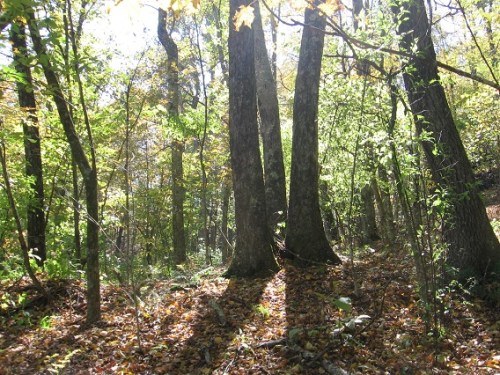
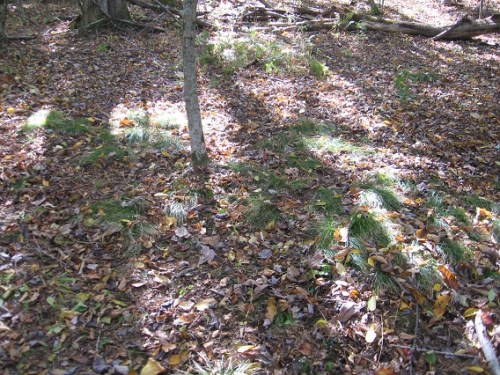
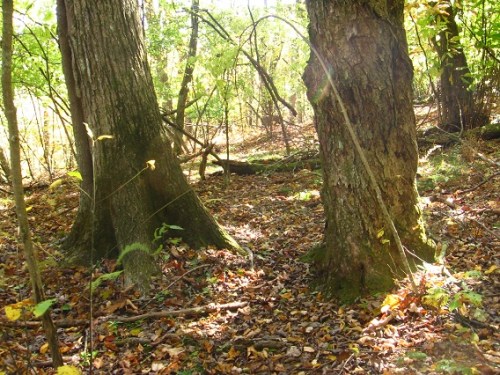
There are no tulip trees in my Kentucky, but instead beech and maple trees, it appears. There is a central tree of maple variety, however, probably as tall as any on this flat or platform, and it is in front this tree I found my own version of a gold bug, about 2 feet from the circumference of the trunk.
During this colloquy no portion of Jupiter’s person could be seen; but the beetle, which he had suffered to descend, was now visible at the end of the string, and glistened, like a globe of burnished gold, in the last rays of the setting sun, some of which still faintly illumined the eminence upon which we stood. The scarabaeus hung quite clear of any branches, and, if allowed to fall, would have fallen at our feet. Legrand immediately took the scythe, and cleared with it a circular space, three or four yards in diameter, just beneath the insect, and, having accomplished this, ordered Jupiter to let go the string and come down from the tree.
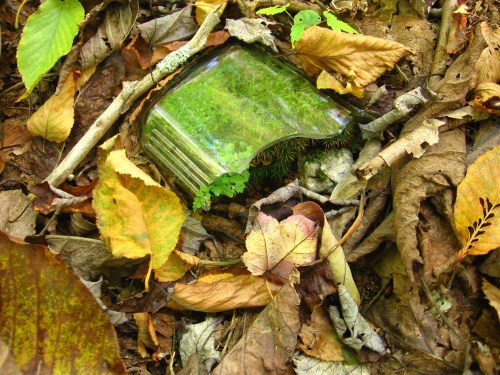
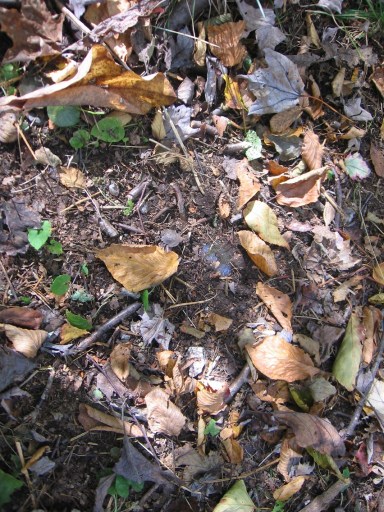
I cleared a space of about 3 or 4 yards in front of aforementioned maple tree, to find the bits and pieces of an old, shattered bottle. In the clearing process I stumbled upon the gold bug. Legrand in Poe’s story clears the ground *for* the dropping gold bug, which landed in its approx. center.
Driving a peg, with great nicety, into the ground, at the precise spot where the beetle fell, my friend now produced from his pocket a tape-measure. Fastening one end of this at that point of the trunk of the tree which was nearest the peg, he unrolled it till it reached the peg, and thence farther unrolled it, in the direction already established by the two points of the tree and the peg, for the distance of fifty feet –Jupiter clearing away the brambles with the scythe. At the spot thus attained a second peg was driven, and about this, as a centre, a rude circle, about four feet in diameter, described. Taking now a spade himself, and giving one to Jupiter and one to me, Legrand begged us to set about one to digging as quickly as possible.
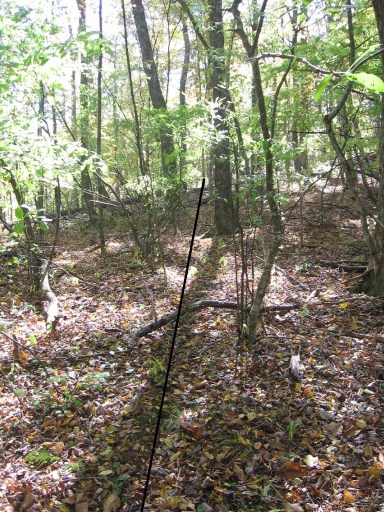
For me, the Bee’s Line, straight as if laid out with a tape measure, extended from the center of this cleared space about 30 yards up to the crest of the hill separating Kentucky from the rest of Herman Park. The line in my case was found first, then the space cleared when I followed the line to the maple tree to reveal the broken pieces of the bottle, then the gold bug uncovered. It was basically backwards from Legrand’s process…
We now worked in earnest, and never did I pass ten minutes of more intense excitement. During this interval we had fairly unearthed an oblong chest of wood, which, from its perfect preservation, and wonderful hardness, had plainly been subjected to some mineralizing process –perhaps that of the Bi-chloride of Mercury. This box was three feet and a half long, three feet broad, and two and a half feet deep. It was firmly secured by bands of wrought iron, riveted, and forming a kind of trellis-work over the whole. On each side of the chest, near the top, were three rings of iron –six in all –by means of which a firm hold could be obtained by six persons. Our utmost united endeavors served only to disturb the coffer very slightly in its bed. We at once saw the impossibility of removing so great a weight. Luckily, the sole fastenings of the lid consisted of two sliding bolts. These we drew back –trembling and panting with anxiety. In an instant, a treasure of incalculable value lay gleaming before us. As the rays of the lanterns fell within the pit, there flashed upwards, from a confused heap of gold and of jewels, a glow and a glare that absolutely dazzled our eyes.
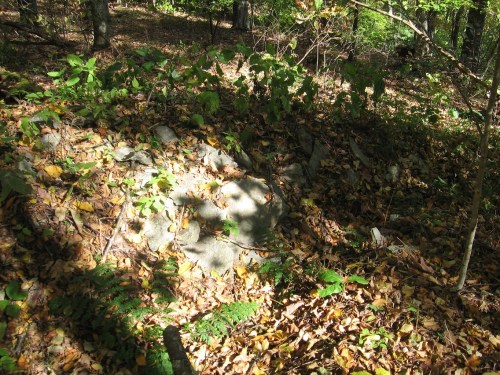
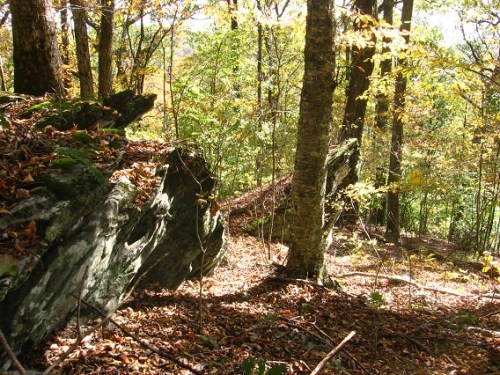
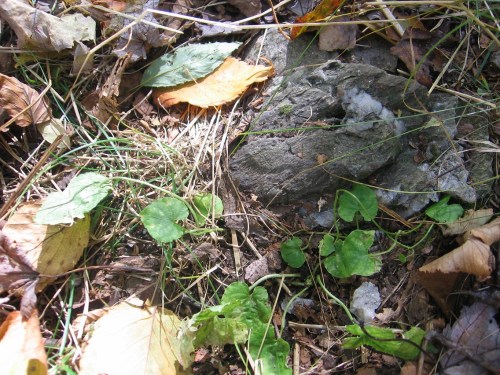
… except I didn’t discover any skeletons or treasure at the crest of the hill to start the whole thing. There *was* a rock pile that seemed artifical. Should I dig there? (probably not).
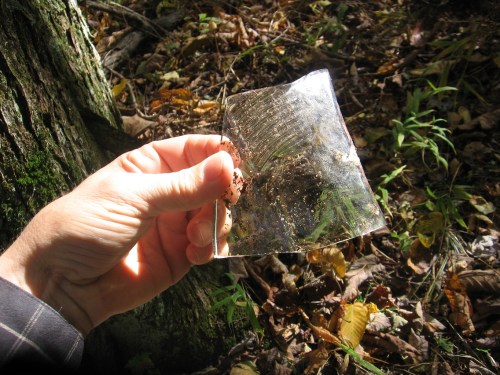
There appears to be no parallel to Legrand’s cryptic parchment either, created by Cpt. Kidd. NOTE: Perhaps the *bottle* itself is the parchement in this case, and not the treasure itself? Pieced back together, does it create some type of similar message? What of the bottom piece of the bottle, found away from the rest and acting like a miniature terranium now? NOTE: Connected to the expression “message in a bottle”, like in The Police song of the same title? One might also have to break such a bottle to retrieve the message. So the message could be the equivalent to Poe’s cryptic parchment here, except there’s no parchment of course. Is there?
NOTE: I skipped the part in Poe’s story about missing the treasure on an original dig by Legrand and co. because the golden bug was dropped from the wrong eye by the dyslexic Jupiter.
NOTE: There is a slight possibility that the crest of the hill with the rock piling can act as a sighting spot, much in the manner of the Devil’s Seat in Poe’s story.













 Sunklands