Daily Archives: October 17, 2012

Kansas & Kentucky & More 02

continuing with descriptions of 1st map of the general Byng area, featuring both Kansas and Kentucky (flat platform area on ridge above Byng)…

we move to Kentucky on the ridge above Bing. Kentucky is then separate (to the immediate south) from the 4 Byng areas identified in the Kansas and Kentucky and More 01 post just below, or Upper Byng, Impasse, Kansas, and Lower Byng.

Locations in Kentucky:

Bee Line — the central ley line (literally perhaps) of Kentucky, cutting across the entire ridge diagonally and staying on a constant slope and angle throughout its 60-70 yard length. Seems very unique.

Tie Rocks — at upper extremity of the Bee Line, perhaps, representing 3 small stone juts from the ground that I used to tie the string subsequently extended across the whole of Bee Line. An alternate name is End Rocks, since they lie at the end of this line.

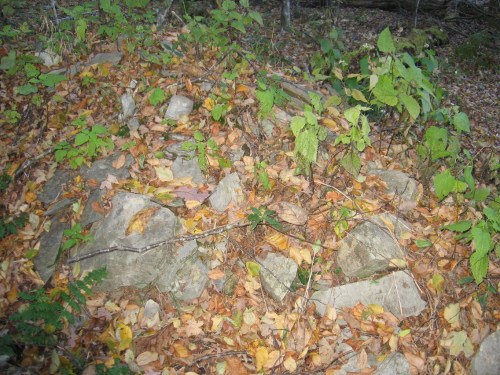
Rocky Mound — mysterious perhaps even ultra-mysterious mound just in front of Tie Rocks, and which Bee Line runs around just at its upper or higher end. Is approx. 15 feet in length. More investigation needed, perhaps even a dig? Possible that Rocky Mound could also be used as a sighting station toward neighboring Yards Mtn. (again, Kentucky is on the slopes of Wealthy Mtn. to the west of Yards Mtn.) per the Devil Seat of Poe’s “Gold Bug” short story (see below); totally unverified as of yet.

3 Trees — 3 trees just across Bee Line from Rocky Mound.

Split Log — long fallen tree mysteriously (once again) split in two almost right on the Bee Line. Represents perhaps 1st clear indication of this line with its stark division.

Rot Cathedral — large rotting tree trunk of reddish color, several yards to south of Bee Line.

Tiny Tree — central tree, perhaps, of Kentucky, and bark mysteriously (once again!) worn out near its base. Represents a polar opposite of huge tulip tree in Poe’s “Gold Bug”. Sits in middle of grass clumps.

Central Tree — the other candidate for central tree of Kentucky, and smart enough to snag the literal title before Tiny Tree or any other tree could step in. Tiny Tree and Central Tree then lie equidistance and on opposite sides of the Bee Line.

Bottle Clearing/”GOLD BUG” — if Tiny Tree or Central Tree is the central tree of Kentucky, then surely the cleared out space between them, which I have called both Bottle Clearing and GOLD BUG, represents the overall central area of Kentucky. Is about 3-4 yards in diameter, or about the same size as the space cleared out by Legrand for the dropping gold bug (from the skull in the huge tulip tree) of Poe’s story. In our case, a gold bug was found *after* the area was mostly cleared — inversion again. This gold bug was then removed and taken home by me for the wife to see and admire, and also our cat got a hold of it afterwards so we had to then put it in a small bottle to preserve.

Lovey Dovey Trees (not named on map) — two beech trees at the end of the Bee Line (Bee Line immediately between them) that are very similar in size and intertwine with each other in their leafy parts, becoming as one.

Terrarium — bottom of apparently same bottle shattered between Tiny Tree and Central Tree, and containing growing moss and at least one other small plant, hence the name. Very green! Just downhill from Lovey Dovey Trees and below the start of Bee Line.

Twomore Trees — two more (conjuncted) tree, as stated, in lower Kentucky and perhaps important in future events of the area. Do not intertwine, however, like L.D. Trees.

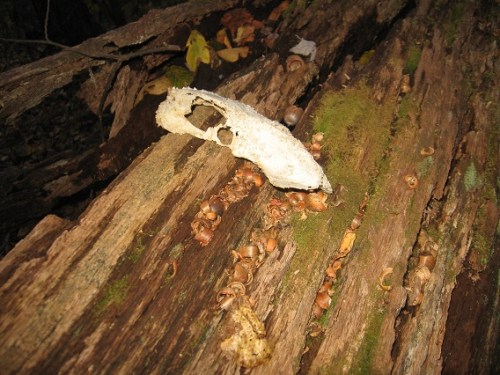
One Eye Skull — unk. animal skull with only one eye socket remaining. Probably a direct resonance with Poe’s skull in “Gold Bug” going on here, since the skull’s eyes are featured in that story. Found in extreme southeast Kentucky and then positioned on top of nearby log for better photos.

2 Comments

Filed under Byng, Herman Park, Wealthy Mountain

Kansas & Kentucky & More 01

1st map of the general Byng area, featuring both Kansas and Kentucky (flat platform area on ridge above Byng).

Byng Stream — starts high up on Wealthy Mtn. as a multitude of various forks which combine just before The Impasse (see below). Byng Stream basically runs through these areas:

– Upper Byng (forks just mentioned, in open, walkable woods);
– Impasse or The Impasse (rhododendron clogged region where forks unite as one stream — Byng — which then flows more rapidly as it forms several, long cascades;
– Kansas (general area between lower extent of Impasse and Lion’s Roar that has a navigable path running through it [in contrast to Impasse], forming more of a gorge-like region with steep sides);
– Lower Byng (from Lion’s Roar to mouth of creek at Flanigan’s Fork next to the nearest road — runs through a more open area here with, as in Upper Byng, many options for traversing)

Individual sites on Byng Stream:

Lion’s Roar — near lower end of Kansas that Byng flows all the way through; is a large, overhanging rock, the largest in the mapped area, it seems, and perhaps by a considerable margin. The overhang is extended enough so that I could stay here in the rain and be comfortable without getting wet, a notable plus in future considerations about developing this area. Lion’s Roar already shelters 50 objects (jars, pots, etc.) coming from the side of neighboring Yards Mtn., pieces of a future art happening in this area, no doubt.

Kansas Path — traceable path running all the way through the Kansas region of Byng, starting at the upper reach of Lower Byng and ending at the start of Impasse.

Periwinkle Falls — small cascades just upstream from Lion’s Roar. Split in paths just before, with left hand path (Kansas Path still) taking you upstream and right hand path forming basic beginning of Mystery Path connecting Kansas and Upper Byng in passing around the eastern side of Impasse.

Four Minutes — area recently cleared of dead rhododendron just above Periwinkle Falls. Represents possible future site of Temple of TIDE and more. Mystery Path runs through here; Kansas Path on other side of Byng from here. Named for a Roger Waters song.

Rock Island — small isle of rocks upstream from Four Minutes, near the center of Kansas. Debate in past whether this is part of Kansas or older defined yet vague regions of both Illinois and Iowa, perhaps stemming from the existence of a city called Rock Island (named for an island located between these 2 states) in the “real world”.

http://en.wikipedia.org/wiki/Rock_Island,_Illinois

This also seems to imply an assoc. between Byng Creek and the Mighty Mississippi River. Iowa and Illinois, seen as one, are also 2 states bridging Kansas to the west (bordering Iowa) with Kentucky to the east (bordering Illinois). Some say our Rock Island floated downstream from somewhere within The Impasse, losing its Illinois/Iowa ties in the process (deeply debatable).

6 Mile Hill — as yet undeveloped region surrounding a large, dead tree (Rot Tree) in upper Kansas. Could be a center of that already mentioned future art happening. Perhaps. The name 6 Mile Hill relates to 4 Minutes also found in Kansas, and also a 6 Minute Hill on the Jeogeot continent of Second Life located in a sim of the same name. Shrine of Second Life here, then? (Jeogeot?)

Impasse Trees/”SF”/Mine — composing a single area in extreme upper Kansas, on the edge of Impasse and where you can’t keep making your way upstream on Byng directly because of clogging rhododendron, falling trees, briars, and more. The Mine in question is rumoured to be owned by Lisa the Vegetarian, and thus is perhaps an old quartz mine. “SF” just below it (“Suspiciously Flat”) may also be a hopeful reference to gold town San Francisco. Kansas Path end can connect to Mystery Path here, but the way up the embankment is quite steep, with falls and possible loss of limbs forewarned.

Kansas & Kentucky & More 02

3 Comments

Filed under Byng, Herman Park, Wealthy Mountain

Kentucky

Revisited Kentucky yesterday and produced the following pictures. First up is of a string I set up running all along the Bee Line of Kentucky, which I was surprised to find out runs about 60-70 yards across the ridge. Amazingly long, straight line, then, and I’m starting to strongly suspect a direct affinity with DSotR2, another amazing alignment of considerable length. If these two line-ups are essentially one underneath it all, or directly related to each other, then this casts the Tin S. Man/Wallace3 relationship in nearby Green Oz Valley in a new light, perhaps one of renewed cooperation.

First up in our stringed line pictures comes the glass shard left in the ground just up from what I consider now the two central maple trees of our Kentucky story — more on those trees just below. As you can see, the string representing the Bee Line almost directly crosses over this buried segment of glass.

Bee Line running past the tree with the hole at the bottom pictured in this earlier post, and also Split Log just behind it, mentioned in the same post.

I’m calling these 3 rocks projecting from the leaf covered ground here Tie Rocks, not because they wear ties, har, but because these are what I tied the upper end of my string to, and so also marking this as the probable, upper reach of Bee Line itself. Might also be called “End Rocks”, then.

Another picture of that mysterious, rock covered mound just on the opposite side of Bee Line from these rocks.

So back to the 2 maple trees where the glass shards came from, here we have pictured the considerably smaller of the two, called Tiny Tree for now. Contrast this to the description of Poe’s skull bedecked, very tall tulip tree in “The Gold Bug”, already discussed in this earlier post. Since writing that text, I’ve also noticed that the Bee Line runs right through the two maple trees in question, basically bisecting an imaginary line running between them. I believe Tiny Tree relates directly to Poe’s aforementioned, huge tulip tree, then (inversion or reversal), and is doubled by the larger maple right on the opposite side of Bee Line.

Another very interesting thing to mention is that Tiny Tree’s bark has been worn off toward its base, as seen below. Have deer been rubbing against it? Or is this possibly additional handiwork by humans from previous times? It seems like more the actions of a knife did this. Could be wrong, but that makes for a lot of rubbing if not.

2 tall beech trees, which bend toward each other at their tops to intertwine in the leafy parts, seem to dramatically mark the lower end of Bee Line, which might start in the gap between them or in the immediate vicinity. The higher merger of the trees way up in the air here seems to mirror the unifying energy of the Bee Line between them on the ground. Yes, seems significant.

Lastly and probably not leastly we have the presence of an actual skull in Kentucky, of unknown animal origin. This comes from the southeast corner of the platform region. Is it a fox, perhaps? Doesn’t look like a calf’s but could be wrong, once more. Also significant is that only one of the two eyes sockets remain on the skull (the right one), and Poe’s “Gold Bug” story prominently features eyes of a skull. Specifically, Legrand’s servant Jupiter had to drop the gold bug and attached line through the *left* eye of the skull, and not the right eye. Only the left eye drop of the bug determines the correct position of the treasure subsequently uncovered, although the right eye was mistakenly tried first because of Jupiter’s inability to tell his left from his right.

Maybe the skull is that of a domestic dog instead?? (at least it’s not human!)


fox skull

1 Comment

Filed under Byng, Herman Park, Wealthy Mountain